Course Overview
Status
Applications are open via UCAS
Location
Vernon Square Kings Cross, London WC1X 9EP
Duration
3 years, full-time
Awarding body
University of London
Intake
80 - 100 students per year
Course Overview
The Courtauld Institute, the world’s top institution for the study of History of Art (QS 2026), offers one programme at undergraduate level – our highly regarded BA History of Art. The curriculum, revised in 2022/3, offers teaching across an unrivalled breadth of periods and cultures. You will have the opportunity to study art and architecture from across the globe, from late antiquity to the present, from Byzantium to the Early Modern Islamic World, from Medieval and Renaissance Europe to International Modernism, and from contemporary China to Black art histories. Explore our taster lectures to gain a greater insight into studying at the Courtauld Institute.
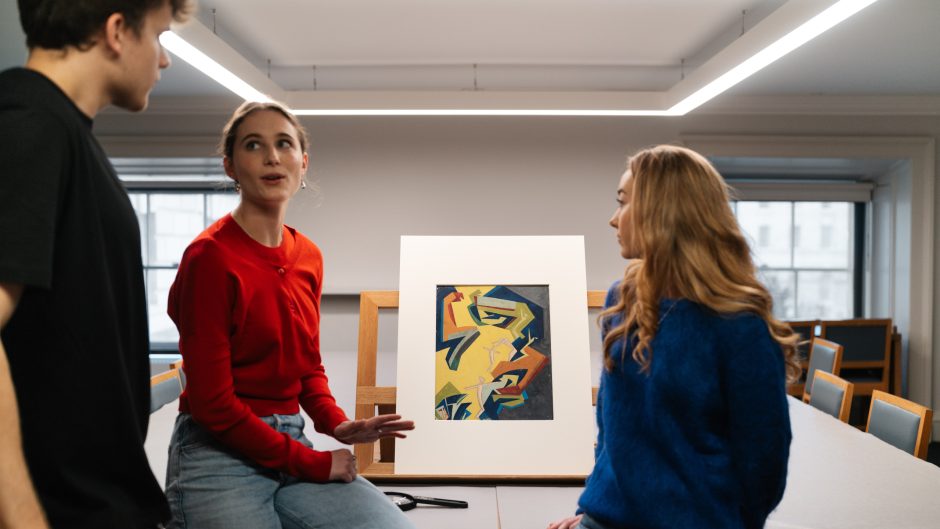
Over three years of study, our BA degree builds up a broad, deep, and multifaceted understanding of art history, encouraging both range and specialism, fostering both subject-specific and transferable skills and knowledge. It encourages you to study works of art at first-hand, including the Courtauld Institute’s own extraordinary collection, and to understand them in light of the latest critical approaches and ideas. All our teachers are researchers at the cutting edge of their areas of specialism and they bring their knowledge, discoveries and ideas to discuss with you in seminars, lectures, gallery visits and tutorials. You’ll also have the opportunity to study a language, and apply for dedicated funds to travel and see works of art you are studying.
Courtauld students come from all kinds of backgrounds, and most are studying History of Art for the first time. History of Art is a broad, exciting humanities degree that prepares students for many, diverse career routes, and our students have gone on to a range of careers both within the cultural and heritage industries, the art world and beyond.
Strategic relationship with King’s College London
In January 2022, the Courtauld Institute and King’s College London announced a relationship which will see our institutions collaborate on teaching, research and student experience, offering joint programmes and research. As a Courtauld student, you will have access to King’s facilities, in addition to all the existing facilities and services that we offer at the Courtauld Institute. Language modules for undergraduate students are delivered by King’s Modern Languages Centre, and BA History of Art students will be invited to take part in student-led collaborative initiatives. Read more about our relationship with King’s.
Watch our course video
Download the prospectus:
Entry Requirements
You do not need any background in art history to apply.
A-Levels: Grades AAA-ABB (excluding General Studies). There are no required A-level subjects.
We warmly encourage students of all backgrounds to apply to the Courtauld Institute. If you are applying as a candidate from socio-economic groups that are under-represented in Higher Education, we are able to make you a lower offer than our typical entry requirement via widening participation and our contextual admissions scheme.
International A-levels: Applicants sitting International A and AS-levels can generally expect their grades to be accepted as comparable, grade for grade, to UK AS and A-level grades.
GCSE: A grade A-C in a language is desirable but not required.
Scottish Highers: AAAAB or AAABB, (usually supplemented by two or more Advanced Highers).
If you are studying the Advanced Higher subjects, you are likely to be set AA for two subjects, and AAB for three subjects.
Welsh Baccalaureate: Advanced Diploma with two A grades at A-Level alongside the Core Certificate at Level 3.
International Baccalaureate (IB): a minimum 35 points overall.
European Baccalaureate: 80% overall.
Cambridge Pre-U: D3, D3, M2 in three Cambridge Pre-U Principal Subjects.
BTEC: DDM.
Access: Access to Humanities Diploma at Level 3 with 39 Level 3 credits from units awarded at Distinction, with the remaining credits at Merit.
International applicants: Entry requirements for many EU and International qualifications can be found here.
English Language proficiency: You will be expected to have an effective knowledge of English, both spoken and written in order to apply. If your first language is not English, we will require proof of English proficiency – for details, please see the English Language Requirements page.
Mature Students: We welcome applications from mature candidates, defined as those at least 21 years old at the time of application. If you are a mature applicant, please forward a copy of your CV and any transcripts of results from recent study to our admissions team via email, in addition to completing the UCAS application form.
More information: All applications are submitted through UCAS. Information and guidance on how to apply for the BA History of Art is available, and if you have any further questions, please contact Student and Academic Services.
Structure & Modules
Each year you will take a combination of required and optional modules totalling 120 credits, with the whole degree equalling 360 credits. The first year will establish solid foundations in the subject through modules that introduce you to a range of periods, places, and methods, with classes taught in London’s art collections. You will also pick a modern language to study.
In the second year, you will take two core modules. One explore works of art as physical objects (Physical Histories) and the other examines the role that museums, galleries and exhibitions play in society (Exhibiting Art). Alongside these, a range of optional modules are offered, exploring different art histories and critical approaches, as well as some electives through the Arts and Humanities departments at King’s College London and the King’s Modern Language Centre.
In your final year, you will be able to express preferences for Special Options and further electives and will also pursue your own research project, culminating in a dissertation. We will accommodate your choice wherever possible, keeping in mind the value we place on research- led teaching in small seminar groups of 12 to 15 students.
You will be supported throughout your degree by a personal tutor who will meet with you regularly to discuss your work and progress, assist you in selecting appropriate modules and offer guidance in your future plans.
The modules we teach are directly shaped by the tutor’s research and partly for that reason, they change from year to year – modules outlined below are therefore indicative of subjects that may be on offer.
Year one
The first year is designed to give you a solid basis for the study of Art History by introducing you to broad content and key skills.
Foundations 1 and 2 (30 credits each):
These two modules, which run in both semesters, introduce you to major themes in art history from late antiquity to the present day, and from across the globe. You’ll learn through lectures and small discussion groups (around 16 students), helping you develop your critical thinking, interpretation, writing and communication skills.
Topics change regularly, but recent lectures have covered:
- Classical and Byzantine Art
- Medieval Art
- The Buddhist Arts of Asia
- Vision and Knowledge in Britain, 1600–1900
- From Civil Rights to Black Lives Matter
- Early 20th-Century Avant-Gardes
Topics (15 credits each):
Each semester, you’ll complete a module that takes you out into London – making the most of the incredible art, galleries and museums the city has to offer. You’ll study in small groups (of around 12 students) that meet weekly.
Indicative topics include:
- Chinese Art in London Collections
- Architecture and Identity
- Decolonising the Gaze
- Techniques and Meaning in 20th-Century Art
- Contemporary Art in London
- Medieval Sculpture in London Collections
- Craft and Material Culture in Medieval Islamic Art
Principles of Art History (15 credits):
Language (15 credits):
You’ll have the opportunity to study a language at the Language Centre, King’s College London. You can choose from a wide range of modern languages, such as French Italian, German, Spanish, Russian, Arabic and Mandarin, from beginner to advanced level*. By learning a foreign language, you’ll develop deeper cultural insights, access new ways of thinking and gain valuable complementary skills.
*Some restrictions may apply depending on previous experience and timetabling.
Year two
The second year is designed to help you develop your skills in critical thinking and extend your detailed knowledge of particular art historical periods and themes.
Physical Histories (15 credits):
In the first semester, you’ll take a unique module created with our conservation experts. This module encourages you to explore and interpret works of art by closely observing their physical and material characteristics.
Exhibiting Art (15 credits):
In semester two, the focus shifts to the role of museums, galleries and exhibitions in societies (past, present and future) and how different display techniques can shape (and limit) our understanding of works of art and architecture.
Drawing on London’s art collections for inspiration, you’ll think analytically about the display choices, methods and narrative approaches adopted by different museums and galleries.
Histories (15 credits each):
In each semester this year, you’ll also take up to two ‘Histories’ modules that focus on a particular period, theme, or event. Through lectures and small seminar groups, you’ll explore how art has been interpreted or created in different times and places.
Examples of ‘Histories’ modules include:
- Latin American Modernisms
- Artists, Radicals, Mystics: European Art, 1760–1830
- Image, Object, World: American Art 1945–75
- Art, Travel and Imagination in the Middle Ages
- Reality and Fantasy in French Art, 1863–97: From Haussmannisation to Enchanted Ground
- Italian Renaissance Art in Global Perspective
- Art and Cold War Politics
- Mongol Bling: Nomadic Taste and the Art of Seeing
Approaches (15 credits each):
Each semester, you’ll take an ‘Approaches’ module designed to introduce you to the theories and methods that shape how we think and write about art and art history.
Our weekly small-group seminars give you the freedom to explore your ideas and express yourself in a supportive environment.
Indicative modules include:
- Art History and Social Justice
- Approaches to Islamic Ornament c.650–1350
- Thinking with Things: Theories of Materiality and Material Culture
- Sexual Politics
- Art and Magic in the Pre-Modern World
- Ways of Seeing and Being Seen: The Politics of Vision in Modern and Contemporary Art
- French Writers Think with Contemporary Art
- Approaches to Global Art History
- Sisters/Outsiders/Citizens: Black Feminisms as Praxis
Elective modules at King’s (15 credits):
You can swap one of your ‘Histories’ modules for an elective in selected humanities departments or from the Language Centre at King’s College London.
Year three
Special Options (30 Credits each):
You’ll take two Special Options – one in each semester – taught in small seminar groups that meet twice weekly. These in-depth elective modules take a closer look at specific topics and methods at an advanced level, preparing you for further study and a wide range of careers.
Examples of Special Options include:
- Modernist Art in Theory
- Art and the Modern Nation: from Medieval Islam to Post-Modern Iran
- The Global Print
- The Black Imaginary in Art
- Sea of Dreams: A Tidalectic Approach to Modernism
- Global Constructivism: Art, Politics and the Everyday
Approaches/Histories/Electives (15 credits each):
You’ll take two further 15-credit modules: one from our range of ‘Approaches’ and the other either a ‘Histories’ or King’s elective. This gives you even more flexibility to tailor the degree to your interests and future career goals.
BA Research (30 credits):
Beginning in semester one, you’ll start planning your independent research project, defining your topic, chosen research questions and methods. With one-to-one supervision, you’ll write a 7,000 to 8,000-word dissertation, which is handed in at the beginning of the summer. For many students, the dissertation is the highlight of the degree – a chance to explore a specialist topic in depth and develop advanced research skills.
How we assess your progress
- You’ll need to pass your first year with a minimum mark of 40% to progress to the second year
- Your second year makes up 40% of your final degree mark
- The third year counts for the remaining 60% of your mark
Teaching & Assessment
The BA course is taught through a combination of lectures, seminar and discussion classes, site visits and one-to-one tutorial meetings.
Seminar classes are held in classes of up to 12 to 15 students to facilitate an intimate environment in which to study and engage with subjects in depth with your teacher and your classmates.
Lectures are delivered and taught to the full student cohort, and are supported by discussion classes in which you are divided into smaller groups of up to 15 students. The discussion classes enable you to discuss and develop your understanding of topics covered in lectures in a setting where you are invited to actively participate in debates and discussion.
In addition, you have timetabled meetings with your personal tutor at least once per term and you can always request further meetings with your personal tutor should you wish.
Throughout your degree, you will be taught by a mixture of professors, senior lecturers, lecturers and doctoral researchers, who bring a rich diversity of knowledge and experience to the classroom. Our faculty come from many different backgrounds across the world and are among the leading experts in their field. They have published important works about their areas of expertise, and will introduce you to the excitement and dynamism of their cutting-edge research.
Assessment:
The degree is assessed by a range of methods, including coursework, independent study, take-home and sat exams and a final-year dissertation.
• You must pass your first year to progress to the second year with a pass mark of 40%.
• The second year counts towards 40% of your final degree average.
• The third year counts towards the remaining 60%.
Fees, Funding, Scholarship & Bursary
Tuition fees:
Tuition fees are available here.
Undergraduate Student loans:
Please visit the Student Finance England website for further information and to apply online.
Bursary:
The Courtauld Institute is committed to making its degree accessible to all suitably qualified Home students. We offer financial support, up to £3,000 per year, on a sliding scale for Home undergraduate students who meet set criteria. More information can be found here.
Scholarship:
The James Hughes-Hallett Undergraduate Scholarship has been established through generous philanthropy to support students who are from groups that are underrepresented in UK Higher Education. The scholarship is worth £10,000 over the duration of your three-year degree. More information can be found here.
Travel:
In addition, many final year special options include short group trips with the lecturer to see the art they are studying. These trips are generously subsidised according to their location (UK or abroad), and are planned with the subsidies in mind in order to minimise any additional costs for students. However, it is possible that subsidies will not cover all costs in some instances. Students are encouraged to speak to Student and Academic Services, should they need further support.
Associated Programme Costs: See General Associated Programme Costs.
Careers & Employability
The BA programme is designed to produce graduates with highly transferable skills, which will prepare you for a wide range of employment opportunities, or further academic study. Our graduates are not only equipped with a detailed knowledge and understanding of the History of Art, but also learn how to:
- Analyse visual imagery and articulate sophisticated arguments in formal writing and in oral presentations.
- Read critically and economically.
- Assimilate complex material.
- Formulate and express a broad range of different ideas.
- Present research to a varied audience.
- Develop independent research skills.
- Experience collaborative work in groups.
With these skills, Courtauld graduates go on to further study and to jobs across the economy including:
Curators, Conservators, Art Dealers, Auction House experts, Lawyers, Entrepreneurs, Publishers, Media professionals, Teachers, Banking and Finance, Journalists, Business / Marketing & Communications, Fashion buyers, Civil servants
All students can access bespoke, one-to-one careers guidance throughout their studies. The Courtauld Careers Service offers advice and support on exploring career and further study options, finding internships, enhancing employability, understanding and navigating the jobs and self-employment market, and making successful applications. This service is available to all graduates for up to two years after graduation.
Support
To support you through the degree, we offer:
Wellbeing: We have a dedicated Wellbeing team, with counsellors and advisors.
Academic Skills: The academic skills tutor offers group and one-to-one help to develop the skills and confidence you need to succeed on the degree. We also have two Royal Literary Fund fellows who will help you with your writing skills – concentrating on how to structure and improve your writing.
Personal tutor: You will be supported throughout your degree by a personal tutor, who will meet with you regularly to discuss your work and progress, assist you in selecting appropriate modules and offer guidance in your future plans.
Get Involved Now
Learning Programme for students attending a non-selective state school or college who want to discover what Art History is all about. We run many exciting programmes which are free of charge and led by Courtauld art historians, curators and contemporary artists. You can participate in workshops, projects, lectures, courses and discussions, and even presentations of your own. This includes our Year 12 Art History Summer University. Find out more here.
The Research Forum deliver an extensive programme of lectures, conferences, workshops and seminars supporting advanced inquiry into the History of Art, Conservation and Curating. We host around 150 events per year, from research group seminars to lecture series catering to a wider interest. Our varied programme of events look to different periods and themes in art, visual culture and its history. Explore upcoming events, and watching recordings of previous events, here.
The Courtauld Gallery is home to one of the greatest art collections in the UK. The Gallery is most famous for its iconic Impressionist and Post-Impressionist masterpieces– such as Van Gogh’s Self Portrait with Bandaged Ear and Manet’s A Bar at the Folies-Bergere – but also displays major paintings, drawings and decorative arts from the Middle Ages through to the 21st century. Tickets to the Courtauld Gallery’s main collection are free for 18 and under, and for students. You can book your ticket here. You can also explore the Gallery virtually here.