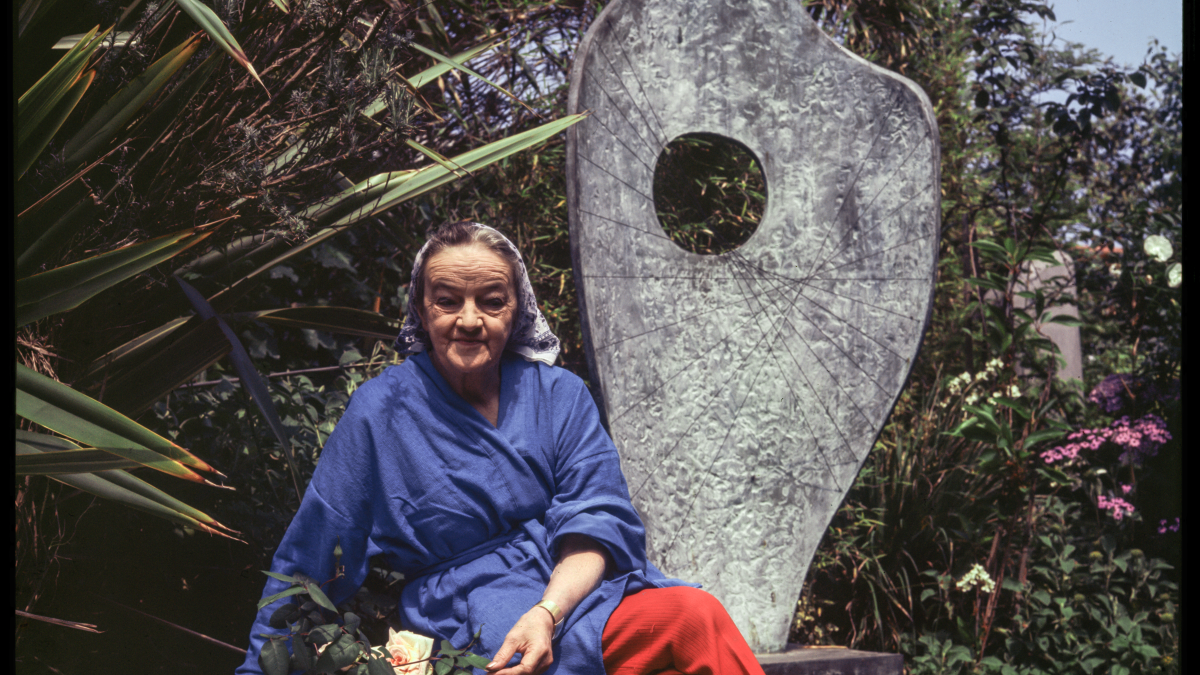
You might know Barbara Hepworth (1903-1975) through her pioneering abstract sculptures, incorporating light and space into her works of wood, stone, and bronze. She pierces solid forms with empty space, surprising materials, and bold colour, especially in her works from the 1940s and 1950s. But do you know how she got there?
To celebrate our current exhibition The Joseph Hage Aaronson & Bremen Exhibition: Hepworth in Colour, read on to explore Hepworth’s life and legacy.
Early Life
Born in Wakefield, Yorkshire, in 1903, Hepworth showed early artistic promise. By her late teens, she had secured a scholarship to study at the Leeds School of Art in 1920, before also winning a county scholarship to attend the Royal College of Art in London. Her upbringing in Yorkshire would stay with her throughout her career, feeding her sensitivity to the colours and textures of the natural world.
Hepworth's time at the RCA
Barbara Hepworth joined the Royal College of Art in 1921, supported by a West Riding of Yorkshire County Art Scholarship from the region in which she had grown up. During her studies in London, she lived in lodgings and, on graduating, intended to become either a “teacher or a sculptor”. She graduated from from Sculpture at the RCA in 1923, alongside Henry Moore.
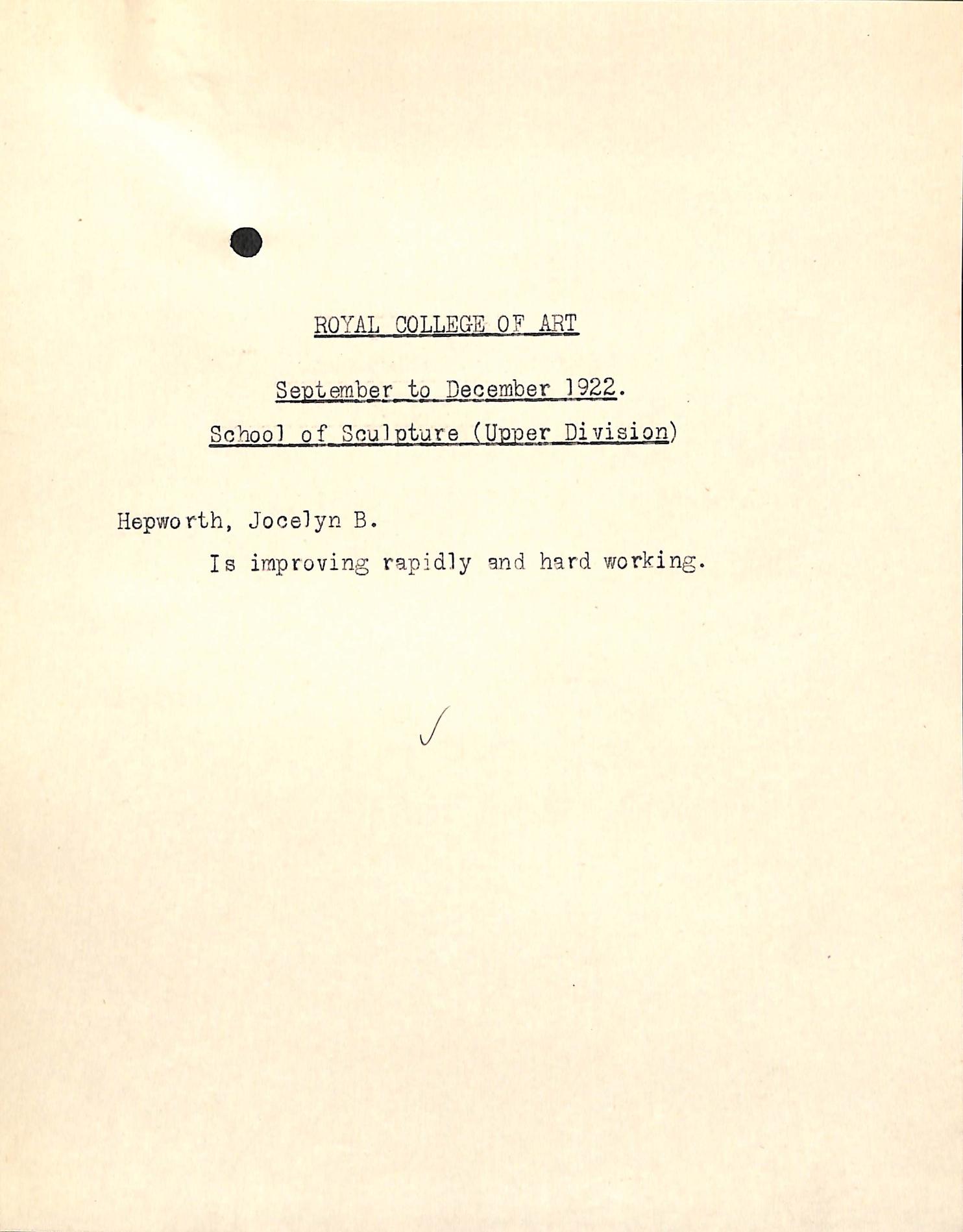
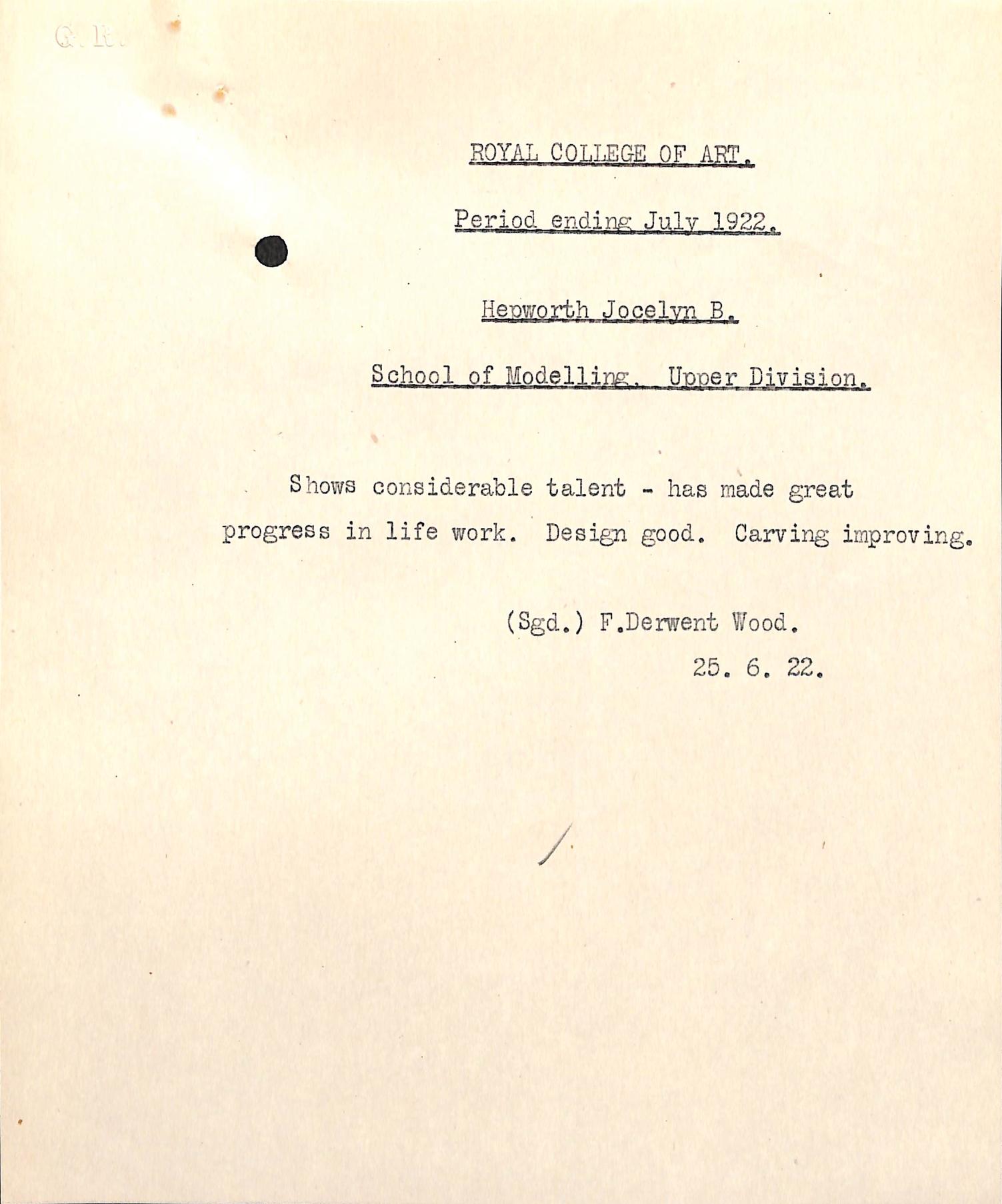
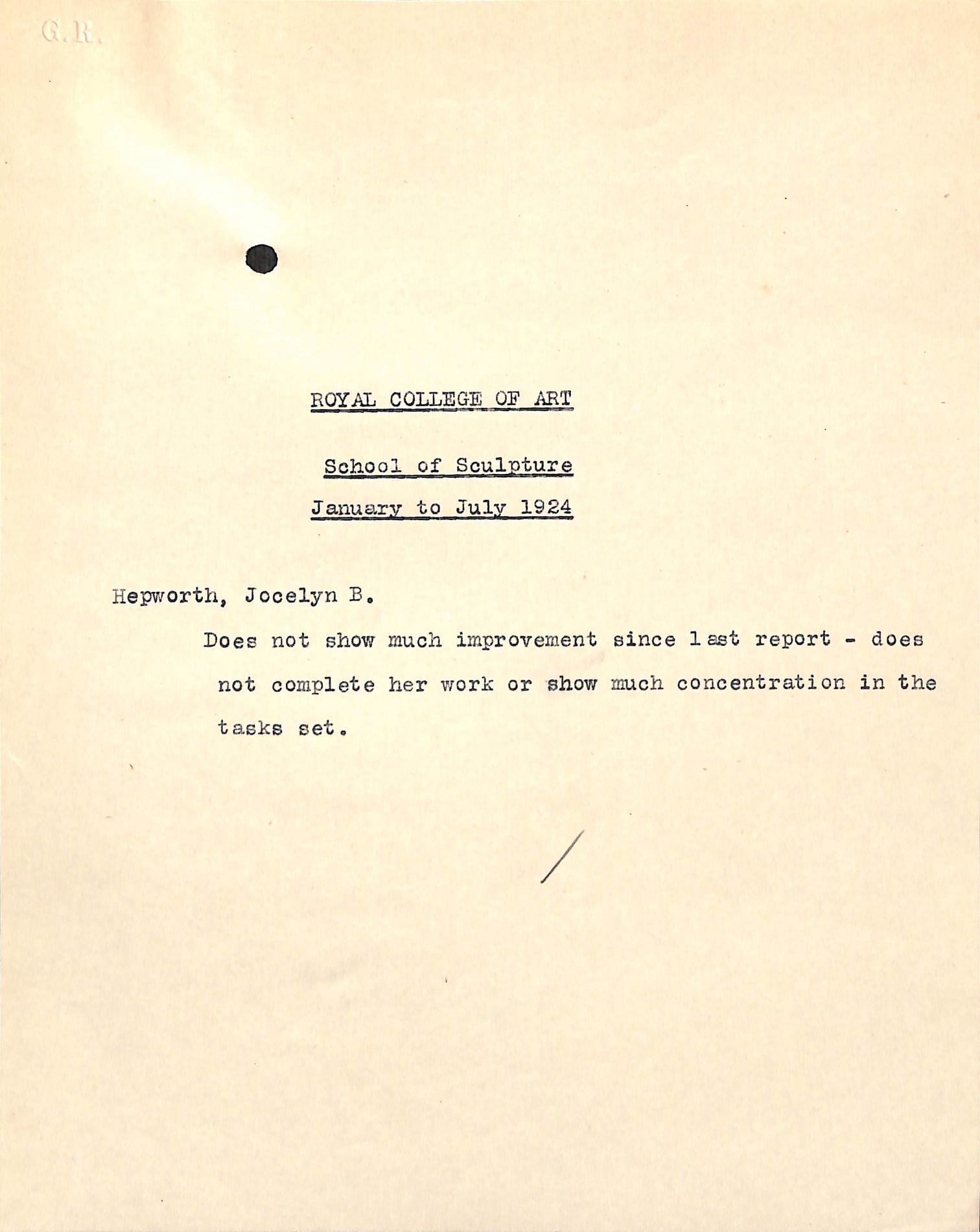
The reports preserved in the RCA Special Collections reveal a young artist of evident promise, though one whose gifts were not always straightforwardly recognised by her tutors.
In her first year, she was described as “an able designer and good draughtswoman” with “excellent abilities”; the report concluded that she was a “very good student”. By her second year, her tutors noted that she “showed considerable talent”, had “made great progress in life work”, and that her design was “good” and her “carving improving”. But later assessments struck a more cautious note, potentially impacted by a period of illness in 1924.
Despite these mixed assessments, the RCA offered Hepworth a formative space in which to test, refine and pursue her emerging sculptural language.
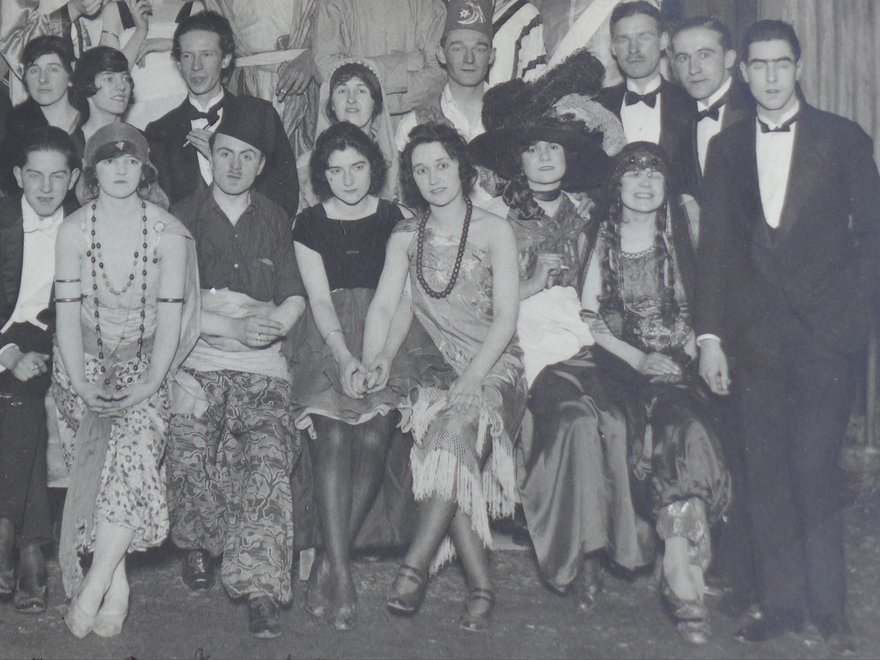
The RCA archive also hints at her wider life as a student. She seems to have thrown herself into the social and cultural life of the College: one RCA student magazine records “Miss Hepworth’s charming dancing” at a student ball, accompanied by a photograph of her in fancy dress.
Together, these archival documents offer a vivid glimpse of Hepworth before the certainty of reputation: a young artist whose talent was visible, if not always fully understood, and whose time at the RCA formed part of the early ground from which her extraordinary career would grow.
Blog excerpt with thanks to the Royal College of Art. Find out more about the RCA’s MA Sculpture programme.
After finishing her studies, Hepworth continued to thrive. In 1924, she was the runner-up for the Prix de Rome sculpture scholarship, which was won by her contemporary John Skeaping. Her competition relief earned her a West Riding Travel Scholarship which she used to travel to Italy, visiting Rome, Siena and Florence and developing her skills in stone carving.
Experimenting with colour
Hepworth began incorporating colour into her work in 1939, and colour would continue to have a significant presence in her work across her artistic career.
Colour to Hepworth was more than just adding bold pops of paint. She had been drawn towards the natural colours of her favourite materials (wood and stone), and also to strikingly coloured materials. Meticulously documented in her sculpture records, for instance, is an extensive array of colourful stones: blue Armenian marble, blue Hornton stone and blue Ancaster stone; brown Hornton stone; green marble; grey Cumberland stone with grey alabaster; black, pink and white alabaster; green and white onyx; and white marble.
As her sculpture became more abstract, Hepworth began formulating her earliest thoughts on colour in print. In her first published text for the magazine of the international association of abstract artists called Abstraction-Creation: art non-figuratif (1933), she placed colour alongside musical and mathematics as modes of expression that express a pure, eternal, and all-powerful beauty.
Living and working alongside the painter Ben Nicholson from the early 1930s, based at their studio at 7, The Mall, Hampstead also sharpened her colour sense.
When Hepworth finally applied colour to sculpture, it wasn’t as decoration, but as a structural and spatial device. When asked why she painted her sculpture, she would often explain that her colour was the equivalent of light falling across a surface. This was not in an analytical way, as Paul Cézanne or Georges Seurat would have meant it, but rather to do with the experience and feeling of light. In this sense, colour was about sensation and embodied memory: to “establish the mood of place and time”, as she wrote in 1966.
Colour and Cornwall: Hepworth's wartime practice
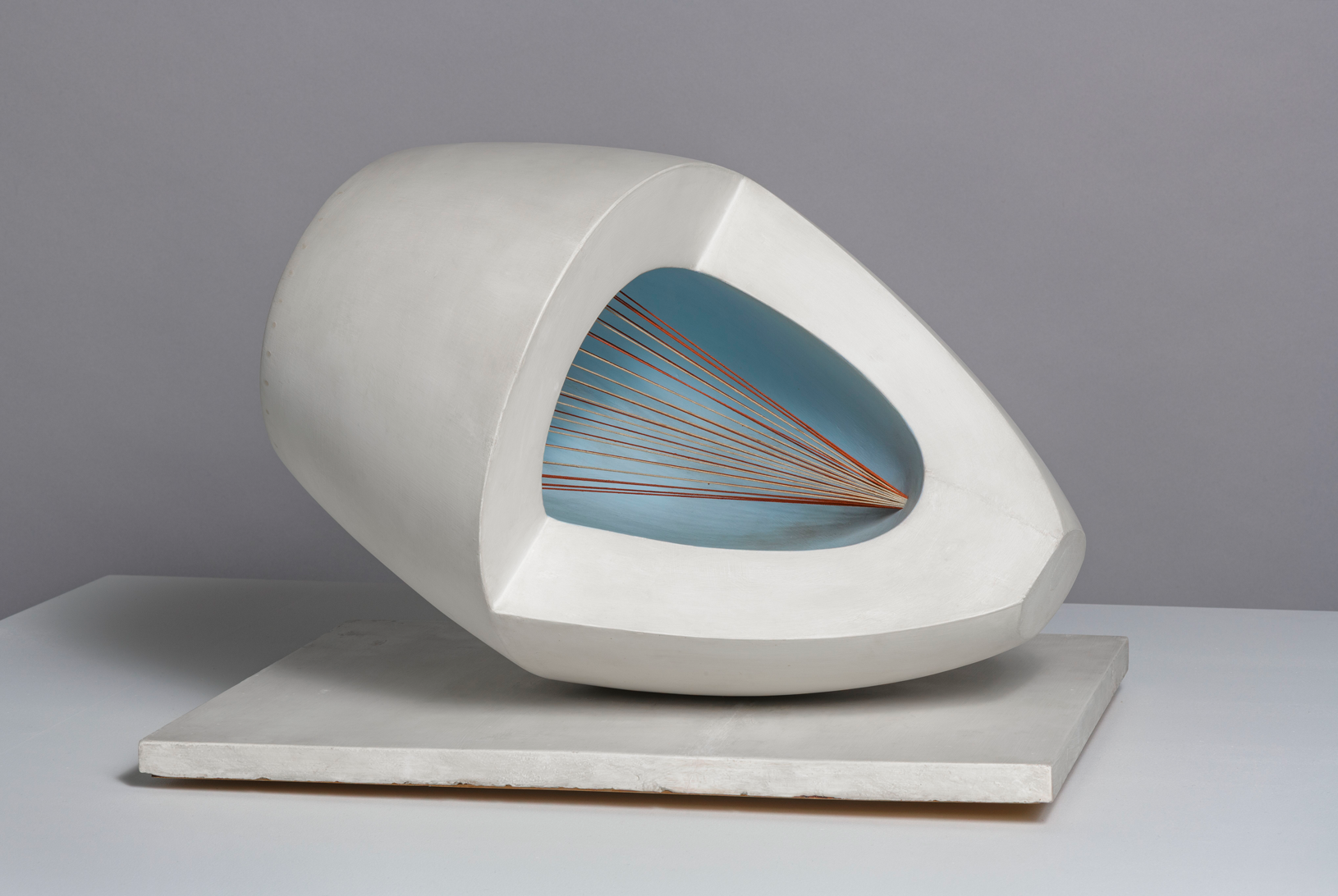
When Hepworth and Nicholson left London for Cornwall just before war was declared in 1939, she only mentioned taking one sculpture with her to safety – her plaster model, Sculpture with Colour, White, Blue and Red Strings (1939). Wartime Cornwall, for all its material hardships, proved to be a defining period; the landscape – its sea light, caves, its blues and greens and greys – transformed her visual vocabulary.
Writing to her friend Leslie Martin in May 1940, she outlined the importance of form and colour:
“I actually think I have discovered how to use both [colour and form] together to achieve a new power & experience & I have discovered certain laws. I don’t think anybody has done it before – to my knowledge it has always been coloured sculpture. You have done it in relation to architecture. There’s a lot of work to be done & I only hope there will be time. Because I think it has a direct bearing on a sort of pooled effort of architecture sculpture & sociology.”
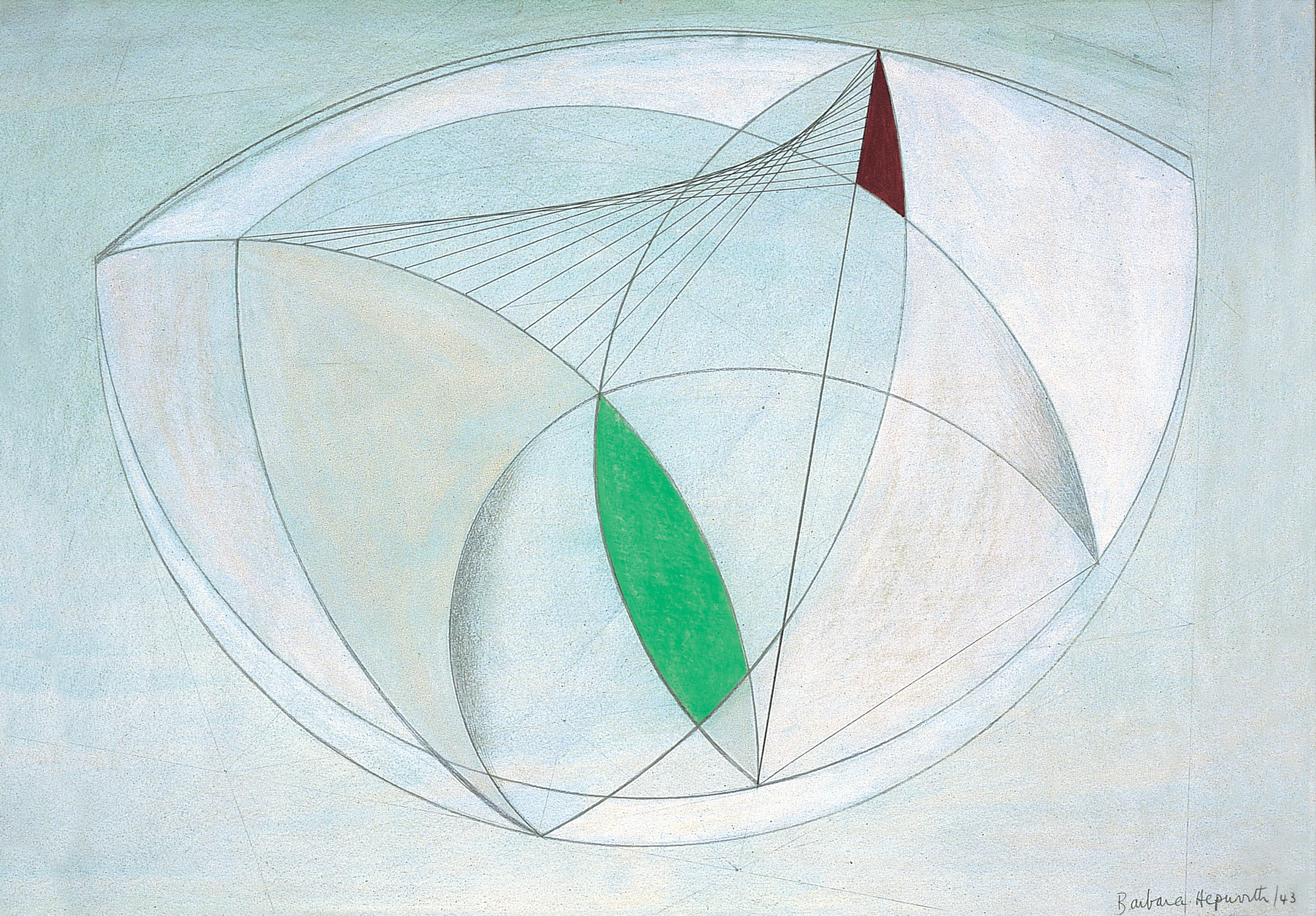
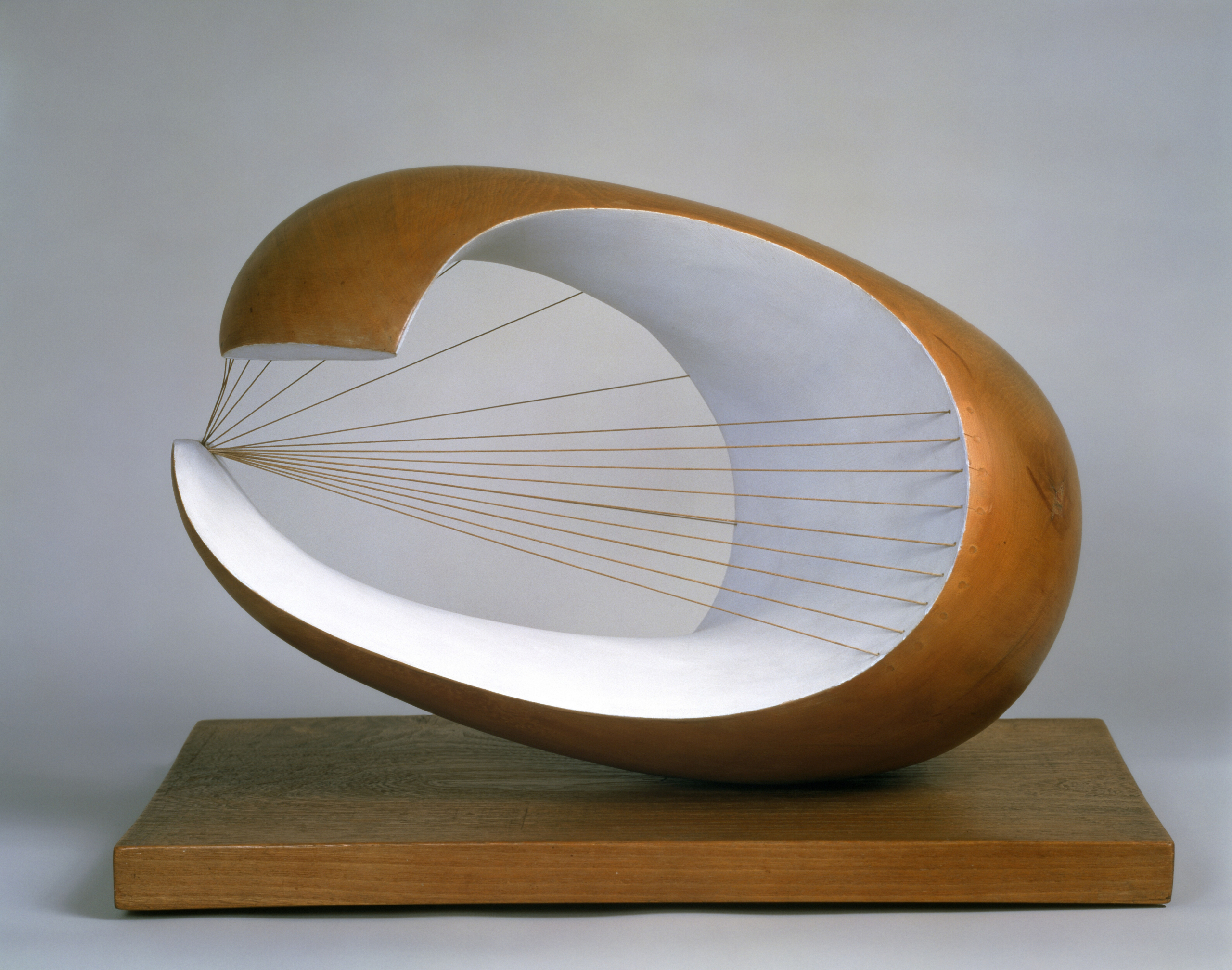
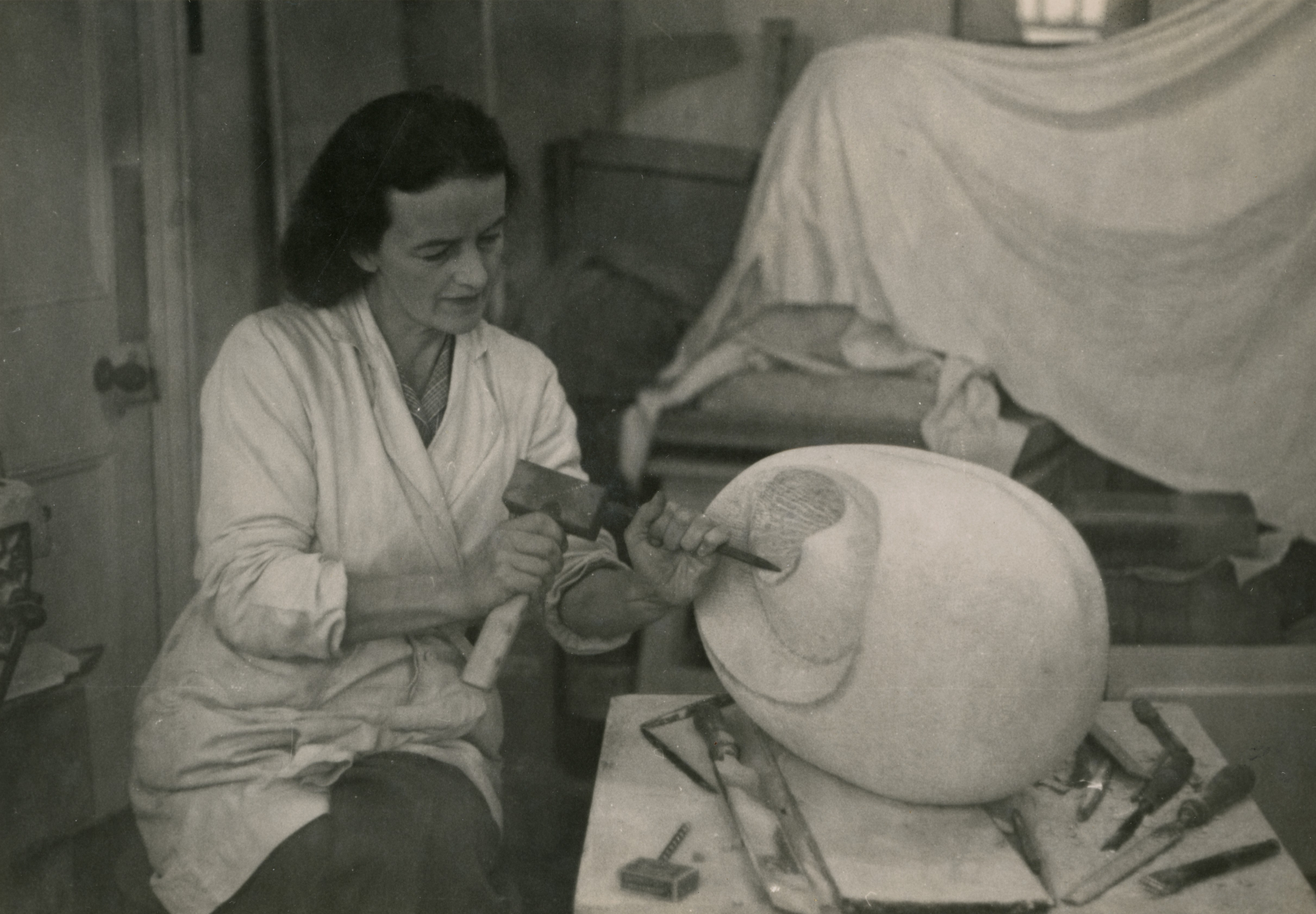
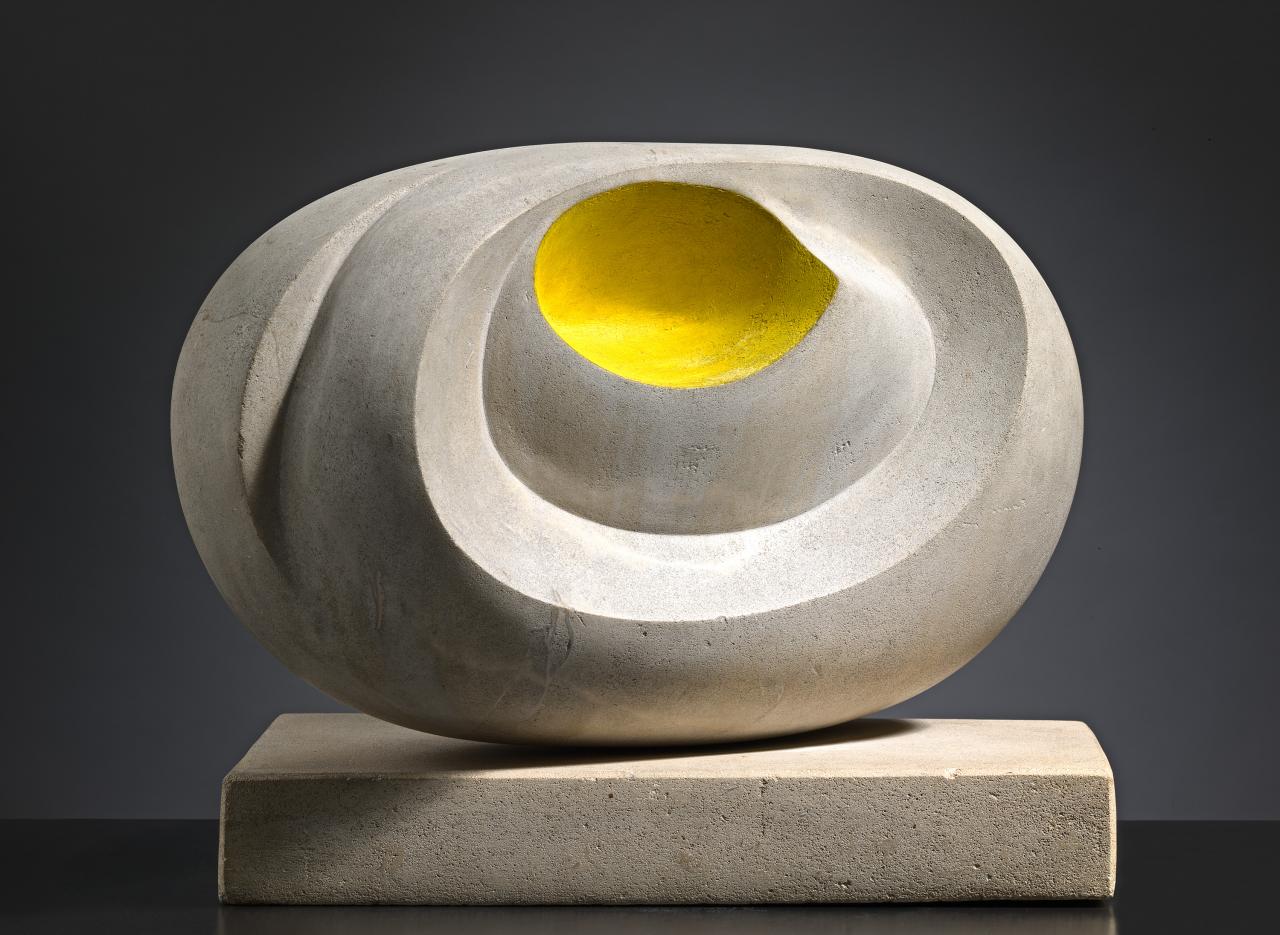
In her 1952 monograph, Hepworth described her early encounter with the light of the Cornish landscape and how it had opened up new possibilities: the colour in the concavities of forms plunged her into the depths of water, caves, or shallows. She began working with oil colour painted directly onto the inner surfaces of her sculptures, introducing a richness and chromatic depth that went far beyond the original blue-and-white palette of the wartime years.
During evenings and nights of the war years, she produced innumerable drawings in gouache and pencil – abstract works exploring the tensions and relationships of form and colour that would occupy her sculpture work. These layered, crystalline drawings, with their mathematical geometries and jewel-like intensity of colour, became among her major achievements of the period.
Later life
In the post-war decades, Hepworth’s use of colour became more expansive. Her 1946 exhibition at the Lefevre Gallery in London was her first major post-war solo show, and she wrote to E.H. Ramsden that she would be showing her pursuit of “the threads of stone and colour”. By adding colours taken from nature, she imbued her works with her response to the Cornish landscape and terrain in all its richness.
Recognition for this radical aspect of her work remained elusive. Hepworth herself felt that critics had overlooked her use of colour. Writing to Bryan Robertson, Director of Whitechapel Art Gallery, in preparation for her 1954 retrospective there, she observed that, “nobody had ever mentioned this [colour] tho’ my first was 1938” adding that ‘nobody ever pays attention to even more important phases such as the use of colour and form’. In an interview with her son-in-law, the art historian Alan Bowness, she said, “My colour has been accepted, but never understood”.
From the mid-1950s onwards, her painting style became bolder and more experimental, inspired by artists like Pierre Soulages and Mark Rothko. Visiting Mark Rothko’s exhibition at Whitechapel Gallery in 1961 was, as she wrote to Mark Rothko himself in 1968, “one of the big moments of my life, never to be forgotten”.
Hepworth was, in many ways, ahead of her time. Explore her expressions of colour in our current exhibition, The Joseph Hage Aaronson & Bremen Exhibition: Hepworth in Colour.
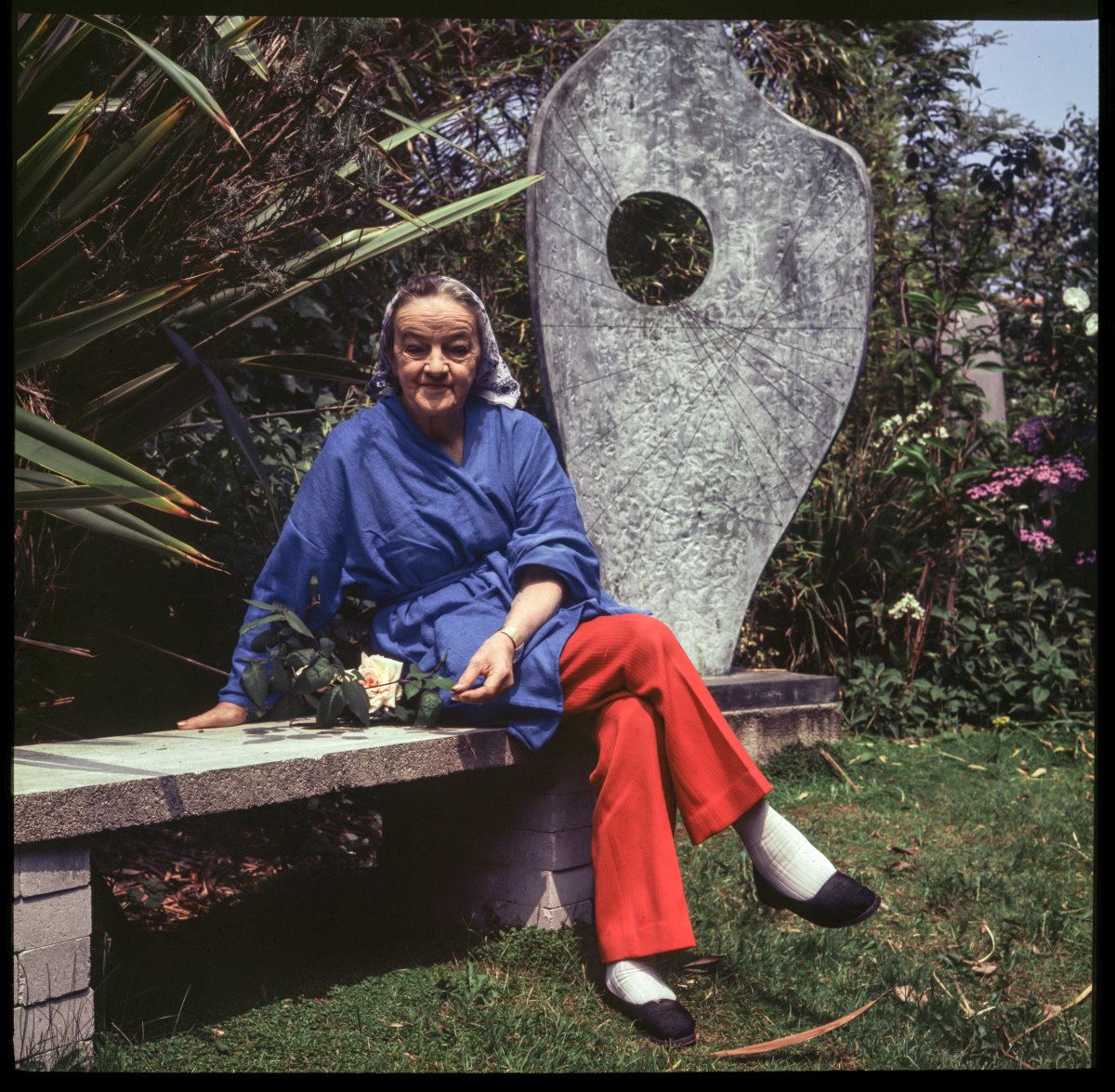
The Joseph Hage Aaronson & Bremen Exhibition: Hepworth in Colour is open at the Courtauld Gallery from 12 June – 6 September 2026.