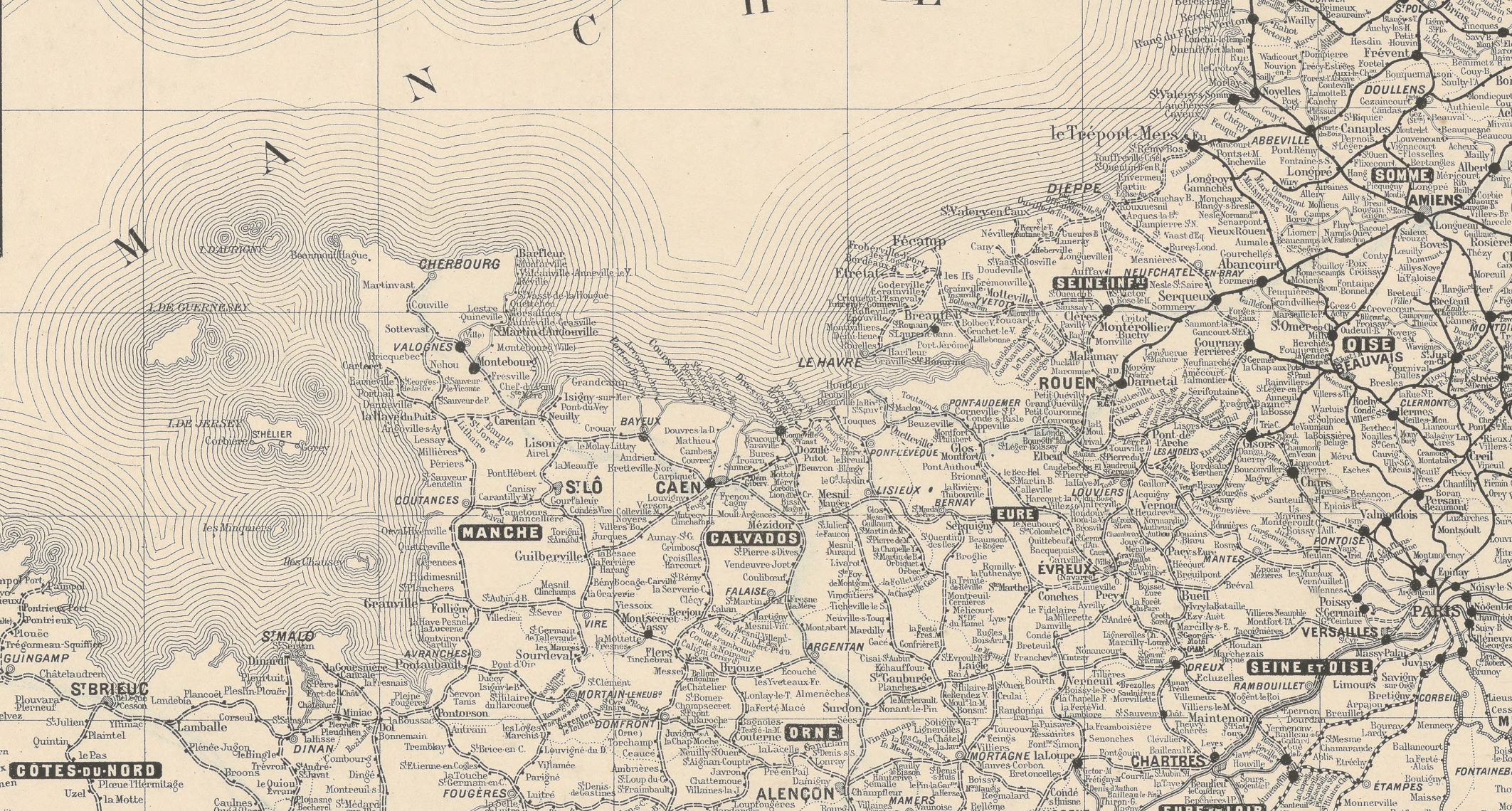
It’s summer 1886, and Georges Seurat has packed his art supplies for his second annual trip to the northern coast in France. He settles in Honfleur, a historical port town on the estuary of the Seine in Normandy, around three or four hours by train from Paris.
Generations of artists before him had visited the town, attracted by its medieval streets and picturesque port, which, despite recent enhancements, had escaped the heavy industrialisation of its neighbour across the river, Le Havre.
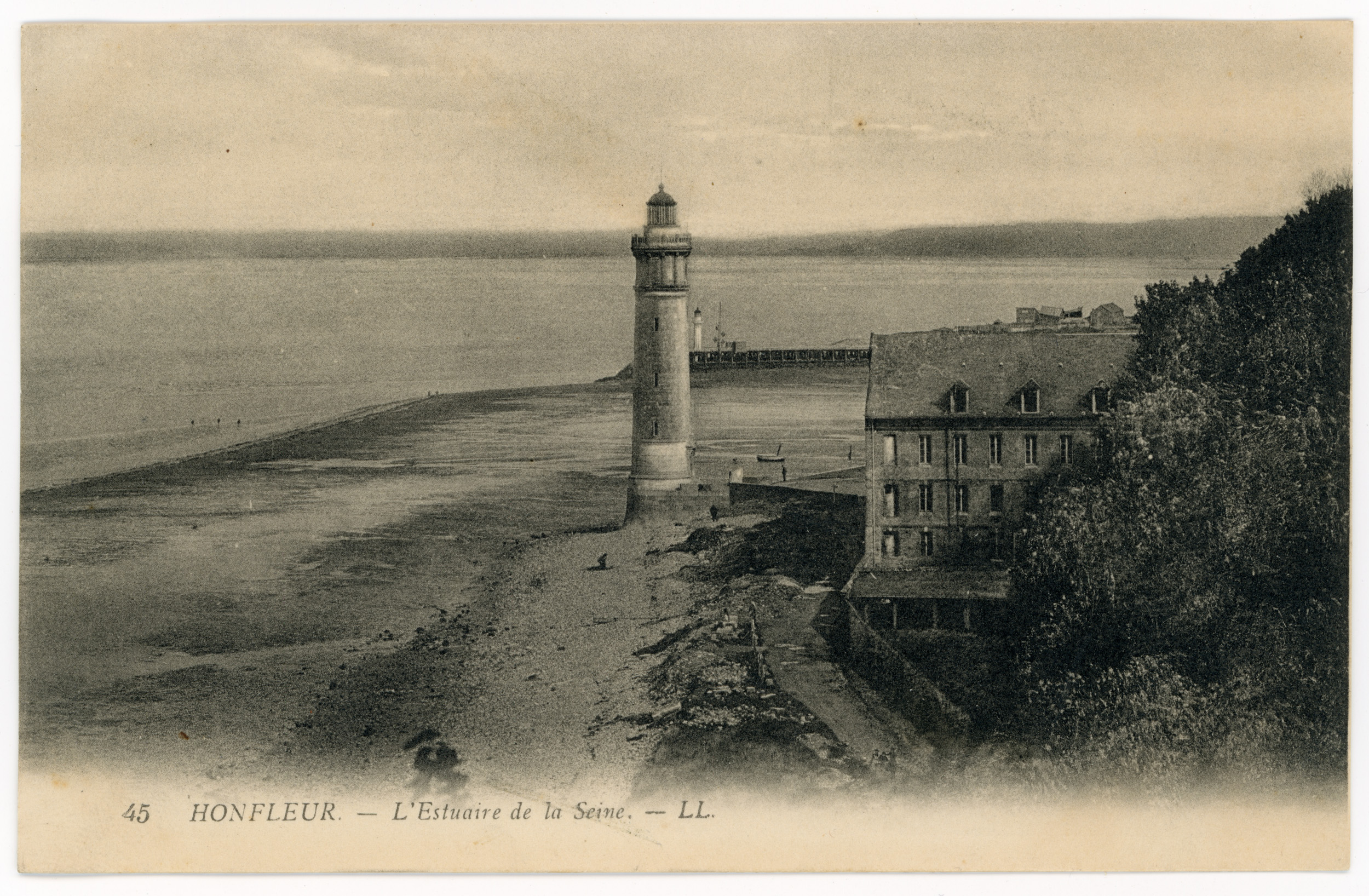
The striking site of Honfleur’s lighthouse and hospital had also been inspiring painters for decades before Seurat made it his own. During his eight-week stay in Honfleur, he resided west of town, on the Rue de Grâce, a steep street in the back hills that offered views of the lighthouse as well as the Beach du Butin.
A transition in Seurat's technique
Seurat’s approach differs markedly from these photographs and the work of previous artists, where the lighthouse is cast as a symbol of the coast and is set at the centre of a vast expanse of beach, sea and sky. By shifting the placement of these elements, Seurat turned a traditional scenic view into a daring composition.
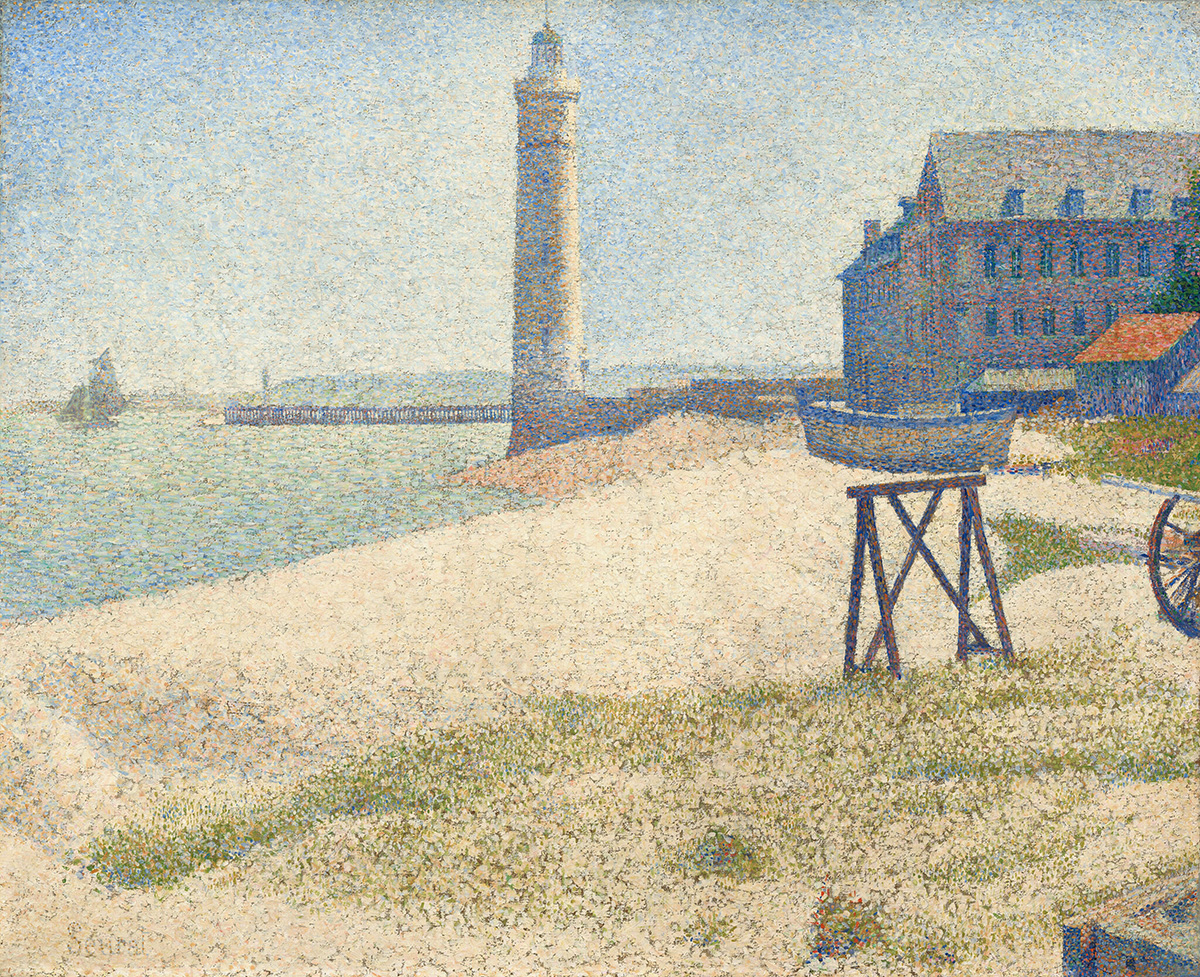
The Honfleur paintings are particularly revealing of a moment of transition in Seurat’s technique. An X-ray of The Hospice and the Lighthouse of Honfluer shows a flurry of criss-cross brushstrokes as an initial layer, later covered by a ‘skin’ of irregular thick dots, often applied once the first layer had had time to dry. Despite this thickly layered surface, the white priming has been left visible in certain areas, as part of the colour scheme and to reinforce the edges of some elements. As Seurat later told the Belgian poet and critic Émile Verhaeren, who would purchase the painting, he worked on it for two and a half months.
Seurat's emerging painted borders
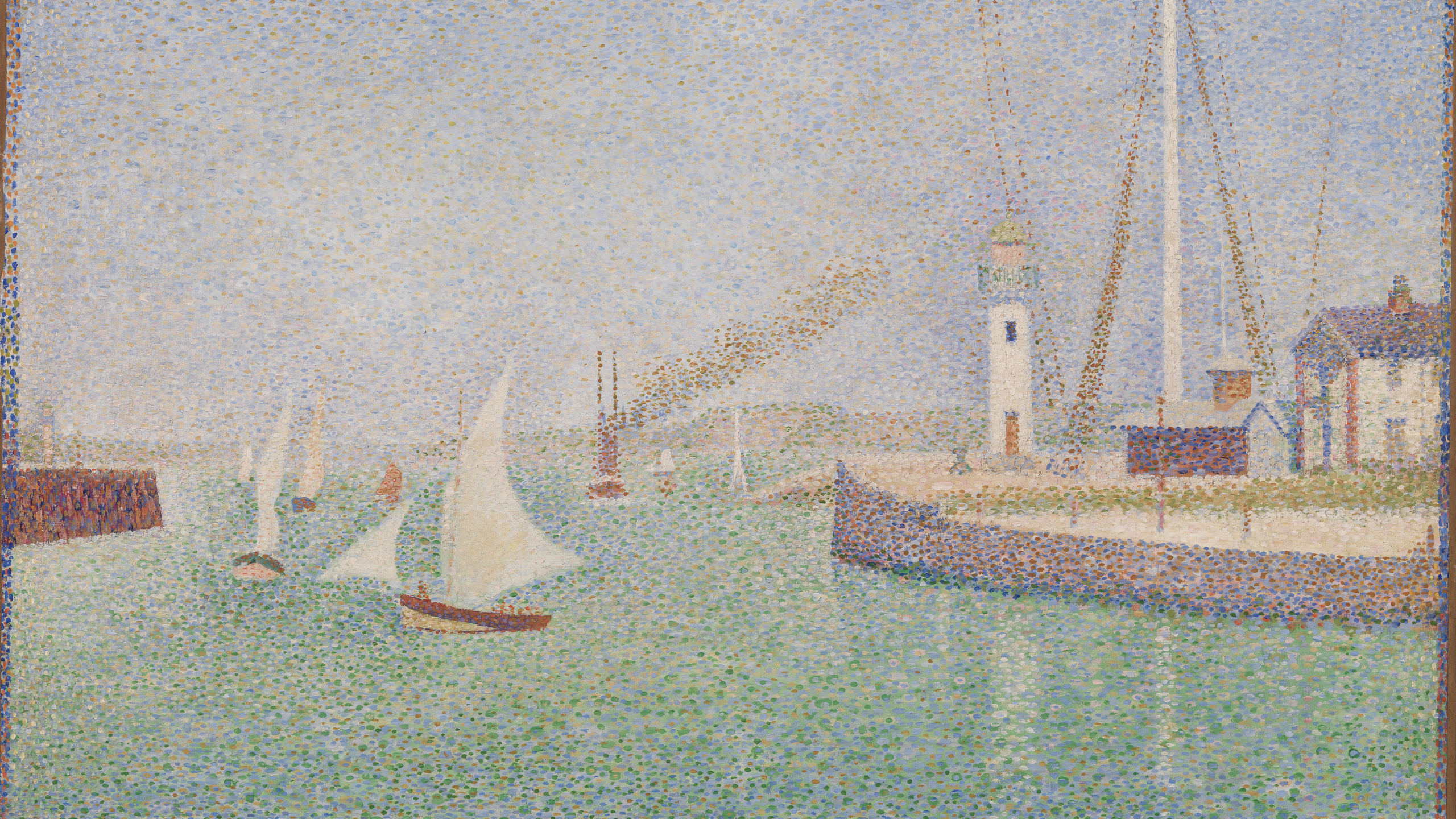
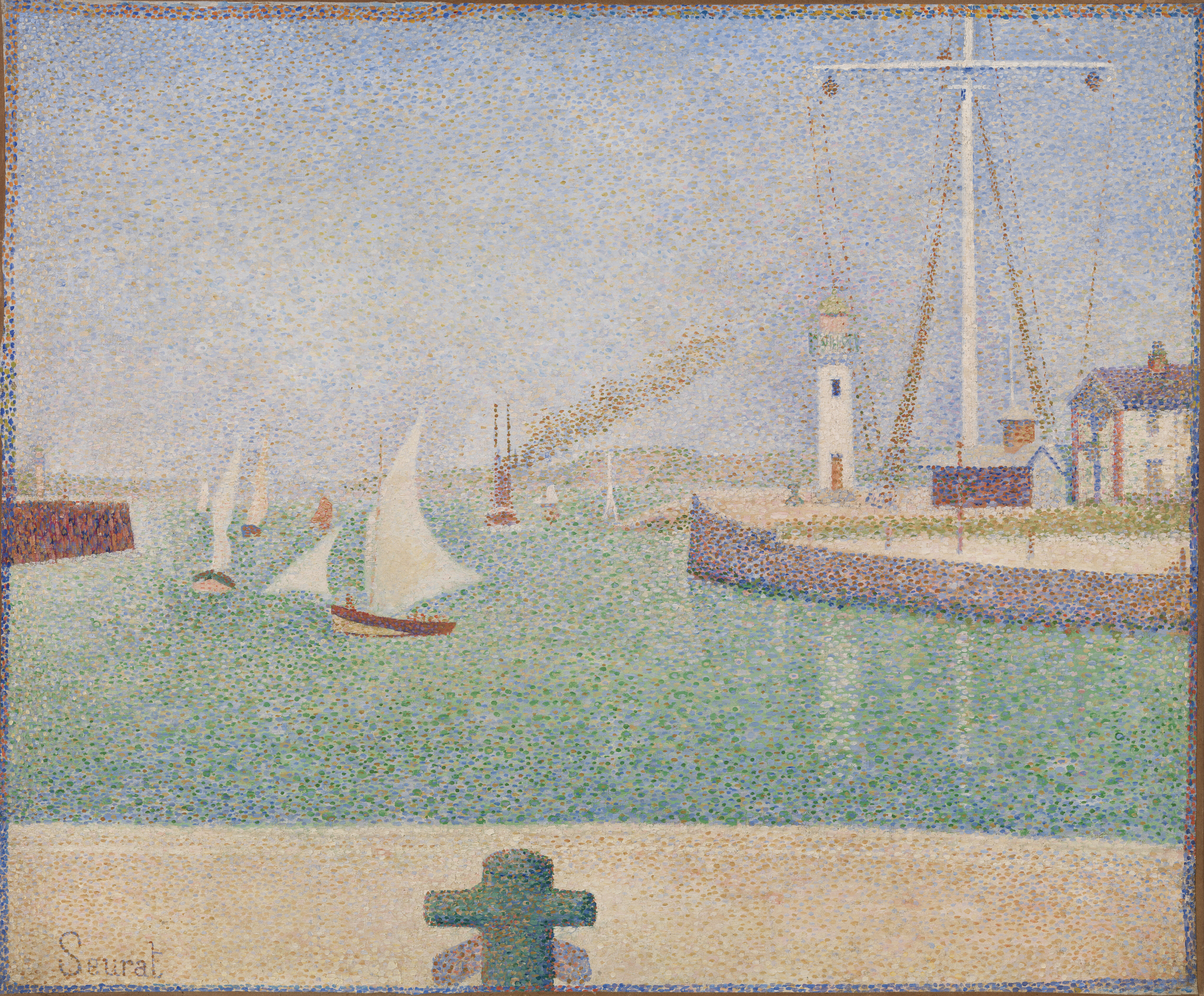
Georges Seurat painted this view of Honfleur standing on the central Jetée du Transit and looking out towards the narrow opening of the port as boats entered and exited its shelter.
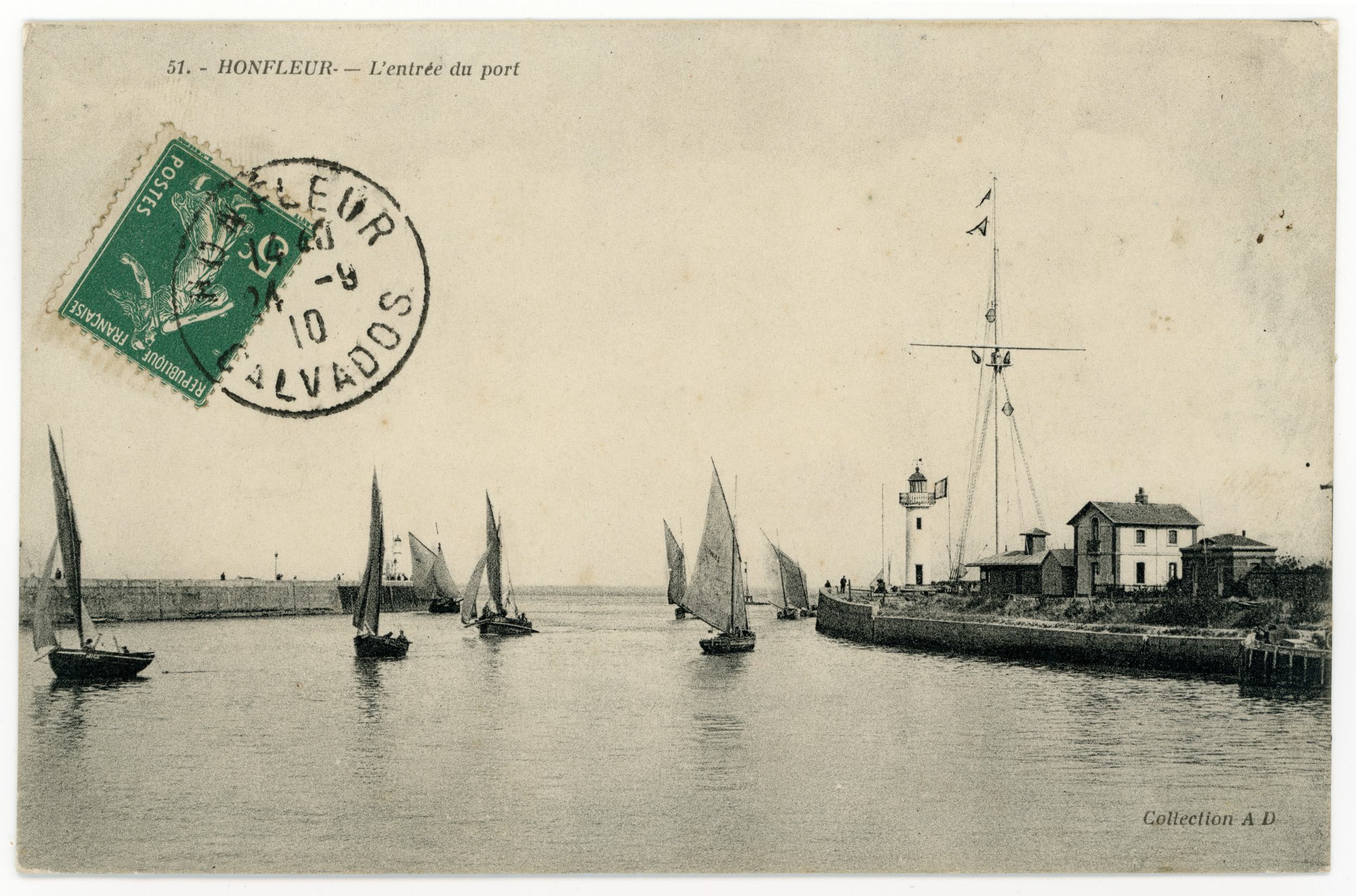
A contemporary postcard places us in the same spot as Seurat, revealing how carefully he rendered what were to him unfamiliar surroundings. Such postcards are particularly useful in enabling us to recapture the area in the late nineteenth century, as the landscape of Normandy has since undergone major changes, through industrialisation, the defences erected during the Second World War, and the destruction in its wake.
They, and works by other artists depicting the same site, reveal (by contrast) the particularities of Seurat’s approach. Instead of emphasising open vistas, Seurat flattened his composition and focused on the port entrance. He crowded the narrow channel with sailboats, steamships, bouys and masts, symbols of the intense activity in Honfleur.
An intriguing feature of the painting is its coloured perimeter, composed of an open weave of coloured dots, which let the paint below show through. Painted borders only started appearing in Seurat’s work from late 1888 or, most probably, 1889 onwards. At that time, the artist also returned to earlier paintings and reworked them to add borders on top of existing compositions.
Painting the inner harbour views at Honfleur
Georges Seurat’s exploration of Honfleur in the summer of 1886 included this unusual work. Here, Seurat turned his back to the sea and depicted ships moored in the port’s inner harbours. Devoid of human presence, the quays look abandoned, instead of the busy hubs they were at the time. However, this choice allowed Seurat to focus on the dynamic lines of the rigs, masts, chimneys, mooring posts, and rails on the docks to create this striking scene.
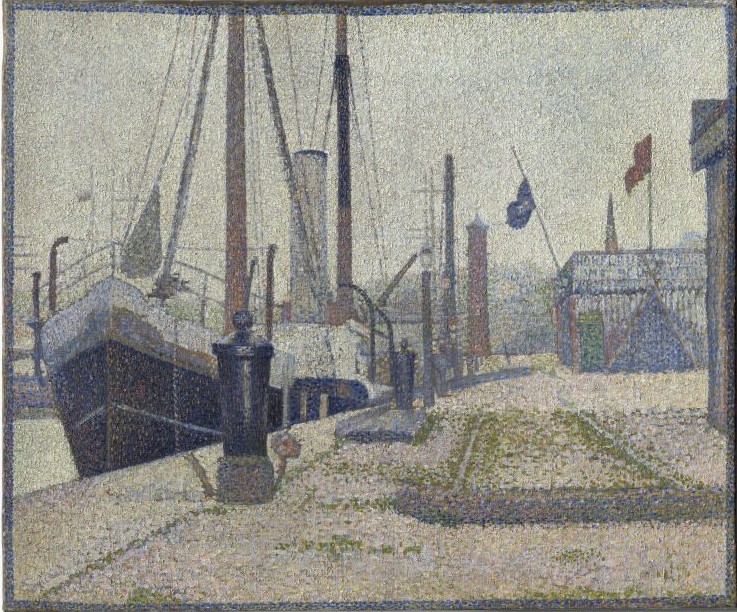
The ‘Maria’ was a British ship built in Glasgow in 1871. Operated by the London and South-Western Railway Company, it ran, in Seurat’s time, a regular cargo and passenger service between Honfleur and Southampton.
The dependable route of the ‘Maria’ meant that the painter was sure to find its moored in the harbour every few days. He has carefully rendered its iron hull; its central funnel, the top darkened by coal smoke; its two ancillary masts; and the cranes (called davits) on either side of the ship to lift goods onboard. The route to Southampton was enough of a stalwart of Honfleur port life to warrant a postcard, showing a ship with similar features to the ‘Maria’.
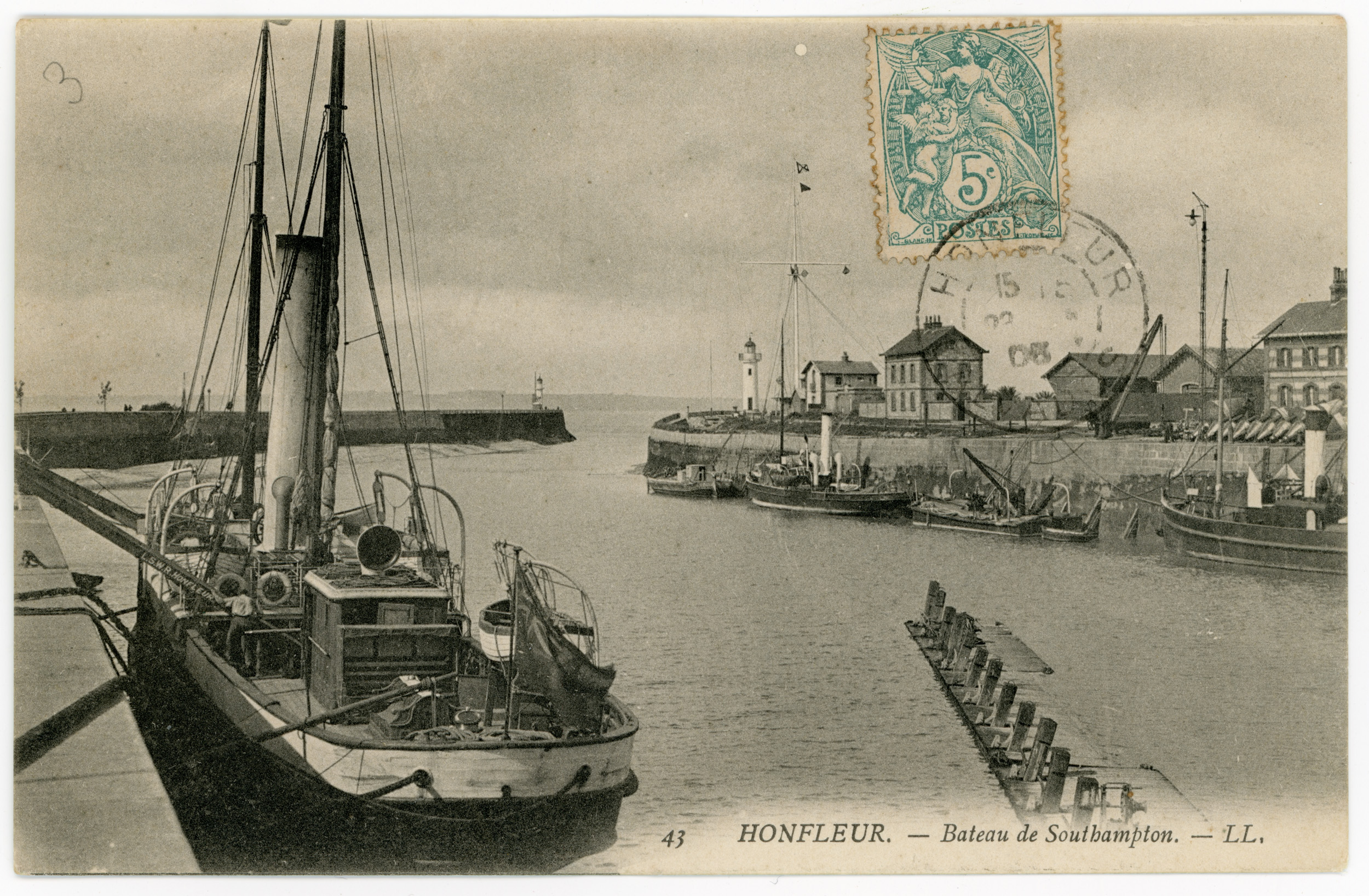
In contrast to the flatter composition of Entrance of the Port of Honfleur, The Maria at Honfleur has a great sense of depth, thanks to the perspectival lines created by the position of the ship, the edge of the quay, and the receding rail tracks used to bring merchandise for loading. Even Seurat’s signature in the lower left follows the perspective and is painted at an angle, a unique occurrence in his ouevre.
Shop the Catalogue
Delve further into Seurat’s seascapes in the beautifully illustrated catalogue of the first-ever exhibition dedicated to Seurat’s seascapes and the first devoted to the artist in the UK in almost 30 years.