Robyn Barrow
From October 2021 until August 2022, a large marine mammal far from her Arctic home went on an ill-fated, indeed, ultimately fatal, tour of European coastlines. This young, six-hundred-kilogramme walrus visited Norway, Sweden, Denmark, the Netherlands, Germany, and Northumbria, sunbathing, interacting with her growing number of human fans, and occasionally sinking boats.1 Likely driven from her home in Svalbard by rapid Arctic melt, Freya the walrus drew international attention with her antics, her growing publicity leading to anxiety on the part of the Norwegian government about the danger she posed to public safety. On 13 August 2022, a team of four men was dispatched to kill Freya in the Oslo harbor.2 It took multiple shots with special ammunition from a rifle to kill the walrus, her tough hide and incredible size offering significant protection. When the news of Freya’s demise got out, it was met with outrage and grief from the international community who had tracked her progress through the waterways of northern Europe.
On 30 April 2023, a publicly funded sculpture was erected in Oslo commemorating Freya. The image in bronze shows the walrus curled on her side, flippers folded, her small tusks (a particular feature often used to identify her) just peeping from her lips. The artist Astri Tonoian entitled the work For Our Sins (Fig. 5.1).3 The work and its title immortalize the walrus as a martyr, casting blame upon not only the Norwegian officials who ended her life but also the public who got too close to her in their zeal and, more broadly, all of humanity, who drove her from her home in the melting ice and who endanger all Arctic life through careless resource extraction.
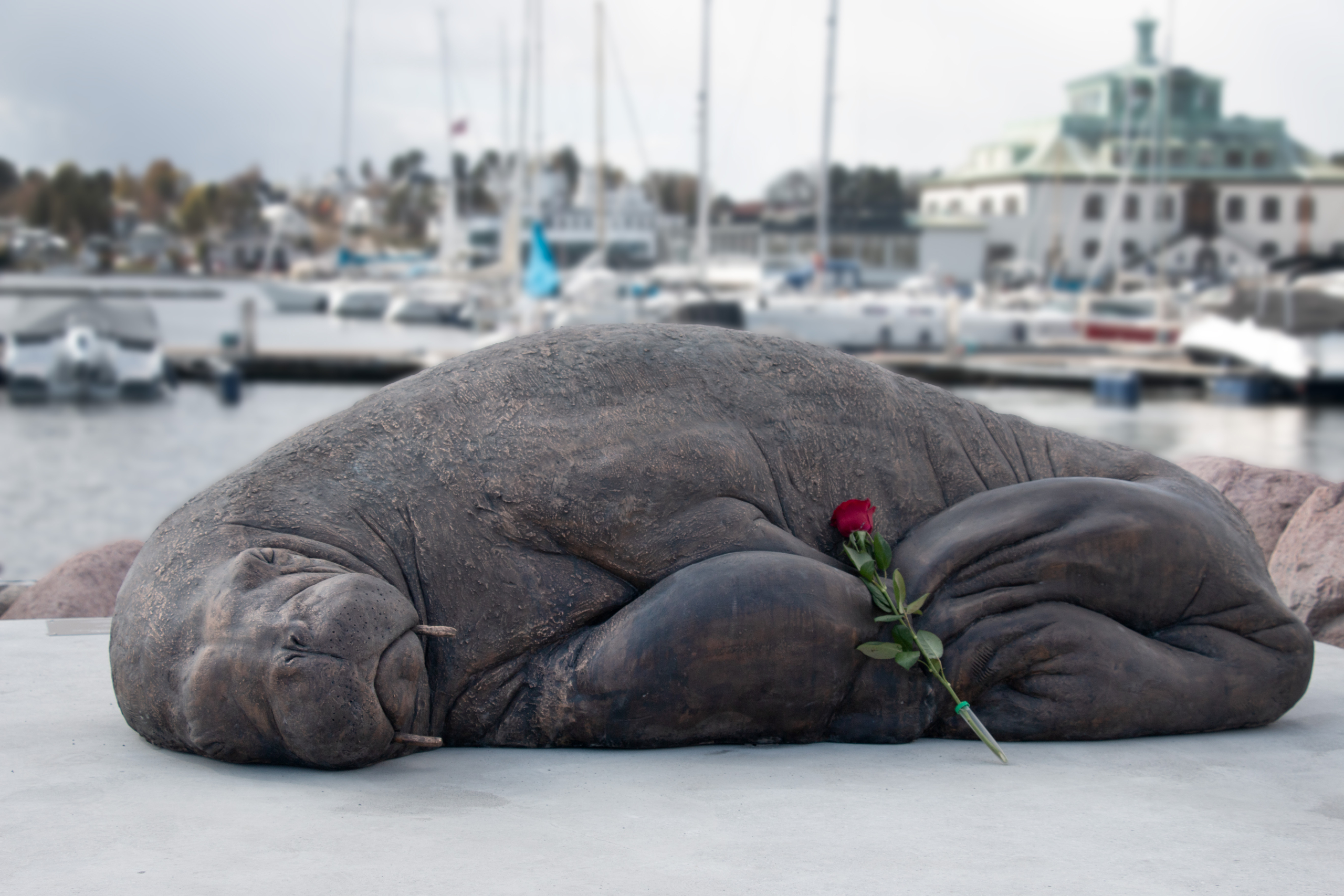
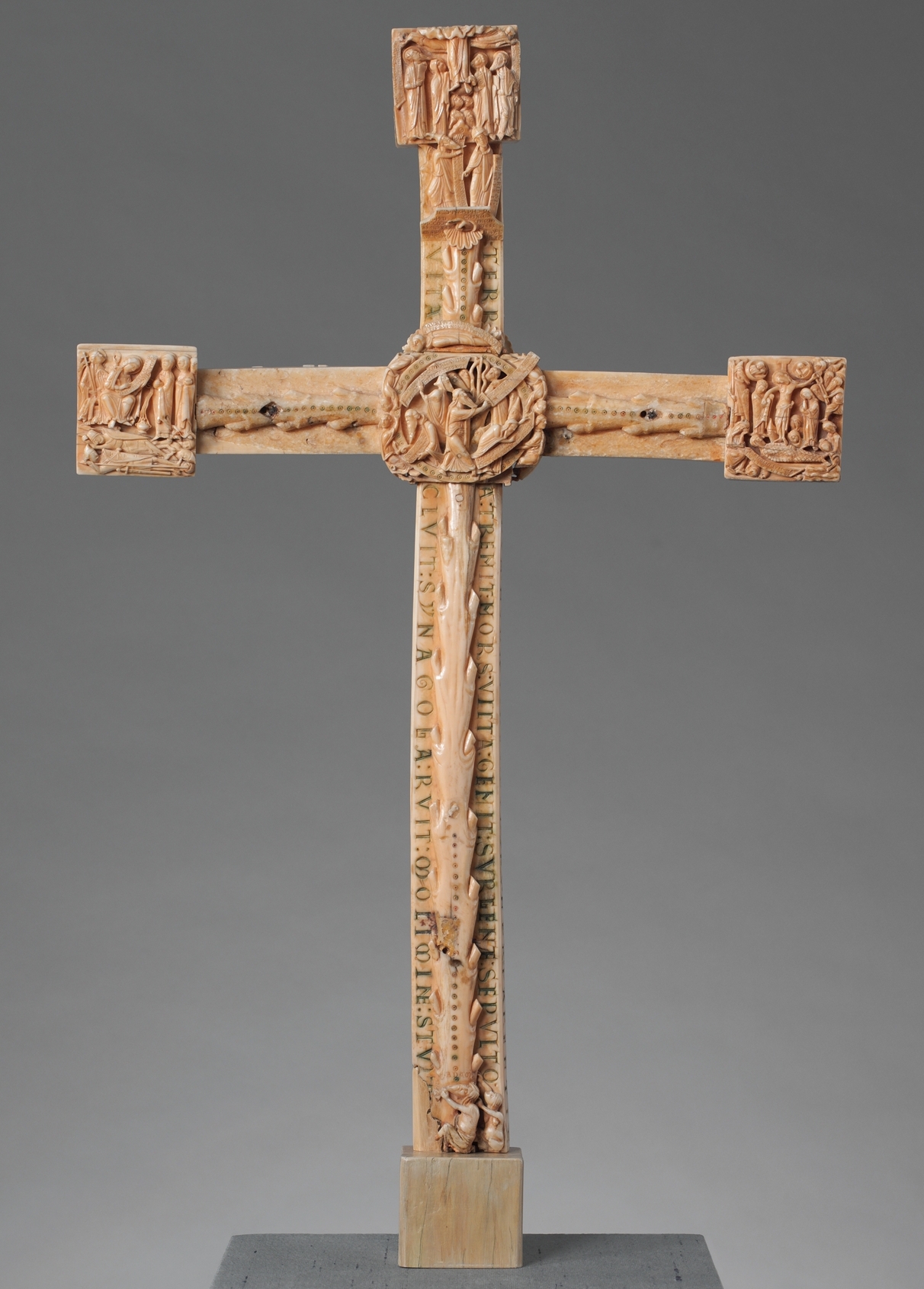
This walrus body, transformed into an image to remember and to charge with the sins of humankind, recalls a medieval work of art of ongoing international interest: the Cloisters Cross (Fig. 5.2). Like the sculpture of Freya, the Cloisters Cross is an afterlife, a remembrance of both its material origins in the Arctic and its iconographic manifestation of the Christian cosmology. The tusks, synecdoches for a dead walrus body, become the cross and missing corpus of the martyred Christ. One violence echoes in the other, a strong message of condemnation against sin and especially the medieval Jewish community, now carved into the ivory’s surface. This essay will consider the mechanisms of extraction, transportation, and refinement of this walrus ivory and contextualise the Cloisters Cross within the wider exchange of Arctic ivory in the Middle Ages.
Walrus ivory, like elephant ivory, is dentine from the enlarged tooth of a large mammal. It is a lustrous and carvable material composed of a dense structure of mineralized collagen fibers. Walrus tusks tend to be somewhat straighter than elephant tusks, more consistent in diameter from root to tip and more irregularly ovoid in shape. Unlike elephant ivory, walrus ivory has two distinct dentine structures: the primary dentine, which is similar to elephant ivory in colour and composition, and an interior, secondary dentine, which has an irregular crystalline texture.4 As explained by eleventh-century Iranian scholar Muḥammad ibn Aḥmad Bīrūnī: ‘A Khwarazmian happened to find a tooth which was very white on the side. He had hasps of daggers and knives made from it. The natural patterns described upon it were very thin, white, and pale. It resembled the down of a cucumber if peeled in such a manner that the seed grains are also cut off’.5 This description vividly evokes the chunky, marbled secondary dentine of walrus ivory.
In the early Middle Ages, these so-called fish teeth were traded through the Volga River systems from the Far North into the Middle East, where they were usually used for knife handles.6 The scope of long-distance trade of Greenlandic tusks was demonstrated in 2020 by James Barrett and others using DNA to extend their reach as far as Ukraine and the Baltic river routes which connected Scandinavia to Byzantium and even Asia, debunking earlier assumptions that the walrus ivory farther east all originated in the White Sea or Asia.7
In Scandinavia and Western Europe, walrus ivory was a prized material used in luxury carving, particularly in the eleventh and twelfth centuries, when disruption to long-distance trade routes between sub-Saharan Africa and Western Europe limited access to elephant ivory.8 Walrus tusks were a major incentive for settling Greenland, as earlier sources for walrus ivory in Iceland and the White Sea were already dwindling. In the first known written reference to walruses (in Old Norse, hrosshalvr, or horse-whale), the adventurer Ohthere [OH-theruh] told King Alfred about his voyages in the White Sea around 890 that ‘[h]is main reason for going there, apart from exploring the land, was for the walruses, because they have very fine ivory in their tusks . . . and their hide is very good for ship-ropes.’9 Walrus hides, due to the network of thickly bundled collagen fibrils in the reticular layer of the skin’s dermis, produced the strongest ropes for navigating treacherous waters and, for this reason, were highly valuable. The King’s Mirror, a thirteenth-century Norwegian didactic manuscript, notes ‘[walrus] hide is thick and good to make ropes of; it can be cut into leather strips of such strength that sixty or more men may pull at one rope without breaking it’.10 Already by the tenth century, overhunting had resulted in all but the total extinction of Iceland’s walrus population, and genetic testing has established that by the twelfth century tusks entering Europe via Greenland entirely dominated the walrus ivory trade.11 Because of the size, shape, and compositional constraints of walrus ivory, compared with elephant, most extant objects carved in the material are fairly small: luxury game pieces, reliquaries of intimate size, or small units that were combined into larger objects like the Cloisters Cross.
In the 1994 publication The Cloisters Cross: Its Art and Meaning, carbon-14 (C-14) dating on the Cross dated the ivory to the seventh century, five hundred years before it was carved.12 Understandings of radiocarbon dating have advanced considerably since then. This erroneous dating is due to a skewed interpretation of the data caused by the marine reservoir effect. Because marine animals come in contact with carbon in the ocean that is considerably older than carbon on land the C-14 dating must be recalibrated for this discrepancy; if it is not, it will date marine samples centuries too early. Research on recalibration for the marine reservoir effect is in active development. As recently as 2019, scientists attempting to date walrus ivory from the Foxe Basin region of Arctic Canada reaffirmed the significant variability between samples collected from different areas, meaning that C-14 dating of walrus samples still remains rather uncertain.13 Walruses can dive to depths of up to five hundred metres, and populations in different regions show distinct diving habits in waters with differing compositions.14 For this reason, none of the recent, groundbreaking genetic testing of medieval walrus DNA by Barrett’s team has used the C-14 method.15 Rather than carving ancient walrus-ivory tusks harvested long before either Iceland or Greenland were settled by the Norse, the artist of the Cloisters Cross was far more likely to have had access to twelfth-century Greenland walrus tusks.
Given the conclusions of Barrett’s team, the Cloisters Cross almost certainly began its life in the waters of the North Atlantic as the enlarged upper canines of a large sea mammal in Disko Bay, the walrus-hunting ground on the western coast of Greenland. Spanning one hundred kilometres from east to west and one hundred and fifty kilometres north to south, Disko Bay is the largest open bay on Greenland’s west coast. Given the team of four men with heavy-duty modern weaponry that it took to kill Freya in 2022, it is fascinating to consider what the experience of walrus hunting must have been like for medieval Europeans and early Inuit hunters whose livelihoods depended, in different ways, on the walrus populations.16 In six-oared boats [sexæringr], hunters could set out from the Western Settlement, around modern day Nuuk, and row for about fifteen days, weather permitting, north to Disko Bay, which had already been a popular hunting ground among Arctic peoples for thousands of years.17 This is due to its nutrient-rich waters, with high densities of zooplankton, mollusks, and small fish, which attract marine predators such as whales, seals, and walruses.18 In the springtime, polar ice calves (breaks off to form icebergs) in the Ilulissat Icefjord and falls into the sea.19 These massive icebergs stir up the rich sediment on the marine shelf of Greenland, filling the shallows with food for marine mammals, who spend their springs grazing on this wealth of small organisms. Walrus bulls, cows, and their young live in communities, and have historically hauled out on the ice floes in this area in great numbers.20 With their immense size, walruses are unlikely to retreat from a human hunter’s approach. Walruses are incredible animals, well-adapted to survival in the High Arctic. At up to fifteen hundred kilogrammes, they are enormous, well-armed with up to metre-long tusks and possessing very strong hides.21 Hunting these powerful and intelligent animals was dangerous work. However, walruses are slow and far less manoeuvrable when out on the ice, which made springtime hunting trips to Disko Bay ideal. Hunters, whether armed with blades or projectiles, such as a crossbow, harpoon, or bow and arrow, had to be close enough to these formidable animals for their weapons to drive through their tough hides; the skin and blubber of a male walrus is around ten centimetres thick around its neck. In the early spring, although the Eastern Settlement, all located in the current municipality of Kujalleq, was still iced in from winter, the waters of the Western Settlement, warmed by the Gulf Stream, were open, allowing the Norse hunters to travel to Disko Bay to hunt large populations of walruses on the ice floes there.22
The large, male walrus (or walruses) whose teeth became the Cloisters Cross was likely killed during the summer migration by Norse hunters, who took its skull and hide back with them on the long journey from the hunting ground to their settlements on the southern coast of Greenland. These Arctic exports, walrus tusks and hides, were the underpinning of life on Norse Greenland from its foundation in the tenth century until the end of all Norse settlement around 1415.23
Once they arrived in the Norse settlements, tusks like those used in the Cloisters Cross would have needed to be cured to avoid cracking, then transported to Europe via ships from Bergen. Due to their limited timber for shipbuilding, Norse Greenlanders were essentially marooned by the twelfth century.24 In the eleventh and twelfth centuries, at the height of walrus-ivory demand and Greenland’s communication with the wider Old Norse world, the Norse Greenlanders could generally expect a merchant ship to arrive in the Eastern Settlement in late summer each year.25 These merchants would set off from Bergen sailing due west and arrive at the southern tip of Greenland, which fell on the same latitude (sixty degrees north) as their port, before sailing up the western coast of the island to the Eastern Settlement.26 There, in exchange for the walrus ivory and skins, the merchants could supply the Norse Greenlanders with essentials, like iron, and luxuries, like timber, wine, grains, and glass.27 These merchants would overwinter in the settlements, lodging with locals until they could safely sail away again. However, Greenlandic weather was, as it is today, highly variable, with unpredictable summers, often-low visibility, and restless seas. With such a narrow window of time for departure, merchants might end up prolonging their stay in Greenland for multiple years; alternatively, years might pass when no merchants ships arrived in the settlements to trade.28 The Norse Greenlanders had to maintain a high level of self-sufficiency in order to withstand these unpredictable conditions.
Perhaps the Cloisters Cross tusks were traded in this way, or perhaps they were tithed, part of the annual tenth sent to the archbishop of Nidaros in Norway, the most northerly archbishopric in the world, still more than twenty-eight hundred kilometres from Gardar Cathedral in Greenland. This tithe of tusks and hides was given, when collection was possible, by the Greenlanders from the foundation of their own bishopric in 1123 until the community was neglected, forgotten, and finally dwindled into nonexistence by the early fifteenth century.29 The walrus products would be shipped to the archbishop’s storehouse in Bergen and from there they could either be sold into the European market, taken on to the archbishopric at Trondheim, or gifted.30
Testing of medieval walrus rostra has identified the major urban nodes of ivory distribution at Dublin, Trondheim (the modern name of medieval Nidaros), Bergen, and Ribe, a part of the medieval Danish kingdom.31 Here, tusks not already extracted from skulls at the Western Settlement in Greenland could be removed. To extract a tusk from a relatively fresh walrus skull is difficult, and significant portions of thick maxillary bone must be removed. Once extracted, tusks could then be exported to other workshop centres such as Winchester, Oslo, and Cologne.
Though walrus ivory was present in much of medieval Europe, there is little textual evidence to suggest it was well understood. In Iceland and Scandinavia, however, Arctic mammals were verifiably well known. The archbishop at Nidaros and the Scandinavian elite whose wealth was enmeshed in the trade sphere, which included the luxury resources of the Arctic, would have been explicitly aware of the source of their ivory. The King’s Mirror provides this thoughtful description of the animals:
There still remains another species which the Greenlanders count among the whales, but which, it seems to me, ought rather to be classed with the seals. These are called walrus and grow to a length of fourteen ells or fifteen at the very highest. In shape this fish resembles the seal both as to hair, head, skin, and the webbed feet behind; it also has the swimming feet in front like the seal. . . . Its appearance is distinguished from that of other seals in that it has, in addition to the other small teeth, two large and long tusks, which are placed in the front part of the upper jaw and sometimes grow to a length of nearly an ell and a half [about 50 cm].32
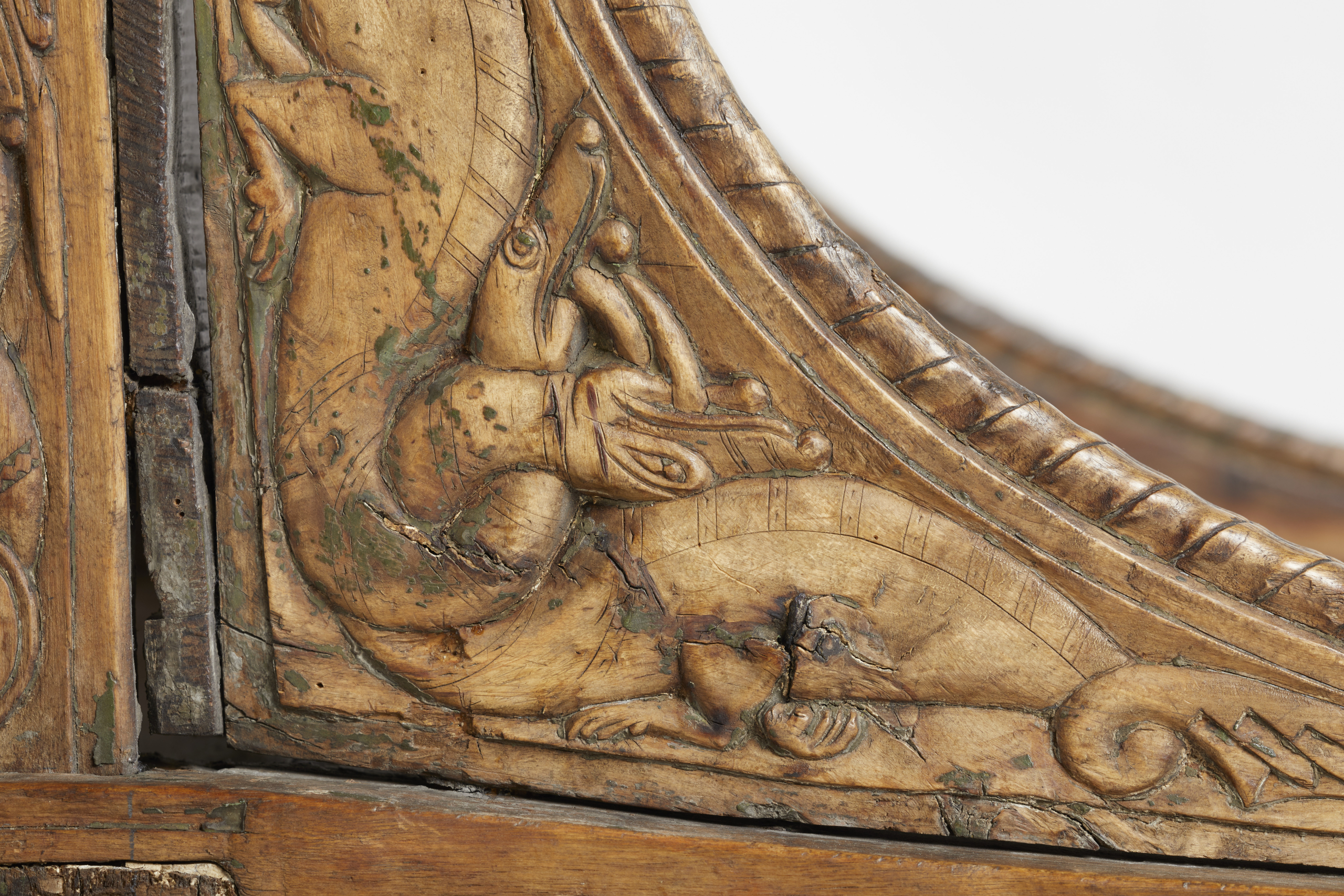
A detail of the arm of a chair from Tydal Church (ca. 1150–1200) in Norway features two walruses in combat, their dragon-like necks interlocked, tusks at one another’s throats (Fig. 5.3). These walruses, perhaps the earliest surviving images in the European canon of the animal, are impressive likenesses, even possessing flippers.
Though walrus ivory was clearly in relatively widespread circulation in Western Europe, the existing artistic corpus and archeological finds do not suggest it was ever commonplace or even particularly plentiful. For northern traders and elite patrons, walrus ivory, as a luxury good exclusively sourced from the Nordic world, was considered an apt gift for kings and saints, either carved or in raw form. The previously mentioned ninth-century chronicle recording Ohthere’s White Sea voyages mentions that he gifted King Alfred a tribute of walrus ivory.33 A thirteenth-century Icelandic saga concerning late twelfth-century events, Hrafns saga Sveinbjarnarsonar, relates another such gift of whole tusks following a walrus hunt, this time to a saint’s shrine:
A walrus came up on land, and men went after it and wounded it, but the whale leaped into the sea and sank, because it had been wounded internally. The men took to their ships and began to drag the bay, hoping to draw the whale up onto land, but nothing came of it. Then Hrafn called on the Holy Archbishop Thomas to help them recover the whale. He vowed that he would give him the whale’s tusks, still fixed in its skull, if they could bring the whale up onto land. And after he made that vow, it wasn’t long before they got the whale.34
As he promised, Hrafn departed the Westfjords in Iceland for England in the spring and gifted the skull with its tusks to the shrine in Canterbury. This passage is fascinating in that it reveals the rarity of spotting a walrus in Icelandic waters in the twelfth century, inspiring such zeal in the hunters that they are willing to attempt to drag the incredibly dangerous coastal waters of the Westfjords in ships. Hrafn’s choice of saint to call upon for help indicates the flowering cult of Thomas Becket on Iceland, but, more importantly for our purposes, it characterizes walrus skulls and tusks in this raw form as an appropriate gift for a saint, taking on a relic-like quality at the martyr’s shrine.35 Preserved in this state rather than refined for carving, they also function as wonders, valuable as tokens of the saint’s miraculous intercession.36
Enlivened by the textile industry centred in Flanders in the thirteenth century, the northern maritime sea routes of Western Europe provided the markets of northern Europe with a steady inflow of large and high-quality elephant tusks from sub-Saharan Africa, meaning that, at least beyond Scandinavia, the desirability of walrus ivory waned.37 Even as walrus-ivory carving became less prevalent in Western Europe, Scandinavian powers continued to gift walrus ivory diplomatically. A walrus-ivory oliphant of mid-thirteenth-century Norwegian provenance from the treasury of the Sainte-Chapelle was likely a gift from King Magnus VI of Norway to French King Philip III in exchange for a thorn from the Crown of Thorns (Fig. 5.4).38 To commemorate the reunification of Norway, Sweden, and Denmark in the 1397 Kalmar Union, a carved walrus tusk bearing the insignia of King Christian I and Queen Dorothea, the rulers who had last maintained rule over the three kingdoms, was gifted to the new ruler, Eric of Pomerania (Fig. 5.5).39 As an emblem of Scandinavian power and luxury, this carved tusk, inherited by one ruler from another, symbolized the kingship of the three unified realms. As a wonder and a curiosity and a rare and exceptional material on which the North held a monopoly, walrus ivory, as gift, embodied Nordic prestige. Gifted to European neighbors, carved or uncarved, ivory could therefore solidify diplomatic bonds. Walrus tusks could even function in similar ways to the tusks of narwhal whales, often understood as unicorn horns. These long, spiraling tusks could also only be obtained, with far less consistency, if a dead narwhal happened to wash ashore off the North Atlantic coasts of the Arctic Ocean.40
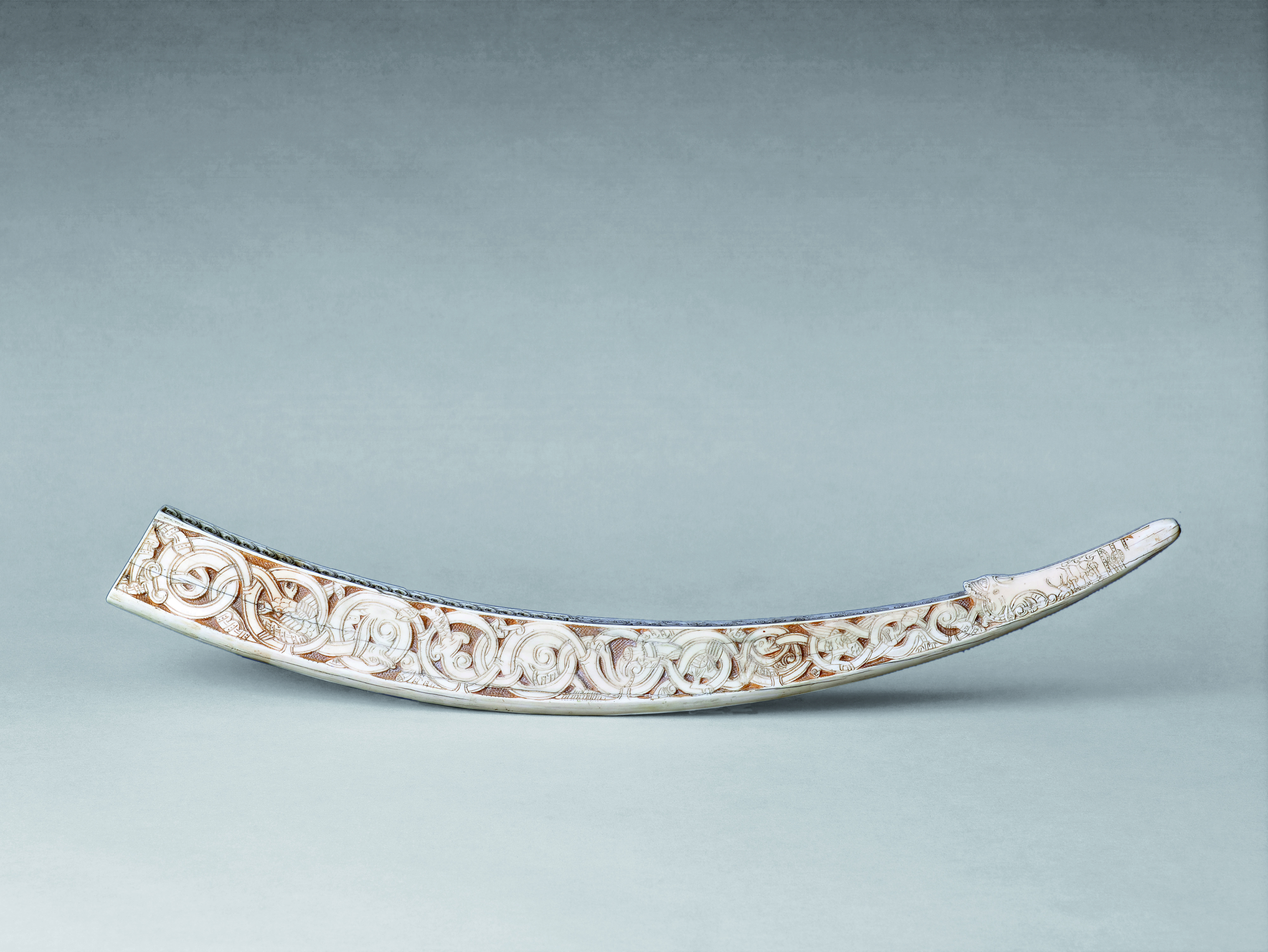
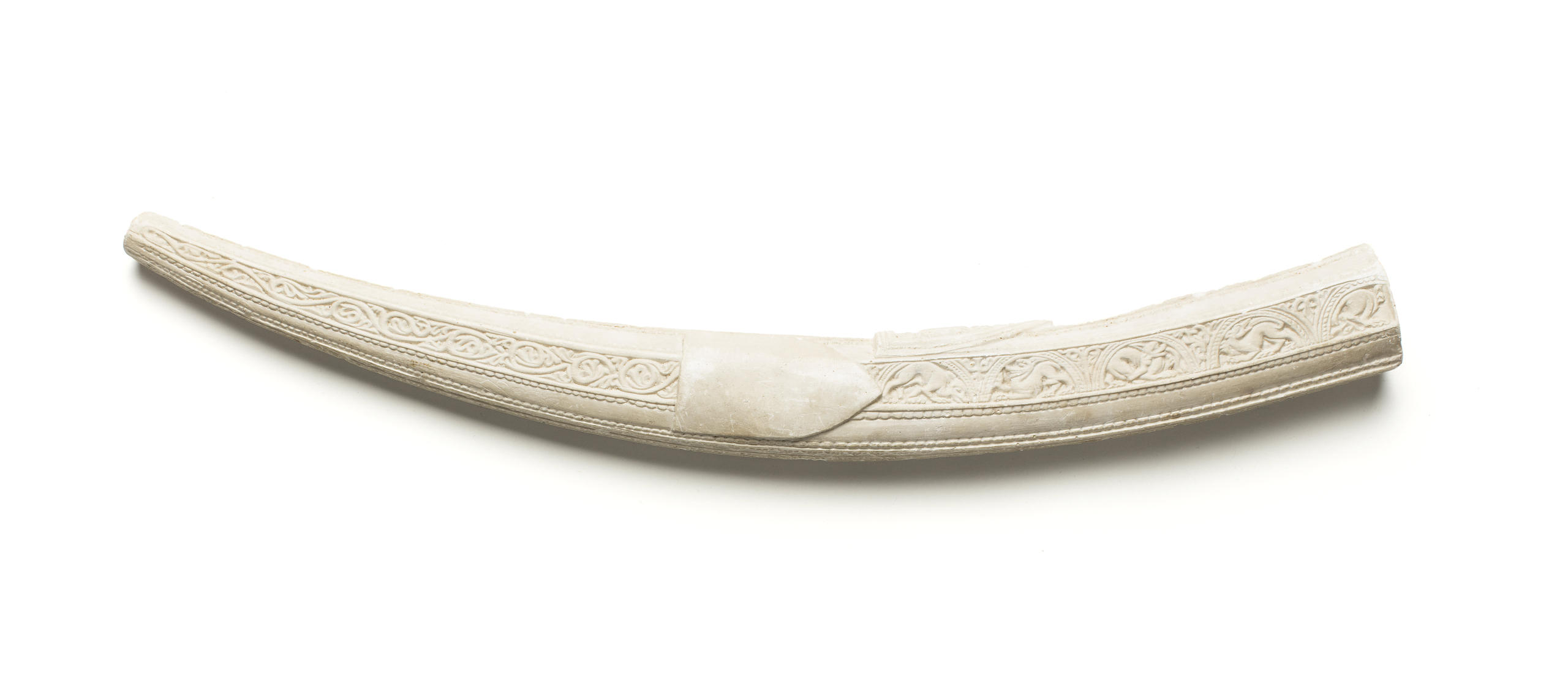
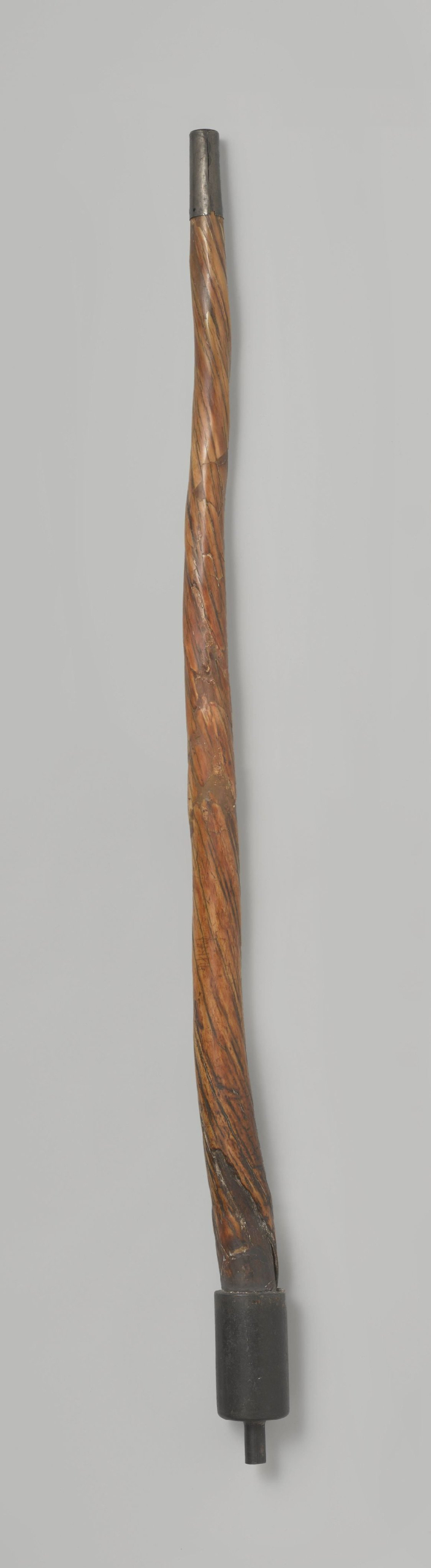
The three narwhal tusks now housed at the Rijksmuseum in Amsterdam, originally part of the treasury of St Mary’s Church in Utrecht, are among the oldest narwhal tusks in a European treasury (Fig. 5.6). Church tradition claims that these tusks were a royal donation by Emperor Henry IV, who was instrumental in the founding of the church in the eleventh century.41 Runes scratched into the ivory surface, using the long-stemmed, younger Futhark alphabet frequently in use through the twelfth century, allude to the steps of exchange from the Arctic to the treasury.42 This series of trades, gifts, and donations spanned great distances of open ocean, encompassing a vast expanse of both time and space in which material understandings were perhaps in flux yet the prestige and importance of the object was maintained.
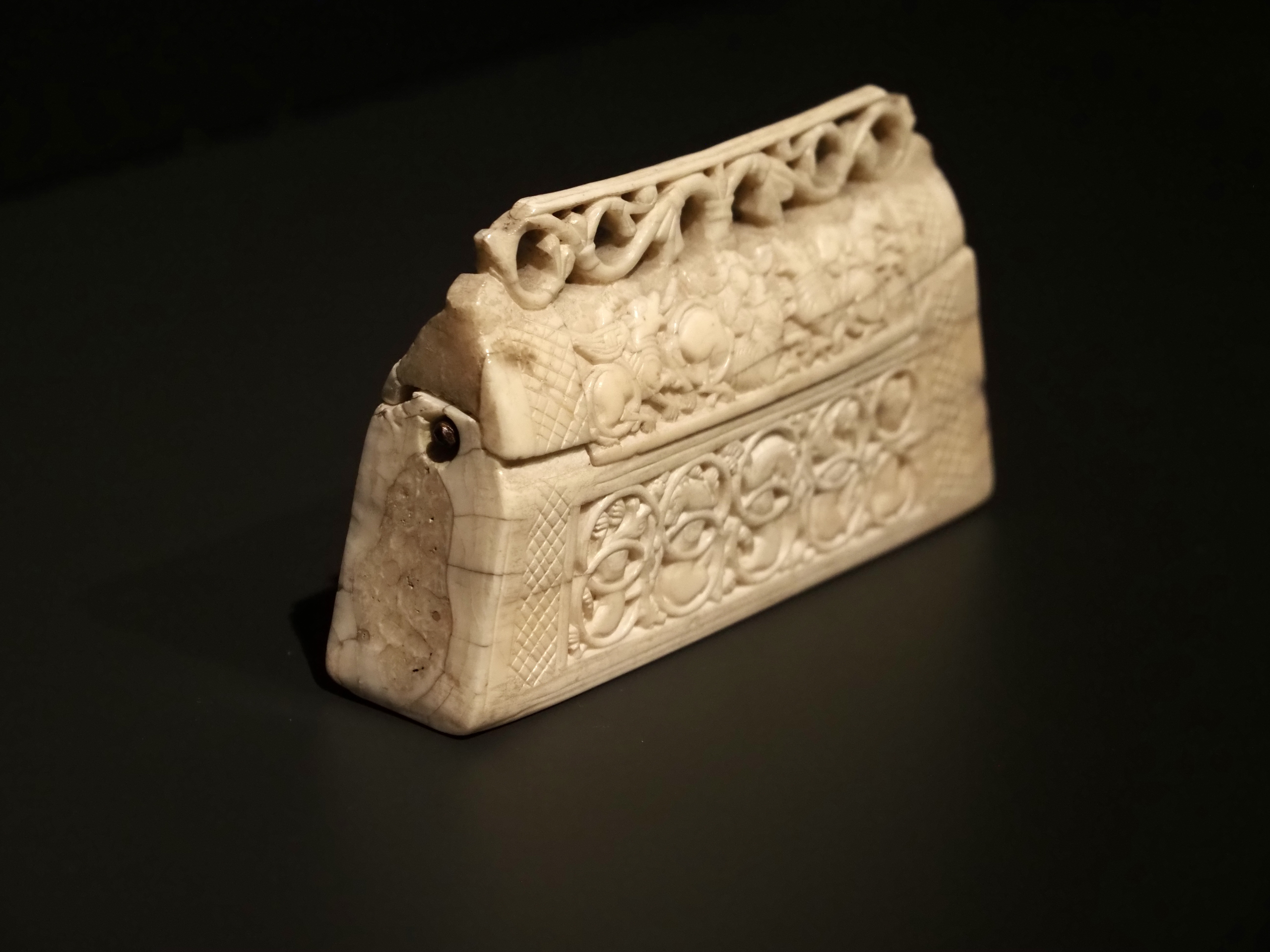
At Trondheim, the seat of the archbishop of Nidaros, there is significant archeological evidence for the presence of walrus ivory.43 Very large, uncarved tusks and walrus skulls have been found in the area. Objects discovered elsewhere, such as a purse-shaped reliquary now in the Rijksmuseum, have been attributed to Trondheim, based upon similarities to the stone carving in Nidaros Cathedral (Fig. 5.7). Trondheim was a major scholastic centre in Norway, with deep ecclesiastical and artistic ties to the English church.44 Its Augustinian canons, along with many sons of the Scandinavian elite, were educated at the Abbey of Saint-Victor in Paris.45 Pilgrim roads to the shrine of Saint Olav at Nidaros connected Trondheim to Canterbury, Compostela, Rome, and Jerusalem.46 Walrus ivory and objects carved from walrus tusks lubricated trade systems and eased diplomatic relationships abroad.
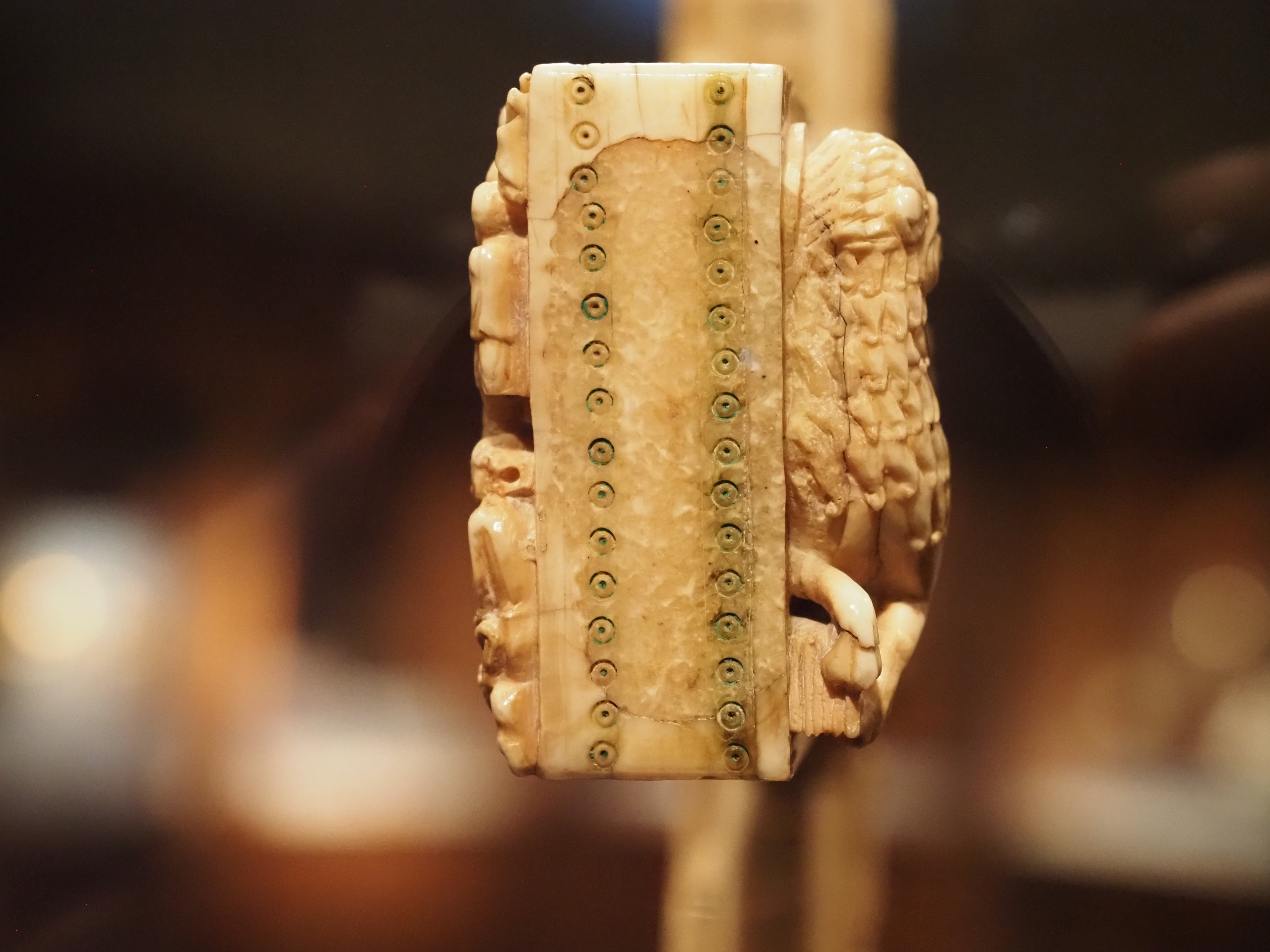
How many walrus tusks were needed to carve the Cloisters Cross? Walrus tusks grow over the lifetime of the animal and can vary significantly in size depending upon the walrus species, gender, age, and nutrition. One material sign, visible on the Good Friday plaque at one end of the cross arm, provides a clue (Fig. 5.8). At 5.9 centimetres in height, 5.4 centimetres in width, and about four centimetres in thickness, this plaque is essentially a cross-cut of a tusk, whose original diameter can be estimated to have been between seven and eight centimetres, with a thickness of about five centimetres. Though there are only circumstantial data establishing the ratio of walrus-tusk maximum diameter to length, this indicates a tusk of impressive size. The largest pieces of walrus ivory utilized in medieval objects generally have a maximum width of about seven centimetres.
In order to accommodate the shape of the walrus tusks and the dual textures of the material, the medieval carver had to work expertly, taking advantage of as much of the primary dentine as possible to create deep relief carving without exposing the interior. Particularly on the shaft of the Cloisters Cross, the carver worked conservatively with the material, revealing and carving the less desirable secondary dentine. In the vertical and horizontal arms of the Cross, the artist attempted to disguise the subtle curvature of his material. The rectangular insert above the head of the Lamb of God in the central medallion, which cuts through an inscription banner and the shoulders of the mourning figure of Saint John the Evangelist, also speaks to a careful use and patching of the material to achieve the composition. These choices demonstrate that the material was not unlimited. The Cloisters Cross is large for a medieval walrus-ivory object. It is substantially carved from five solid pieces, each of significant size, and very little secondary dentine is visible. It can therefore be concluded that the Cloisters Cross was carved from a single pair of large tusks.
The attribution of the Cloisters Cross to Bury St Edmunds has long been a prevalent theory, and one that has lasting significance for the cathedral at Bury today. Though the arguments for a connection between the Cloisters Cross and Bury have been adeptly challenged, the long-standing association still bears some, if not conclusive, weight and provokes the historical imagination.47 In 1180, Øystein Erlendsson, the most important early archbishop of Nidaros, fled his seat and went into exile in England. Funded by Henry II, he stayed three years in England, perhaps in that time working on the liturgy of the cult of Saint Olav, of whom he was the most significant patron.48 Øystein, who became archbishop in 1161, was a major figure in consolidating church power in Norway, replacing the bishops in Iceland with his own choices and, for the first time, meaningfully instrumentalising tithing throughout the archbishopric.49 This means that Archbishop Øystein undoubtedly had walrus tusks from Greenland at his disposal.
Funded by Henry II, Øystein stayed at least six months in the empty abbot’s house at Bury St Edmunds.50 He was a major advocate to the king for the monks being allowed a free election and encouraged the election of Abbot Samson in 1182. The following period was one of great momentum within the community, with a rebuilt choir and towers for the abbey and, of course, an intense rise in anti-Jewish sentiments and violence.51 It is intriguing to wonder whether a gift of tusks from the visiting Norwegian archbishop to Bury St Edmunds might have facilitated the carving of the Cloisters Cross, in a style that recalls that of Master Hugo while also incorporating other stylistic and iconographic choices circulating in the second half of the twelfth century.52
Due to the bizarre and frustrating provenance of the Cloisters Cross, it is an object set rather adrift within the international milieu of twelfth-century Romanesque carving, with only stylistic attribution available for art historians to contextualise the object.53 Regardless of whether the Cross was carved on the continental mainland, in England, or in Scandinavia, grounding interpretations in the mechanisms of the exchange, use, and meanings of walrus ivory in the Middle Ages can help us draw somewhat nearer an object which continues to defy and resist firm attribution. The Cloisters Cross is one of the largest and most complex walrus-ivory objects to survive from the Middle Ages. It demonstrates not only ideological intensity and artistic virtuosity but a particular, material-specific skill in its artistic manipulation. The artist of the Cloisters Cross made the most of the tusk, densely working its surface in three dimensions in a way that mostly conceals the secondary dentine. The carver must have been an experienced master carver of walrus ivory, familiar with the affordances and pitfalls of the material and with long-time access to and experience with walrus tusks.54 The Cross stands as a foremost monument to the skills of the Romanesque walrus-ivory carver, enabled and nourished by the tusks supplied through the North Atlantic trade sphere at the height of their circulation.55
As walrus hunting in Greenland went on into the thirteenth and then fourteenth centuries, the value of walrus ivory also fell.56 The drop in value meant that greater numbers of tusks were required to supply the Greenlanders, who essentially lived at the subsistence level. Desperate to maintain their main source of contact with their wider cultural and economic sphere, the Greenland settlers increasingly exported smaller female tusks in greater numbers.57 By the end of the Greenland settlement’s viability, it was walruses much like Freya, our 2022 martyr, who became their principal prey.
Citations
[1] Caroline Radnofsky, dir., ‘Norway Is Obsessed with Freya, the Walrus Who Rose to Fame While Sinking Boats’, NBC News, aired 22 July 2022.
[2] Jason Horowitz, ‘A Famous Walrus Is Killed, and Norwegians Are Divided’, New York Times, 19 August 2022.
[3] ‘Walrus Freya Killed by Norway Gets Oslo Sculpture’, BBC News, aired 30 April 2023.
[4] Barry Baker et al., CITES Identification Guide for Ivory and Ivory Substitutes, 4th ed., ed. Crawford Allan (Washington, DC: World Wildlife Fund, 2020); Xavier Dectot, ‘When Ivory Came from the Seas: On Some Traits of the Trade of Raw and Carved Sea-Mammal Ivories in the Middle Ages’, Anthropozoologica 53, no. 1 (2018): 160; and Karin M. Frei et al., ‘Was It for Walrus? Viking Age Settlement and Medieval Walrus Ivory Trade in Iceland and Greenland’, World Archaeology 47, no. 3 (2015): 439–66.
[5] Muḥammad ibn Aḥmad Bīrūnī, Kitāb ʼal-Jamāhir fī maʻrifat ʼal-Jawāhir, ed. Abī’ al-Rayḥān (Baghdad: Al-Mutanabbi Library, 1936), 209; and Muḥammad ibn Aḥmad Bīrūnī, Kitāb al-Jamāhir fī maʿrifat al-Jawāhir, trans. Hakim Mohammed Said as The Book Most Comprehensive in Knowledge on Precious Stones: Al- Beruni’s Book on Mineralogy, One Hundred Great Books of Islamic Civilization, 9 Natural Sciences, vol. 66 (Islamabad: Pakistan Hijra Council, 1989), 180.
[6] Dectot, ‘When Ivory Came from the Seas,’ 164; and Matthew E. Gillman, ‘A Tale of Two Ivories’, Espacio, Tiempo y Forma, ser. 7, Historia del Arte 5 (2017): 93.
[7] James H. Barrett et al., ‘Walruses on the Dnieper: New Evidence for the Intercontinental Trade of Greenlandic Ivory in the Middle Ages’, Proceedings of the Royal Society B: Biological Sciences 289, no. 1972 (2022): 1–9.
[8] Sarah Guérin, ‘Avorio d’ogni Ragione: The Supply of Elephant Ivory to Northern Europe in the Gothic Era’, Journal of Medieval History 36, no. 2 (2010): 156–74; and James H. Barrett, ‘The Exploitation of Walrus Ivory in Medieval Europe’, in The Atlantic Walrus: Multidisciplinary Insights into Human-Animal Interactions, ed. Xénia Keighley et al. (Amsterdam: Elsevier, 2021), 175.
[9] ‘Swipost he for dider, toeacan pæs lands sceawunge, for pæm horshwæleum, for dæm hie habbad swipe æpele ban on hiore topum . . . hiora hyd bid swide god to sciprapum’. This account is part of an Old English translation of the Latin Historiae adversus paganis by Paulus Orosius (fl. ca. 400), Cotton Tiberius B.I., fol. 13v, British Library, London. See also, Two Voyagers at the Court of King Alfred: The Ventures of Ohthere and Wulfstan Together with the Description of Northern Europe from the Old English Orosius, ed. Niels Lund, trans. Christine E. Fell (York: Sessions, 1984), 19–20.
[10] ‘Húð hans er góð ok þykk til reipa, ok rista menn þar af sterkar álar, svá at vel draga sex tigir manna eitt reip eða fleiri, ok geta þó eigi slitít’. Speculum regale, 1265–85, MS Arní Magnússon 243, fol. B, University of Copenhagen, Copenhagen. See also Rudolph Keyser, P. A. Munch, and C. R. Unger, eds., Speculum regale [Konungs-Skuggsjá] Konge-Speilet et philosophisk-didaktisk skrift, forfattet i Norge mod slutingen af det tolfte aarhundrede: Tilligemed et samtidigt skrift om den norske kirkes stilling til staten (Christiania: Werner, 1848), 39; and Laurence Marcellus Larson, trans., The King’s Mirror [Speculum regale-Konungs Skuggsjá] (New York: American Scandinavian Foundation, 1917), 140.
[11] Bastiaan Star et al., ‘Ancient DNA Reveals the Chronology of Walrus Ivory Trade from Norse Greenland’, Proceedings of the Royal Society B: Biological Sciences 285, no. 1884 (2018): 1–9.
[12] Elizabeth C. Parker and Charles T. Little, The Cloisters Cross: Its Art and Meaning (New York: Metropolitan Museum of Art, 1994), 16.
[13] Arthur S. Dyke et al., ‘An Assessment of Marine Reservoir Corrections for Radiocarbon Dates on Walrus from the Foxe Basin Region of Arctic Canada’, Radiocarbon 61, no. 1 (2019): 67–81.
[14] Dyke et al., ‘An Assessment of Marine Reservoir Corrections for Radiocarbon Dates on Walrus from the Foxe Basin Region of Arctic Canada’, 69.
[15] James H. Barrett et al., ‘Ecological Globalisation, Serial Depletion and the Medieval Trade of Walrus Rostra’, Quaternary Science Reviews 229 (2020): 5.
[16] Jette Arneborg, ‘Early European and Greenlandic Walrus Hunting: Motivations, Techniques and Practices’, in Keighley et al., The Atlantic Walrus, 156–57.
[17] Morten Meldgaard, Ancient Harp Seal Hunters of Disko Bay: Subsistence and Settlement at the Saqqaq Culture Site Qeqertasussuk (2400–1400 BC), West Greenland, Man and Society 30 (Copenhagen: Danish Polar Center, 2004), 159–71; and Dectot, ‘When Ivory Came from the Seas,’ 161.
[18] Kristin L. Laidre and Mads Peter Heide-Jørgensen, ‘Spring Partitioning of Disko Bay, West Greenland, by Arctic and Subarctic Baleen Whales’, ICES Journal of Marine Science 69, no. 7 (2012): 1227.
[19] Ole Bennike and Jakob Lautrup, Ilulissat Icefjord: A World Heritage Site (Copenhagen: GEUS, 2004). This text includes an extensive natural-sciences bibliography on the site’s composition, calving, flora, and fauna.
[20] Due to climate change that has reduced ice for walruses to haul out on, Atlantic walruses are under extreme threat. The total population of Atlantic walruses in the Baffin Bay region now numbers approximately 2500. See Kristin L. Laidre et al., ‘Arctic Marine Mammal Population Status, Sea Ice Habitat Loss, and Conservation Recommendations for the 21st Century’, Conservation Biology 29, no. 3 (2015): 724–37; Robert Stewart et al., ‘Estimates of Minimum Population Size for Walrus near Southeast Baffin Island, Nunavut’, NAMMCO Scientific Publications 9 (2013), 141–58; and Committee on the Status of Endangered Wildlife in Canada, ‘COSEWIC Assessment and Status Report on the Atlantic Walrus odobenus rosmarus rosmarus, High Arctic Population, Central-Low Arctic Population and Nova Scotia- Newfoundland-Gulf of St. Lawrence Population in Canada’ (Ottawa: Committee on the Status of Endangered Wildlife in Canada, 2017).
[21] Hervé Monchot, et al, ‘The Modus Operandi of Walrus Exploitation during the Palaeoeskimo Period at the Tayara Site, Arctic Canada’, Anthropozoologica 48, no. 1 (2013): 25.
[22] Arnved Nedkvitne, Norse Greenland: Viking Peasants in the Arctic (Milton Park: Routledge, 2019), 174–75.
[23] Nedkvitne, Norse Greenland, 212; and Jette Arneborg, ‘The Norse Settlement of Greenland,’ in The Cambridge History of the Polar Regions, ed. Adrian Howkins and Peder Roberts (Cambridge: Cambridge University Press, 2023), 148–49.
[24] Lisbeth M. Imer, Peasants and Prayers: The Inscriptions of Norse Greenland, Publications from the National Museum: Studies in Archaeology & History 25 (Odense: University Press of Southern Denmark, 2017).
[25] Nedkvitne, Norse Greenland, 198.
[26] Nedkvitne, Norse Greenland, 196.
[27] Lísabet Guðmundsdóttir, ‘Timber Imports to Norse Greenland: Lifeline or Luxury?’ Antiquity 97, no. 392 (2023): 454–71; and Nedkvitne, Norse Greenland, 163.
[28] Nedkvitne, Norse Greenland, 198–200.
[29] Nedkvitne, Norse Greenland, 361.
[30] Nedkvitne, Norse Greenland, 122.
[31] Barrett et al., ‘Ecological Globalisation’, 6.
[32] ‘Nú er þat enn eitt kyn eptir, er Grœnlendingar kalla í tolu með hvōlum, ok virðisk mér svá, at þá megi heldr telja með selum, er rostungr heitir, ok verða þeir at vexti fjórtan álna eða fimtán, þeir sem lengstir verða. Vöxtr þess fisks er allr sem sels, bæði hár ok hōfuð ok húð ok fitjar aptr, ok sundhreifar frammi svá sem i sel. . . . En þat bregðr af vexti hans frá öðrum selum, at hann hefir tennr tvær stórar ok langar umfram aðrar smátennr, ok standa þær i efra gómi i öndverðu hofði, náliga hálfrar annarrar álnar langar, þær sem lengstar verða’. Speculum regale, 1265–85, MS Arní Magnússon 243, fol. B, University of Copenhagen, Copenhagen. See also Keyser, Munch, and Unger, Speculum regale, 39; and Larson, The King’s Mirror, 140.
[33] Orosius, Two Voyagers, 19–20.
[34] ‘at rosmhalvr kom upp á land, ok fóru men til a særa hann, en hvalrinn hljóp á sjó ok sokk, því at hann var sædr á hol. Sídan fóru men til á skipum ok gørdu til sóknir ok vildu draga hvalinn at landi ok unnu engar lyktir á. Þá hét Hrafn á inn helga Tómas erkibiskup til þess, at násk skyldi hvalrinn. Hann hét at gefa hausfastar tennr ór hvalnum, ef þeir gæti nát hvalinn at landi fluttan’. Hrafns saga Sveinbjarnarsonar, 1625–72, AM 155 fol., 2v, Arní Magnússon Institute for Icelandic Studies, University of Iceland, Reykjavík. See also Guðrún P. Helgadóttir, ed., Hrafns saga Sveinbjarnarsonar (London: Clarendon, 1987), 3.
[35] Margaret Cormack, ‘The Cult of Thomas Becket in Iceland’, International Journal for the Study of the Christian Church 20, nos. 3–4 (2020): 180–93.
[36] Caroline Walker Bynum, ‘Wonder’, American Historical Review 102, no. 1 (1997): 1–26.
[37] Barrett, ‘Ecological Globalisation’, 12.
[38] See Kirsten A. Seaver, ‘Desirable Teeth: The Medieval Trade in Arctic and African Ivory’, Journal of Global History 4, no. 2 (2009): 277; and Danielle Gaborit-Chopin, ‘L’Oliphant’, in Gli avori del museo nazionale del Bargello, ed. Ilaria Ciseri (Milan: Officina libraria, 2018), 115–16.
[39] Seaver, ‘Desirable Teeth’, 277.
[40] Aleksander Pluskowski, ‘Narwhals or Unicorns? Exotic Animals as Material Culture in Medieval Europe’, European Journal of Archeology 7, no. 3 (2004): 297.
[41] Marieke van Vlierden, ‘De eenhoorns van Sint-Marie’, Bulletin van het Rijksmuseum 37, no. 1 (1989): 5.
[42] Vlierden, ‘De eenhoorns van Sint-Marie’, 8.
[43] Nedkvitne, Norse Greenland, 172; Else Roesdahl, Hvalrostand, elfenben og nordboerne i Grønland, C. C. Rafn-forelæsning 10 (Odense: Syydansk Universitetsforlag, 1995), 21; Neil Stratford, The Lewis Chessmen (London: Trustees of the British Museum, 1997), 44–45; and Sæbjørg Walaker Nordeide, ‘Handel og vareutveksling, in Kaupangen ved Nidelva: 1000 Års byhistorie belyst gjennom de arkeologiske undersøkelsene på Folkebibliotekstomten i Trondheim 1973–1985, ed. Axel Christophersen and Sæbjørg Walaker Nordeide, Riksantikvarens Skrifter 7 (Oslo: Riksantikvaren, 1994), 248–49.
[44] Relations between the English and Norwegian churches is an extensive topic only touched upon in this essay, but Saint Olav Haraldsson’s conversion campaign was supported by English clergy he brought along as allies, including Grimkell, later bishop of Selsey and Elmham. In the 1140s, English Cistercians brought the monastic order to Norway. For artistic connections, see, for example, Paul Binski, ‘Liturgy and Local Knowledge: English Perspectives on Trondheim Cathedral’, in The Medieval Cathedral of Trondheim: Architectural and Ritual Construction in Their European Context ed. Margrete Syrstad Andås, et al. (Turnhout: Brepols, 2007), 21–46.
[45] Lars Boje Mortensen, ‘The Anchin Manuscript of Passio Olavi (Douai 295), William of Jumièges, and Theodoricus Monachus: New Evidence for Intellectual Relations between Norway and France in the 12th Century’, Symbolae Osloenses 75 (2000): 165–89.
[46] Mihai Dragnea, ‘The Cult of St. Olaf in the Latin and Greek Churches between the Eleventh and Twelfth Centuries’, Hiperboreea 7, no. 2 (2020): 144–66.
[47] The association between Bury St Edmunds, Master Hugo, and the Cloisters Cross has been a contentious issue, as discussed in the introduction to this volume.
[48] Jocelin of Brakelond, The Chronicle of Jocelin of Brakelond, Concerning the Acts of Samson, Abbott of the Monastery of St Edmund, ed. and trans. Harold Edgeworth Butler (London: Thomas Nelson and Sons, 1949), 15–16: Uacante abbatia perhendi- nauit Augustinus archiepiscopus Norweie in domibus abbatis, habens per preceptum regis singulis diebus .x. solidos de denariis abbatie (While the abbot’s position was vacant, Augustine, Archbishop of Norway, continued to stay in the abbot’s house, having by the king’s command ten shillings a day from the abbey’s funds). See also Anne Duggan, ‘The English Exile of Archbishop Øystein of Nidaros (1180–83)’, in Exile in the Middle Ages: Selected Proceedings from the International Medieval Congress, University of Leeds, 8–11 July 2002, ed. Elizabeth van Houts and Laura Napran (Turnhout: Brepols, 2004), 110; Roman Hankeln, ‘Texting Techniques in St. Olav’s Augustine-Responsories’, in Studies in Medieval Chant and Liturgy: In Honour of David Hiley, ed. Terence Bailey and László Dobszay (Budapest and Ottawa: Institute for Musicology, 2007), 274–94; and Eyolf Østrem, The Office of Saint Olav: A Study in Chant Transmission, Acta Universitatis Upsaliensis. Studia Musicologica Upsaliensia: Nova Series 18 (Uppsala: Uppsala University Library, 2001).
[49] Helgi Þorlákson, ‘Iceland and Norway in the Middle Ages’, in Church and Art: The Medieval Church in Norway and Iceland, ed. Lilja Árnadóttir and Ketil Kiran (Oslo: Norwegian Institute for Cultural Heritage Research, 1997), 13.
[50] Duggan, ‘The English Exile of Archbishop Øystein of Nidaros’, 111; and Samuel Patrick Bidwell, ‘Across the North Sea and Back Again: A Comparative Study between the Cults of St. Olav and St. Edmund’ (master’s thesis, University of Oslo, 2017), 54. For more on the inscriptions on the Cloisters Cross and anti-Semitic tension in Bury at this time, see Sabrina Longland, ‘A Literary Aspect of the Bury St. Edmunds Cross,’ Metropolitan Museum Journal 2 (1969): 45–74; Jocelin of Brakelond, Chronicle of Jocelin of Brakelond; and Norman Scarfe, Suffolk in the Middle Ages: Studies in Places and Place-Names, the Sutton Hoo Ship-Burial, Saints, Mummies and Crosses, Domesday Book and Chronicles of Bury Abbey (Woodbridge: Boydell, 1986), 87–89, 93.
[51] Elizabeth C. Parker, ‘Editing the “Cloisters Cross”’. Gesta 45, no. 2 (2006), 147–60.
[52] For more on Master Hugo, see T. A. Heslop, ‘The Production and Artistry of the Bury Bible’, in Bury St. Edmunds: Medieval Art, Architecture, Archaeology and Economy, ed. Antonia Gransden (Milton Park: Routledge, 1999), 172–85.
[53] For more on the Cross’ strange provenance and Thomas Hoving’s role in its acquisition, see Parker and Little, Cloisters Cross, 14–16.
[54] Affordances, in the words of Ann-Sophie Lehmann, are ‘the properties of a thing, a substance or material that encourage the performance of particular actions with them’. Ann-Sophie Lehmann, ‘The Matter of the Medium: Some Tools for an Art-Theoretical Interpretation of Materials’, in The Matter of Art: Materials, Practices, Cultural Logics, c. 1250–1750, ed. Christy Anderson, Anne Dunlop, and Pamela H. Smith (Manchester: Manchester University Press, 2015), 31, interpreting James Jerome Gibson, ‘The Theory of Affordances,’ in Perceiving, Acting and Knowing: Toward an Ecological Psychology, ed. Robert Shaw and John Bransford (New York: Halsted, 1977), 67–82.
[55] For more on an interlocking system of ‘trade spheres’ as applied to the pre-modern world, see Janet L. Abu-Lughod, Before European Hegemony: The World System A.D. 1250–1350 (New York: Oxford University Press, 1989).
[56] Guérin, French Gothic Ivories, 18–23; and Guérin, ‘Avorio d’ogni Ragione’, 164–73.
[57] Barrett, ‘Ecological Globalisation’, 11.