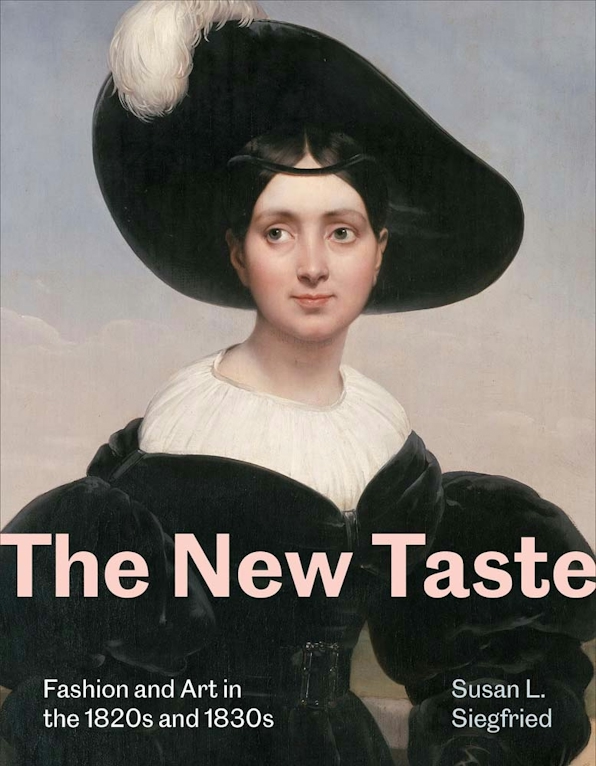
Across the visual arts in France and Britain in the 1820s and 1830s a dynamic culture of fashion was taking shape. Wide-ranging in taste and driven by a quest for the new, fashion flourished in the period’s expansive print production, while the fine arts negotiated demands for novelty more paradoxically, partly by reviving styles from the past. The New Taste examines depictions of clothing and hairstyles in fashion plates, paintings, prints, and sculpture by artists including Jean-Auguste-Dominique Ingres, Horace Vernet, Achille Devéria, and Bertel Thorvaldsen, alongside texts by writers such as Honoré de Balzac and Thomas Carlyle. Susan L. Siegfried argues that the intersections between fashion, costume, and art in these pivotal decades embody the fractured conditions of early nineteenth-century modernity.
Organised by Professor Steve Edwards, Manton Professor of British Art.
Speakers:
Susan L. Siegfried is Denise Riley Collegiate Professor Emerita of the History of Art and Women’s Studies at the University of Michigan. Her acclaimed books include: The Art of Louis-Leopold Boilly: Modern Life in Napoleonic France (1995); Staging Empire: Napoleon, Ingres and David (with Todd Porterfield, 2007) and Ingres: Painting Reimagined (2009). She has organised and contributed to major exhibitions in her field (The Age of Watteau, Chardin and Fragonard: Masterpieces of French Genre Painting, National Gallery of Canada, National Museum of Art, and Gemaldegalerie, 2003-4; The Art of Louis-Léopold Boilly, Kimbell Art Museum and National Gallery of Art, 1995-6; and Works by J.-A.-D. Ingres in the Collection of the Fogg Art Museum, 1980). In previous work for the J. Paul Getty Trust, Los Angeles, she helped develop national and international policy for the arts and humanities in the area of information policy; publications in this area include “The Policy Landscape” in The Politics of Culture, 2000.
Richard Taws is Professor and Head of Art History at University College London. His research focuses on everyday, ephemeral, or obsolete forms of visual and material culture; the social and political stakes of printed images; and histories and theories of science, media, and technology from the eighteenth century to the present. He is the editor of several collections and the author of The Politics of the Provisional: Art and Ephemera in Revolutionary France (2013) and Time Machines: Telegraphic Images in Nineteenth-Century France (2025), which won the CAA Charles Rufus Morey Prize. He is also a member of the editorial group for Oxford Art Journal.
Caroline Evans is Professor Emerita at Central Saint Martins and has acted as specialist consultant on fashion exhibitions at international museums, including The Victoria & Albert Museum London, Musée Galliéra de la Mode de la Ville de Paris, Museum of London, and Musée de la civilization, Québec, and sits on the editorial/advisory boards of several journals including Fashion Theory, Vestoj, Film, Fashion and Consumption, The International Journal of Fashion Studies, dObra[s], and Fashion Studies (Ryerson), and is an Academic Advisor for the Bloomsbury Fashion Photography Archive. She has been instrumental in developing the discipline of fashion history and theory, publishing 7 books and over 40 scholarly articles in the field. These include Fashion at the Edge: Spectacle, Modernity and Deathliness (2003), The Mechanical Smile (2013), and, Time in Fashion: Industrial, Antilinear and Uchronic Temporalities (with Alessanda Vaccari, 2020). Professor Evans was awarded a Leverhulme Trust Major Research Fellowship in 2007-2010; and two AHRC-funded research projects, the Archaeology of Fashion, and Exploding Fashion: Cutting, Constructing and Thinking Through Things.
Sarah Betzer is Professor of Art History at the University of Virginia, where she has recently completed a term as Associate Dean for Arts and Humanities. In the academic year 2025-26 she is a Visiting Fellow at King’s College, University of Cambridge. Her research focuses on the intersections of art theoretical debates and artistic process; the enduring power of the classical past; and the dynamics of gendered and sexed bodies in representation. She is the author of Animating the Antique: Sculptural Encounter in the Age of Aesthetic Theory (2021) and Ingres and the Studio: Women, Painting, History (2012). Her current research investigates the art-theoretical and philosophical stakes of relief sculpture in the long nineteenth century, considered as an unruly, liminal, art form.