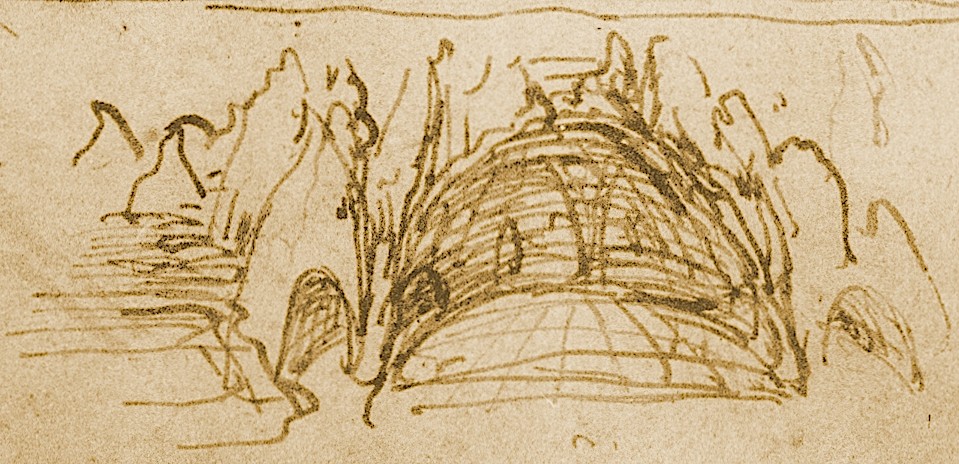
“And drawn by my eager desire, desirous of seeing the great confusion of the various and strange forms created by ingenious nature, having wandered for some distance among the overhanging rocks, I came to the mouth of a huge cavern, before which for a time I remained stupefied, having been ignorant of its existence…” British Library, Codex Arundel, c. 155r)
With these words, Leonardo da Vinci described a journey—at once physical and imaginative—into the recesses of a mountain to peer into its interior. Leonardo’s gaze was met with “deep darkness.” In this lecture, Associate Professor Monica Azzolini explores the period of transition that led from Leonardo’s explorations of caves and grottos to Athanasius Kircher’s systematic visualisation of the Earth’s interior. She argues that across these two centuries, the rhetoric of fear and horror that had characterised the underworld for generations gave way first to a duality of “fear and desire,” and ultimately to a more capacious, celebratory rhetoric of marvel regarding the profusion and beauty of the world below the surface. By analysing this shift, Azzolini will suggest the underlying causes of this epistemic turn and examine its broader implications for European intellectual history and the history of knowledge.
Monica Azzolini is Associate Professor of History of Science at the University of Bologna. She works on early modern science, medicine and the environment, with a particular focus on Italy but increasingly extending to transnational networks. She has published important studies of Leonardo da Vinci’s anatomical work, Renaissance astrology, and courtly science, and has held prestigious fellowships at I Tatti – The Harvard Center for Italian Renaissance Studies, The Warburg Institute, London, and the Shelby Cullom Davis Center at Princeton University. Her research has been supported by the British Academy, The Leverhulme Trust, The Royal Society of Edinburgh, The Carnegie Trust, The European Commission, and The Global Challenges Research Fund.
This event is organised by Dr Robert Brennan, Lecturer in Italian Art 1300-1500, and the Leonardo da Vinci Society.