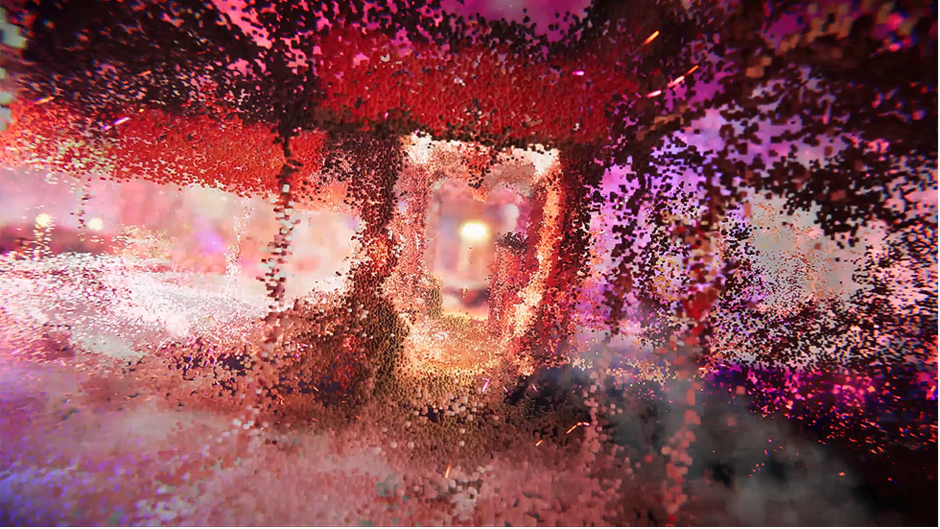
How do we attend to the world, and how are the terms of that attention already shaped for us? Bringing together artists, curators, film theorists, and art historians, Ecologies of Attention: Sensing at the Edge reflects on attention as both a cognitive faculty or a scarce resource, and an aesthetic, embodied, and ecological condition. With a particular attentiveness to voices shaped across and in relation to the Asia Pacific, the symposium considers how perception is formed through social, technical, and sensorial environments, and how art might open other ways of noticing and sensing.
If attention is so often described in the language of crisis – fragmented, captured, exhausted – this programme lingers with its textures and atmospheres. It asks what becomes possible when we move away from an understanding of attention governed by extraction, productivity, and competition, toward what Yves Citton has called an ‘ecology of attention’. A way of thinking that situates perception as diffused and inseparable from the worlds that compose it.
This symposium gathers practices that remain close to the unstable edges of perception – between visibility and opacity, signal and sensation, intuition and analysis, the human and the more-than-human. It invites forms of aesthetic practice that dwell within mediation while also straining against its limits. These practices register ecological entanglement, embodied knowledge, cosmological thought, and the shifting conditions through which images, environments, and narratives come to be felt.
What kinds of receptivity might be cultivated within a culture of distraction? What forms of attunement and sensory relation emerge when perception is approached as exposure and as something shaped with and by others? How might moving image, performance, and curatorial practice reorient the sensible, making space for quieter forms of encounter and for ways of sensing that exceed the immediately knowable?
Across presentations, discussions, performance, and screenings, Ecologies of Attention invites attention to be thought otherwise: shifting away from a mode of capture towards a practice of relation.
Speakers and artists list includes: Dr Kiki Tianqi Yu, Chantel Foo, Yin Aiwen, Serafina Min, Jiayi Chen (remote), Yin-Ju Chen (remote), Stella Zhong, Solveig Qu Suess, and Dr Royce Ng (of Zheng Mahler).
Convened by Dr Wenny Teo, Senior Lecturer in Modern and Contemporary Asian Art at the Courtauld Institute; Michèle Ruo Yi Landolt, Director at Asymmetry; Dr Yayu Zheng, Asymmetry Postdoctoral Fellow at the Courtauld Institute; and Jessica Kwok, Head of Programmes and Curatorial at Asymmetry.
With contributions from:
Kiki Tianqi Yu
Kiki Tianqi Yu is a writer, filmmaker, and curator. She is Reader in Cinematic Art in the Department of Film Studies at Queen Mary University of London, where she set up the Research Hub for Cinema, Asian Philosophies and Visual Ecologies (CAVe). Her current project, ‘Daoism, Cinema and Wellbeing: Meditative Cinema’, received an AHRC Catalyst Award. Her books include, as the author, ‘My’ Self on Camera: First Person Documentary Practice in an Individualising China (Edinburgh University Press, 2019); as the co-editor, China’s iGeneration: Cinema and Moving Image Culture for the 21st Century (Bloomsbury, 2014), the Special Issue of Studies in Documentary Film on East Asian Women’s personal cinema (14:1 2020), Essay Film and Narrative Techniques (Intellect, 2025), and the forthcoming Sinophone Women’s Cinema and Women Filmmakers (Edinburgh University Press, 2027). Kiki’s award-winning films, including Memory of Home (2009), China’s Van Goghs (2016), and The Two Lives of Li Ermao (2019), have been widely screened at international film festivals and art institutions. Her curatorial practices include Spirit of Mountains and Water: Cosmological thinking is Gao Shiqiang’s moving image art, and Dancing with Water: Women’s Cinema from Contemporary China film season.
Chantel Foo
Chantel Foo (they/she) is a Chinese Singaporean artist based in London. Chantel’s practice is anchored in performance, internet aesthetics, writing, and livestreams. Her work and movement style exist at the sticky tension lines where a body’s histories and undoing gather, to come apart. She seeks to decolonise their dance/body through negotiating docility and rebellion, reimagining rage and spite as strategies of defiance against oppressive codes and doctrines. Nodes of thought include: slippages, residual presences, selfhood, and glitch spaces. They also founded and run a movement studio, Studio Lotusroot, which is a space for embodied encounters and somatic healing through movement. Chantel recently concluded a research residency in Amant, New York (Spring 2025), looking at non-traditional Chinese dance phenomena and aesthetics, including Chinese Square Dances (广场舞 guángchángwǔ) and the memetics of ‘awkward dance’ (尬舞 gàwǔ) on social media, as choreo-political reference points for new imaginations of a queer Chinese Dance.
Yin Aiwen
Yin Aiwen is an artist, designer, researcher, and occasional institutional strategist based in London and Rotterdam. Departing from the idea that ‘the technological is institutional, the institutional is technological’, Aiwen reconsiders and reimagines the socio-economic, cultural, emotional, and bodily conditions, etc. by designing the new techno-institutional around care ethics. Her recent major projects include ReUnion Network, Liquid Dependencies (with Yiren Zhao and Zoe Zhao), and Alchemy of Commons (with Yiren Zhao). Aiwen’s writings have appeared on LEAP, e-flux and so-far, among others.
Yin Aiwen is currently the 2024 Asymmetry PhD Scholar in ‘Advanced Practices’ at Goldsmiths, University of London.
Serafina Min
Serafina Sungwon Min (b. 1994) is a South Korean artist and educator based in the UK. Her multidisciplinary practice – painting, sculpture, performance, and film – weaves narratives drawn from linguistic, historical, and traditional research. As a graduate of Chelsea College of Arts, Min’s recent work explores pedagogy as an artistic medium, investigating how education itself can be a form of creative expression. She teaches art to partially sighted and blind students, integrating accessibility and sensory engagement into her practice. Her work has been exhibited internationally, most recently for Beyond the Visual at the Henry Moore Institute.
Jiayi Chen
Yin-Ju Chen is an artist who explores social power and history through cosmological systems, including astrology, sacred geometry, and alchemy. Her work examines nationalism, state violence, and collective consciousness, recently expanding into shamanism, Buddhism, and metaphysical potentialities. Based in Taipei, Chen has exhibited globally at Centre Pompidou-Metz and the biennials of Taipei, Shanghai, Gwangju, Liverpool, and Sydney. She has participated in film festivals like the Berlinale and Rotterdam. A former resident at the Rijksakademie and KADIST San Francisco, Chen continues to probe the material effects of spiritual practices and the boundaries of human consciousness.
Yin-Ju Chen
Yin-Ju Chen is an artist who explores social power and history through cosmological systems, including astrology, sacred geometry, and alchemy. Her work examines nationalism, state violence, and collective consciousness, recently expanding into shamanism, Buddhism, and metaphysical potentialities. Based in Taipei, Chen has exhibited globally at Centre Pompidou-Metz and the biennials of Taipei, Shanghai, Gwangju, Liverpool, and Sydney. She has participated in film festivals like the Berlinale and Rotterdam. A former resident at the Rijksakademie and KADIST San Francisco, Chen continues to probe the material effects of spiritual practices and the boundaries of human consciousness.
Stella Zhong
Stella Zhong (b. 1993, Shenzhen, China) is an artist based in New York. Recent solo exhibitions include Trautwein Herleth, Berlin; ROH, Jakarta; Antenna Space, Shanghai; The Intermission, Piraeus; Chapter NY, New York; Fanta-MLN, Milan. Zhong has been included in group exhibitions at Para Site, Hong Kong; The Power Station, Dallas; Leeum Museum of Art, Seoul; SculptureCenter, New York, and more. She holds a BFA from Rhode Island School of Design and an MFA from Yale University.
Solveig Qu Suess
Solveig Qu Suess is an artist-filmmaker working across documentary cinema, installation, and writing. Her work draws on visual culture and spatial politics to examine how optical and media infrastructures shape experiences of time, space, and memory. Moving between global systems and personal archives, she traces emotional and technological entanglements across postcolonial and diasporic contexts. Her work has been presented internationally at institutions and festivals including the upcoming Sharjah Biennale, the International Film Festival Rotterdam, Bangkok Kunsthalle, Guangzhou Image Triennial, Haus der Kulturen der Welt, Onassis Stegi, ZKM Karlsruhe, and Göteborg Biennial, and Kunsthall Trondheim, among others. She co-authored Geocinema, concerned with the understanding and sensing of the earth, tracing vastly distributed processes of image and meaning making. She has received fellowships from the Swiss National Science Foundation, Digital Earth, Gwaertler Foundation and held residencies at NYU Shanghai, Fondazione Prada, Li Xianting Film Fund, and Tabakalera. She is currently a PhD candidate in Urban Studies at the University of Basel and a visiting scholar at the Center for Global Asia, NYU Shanghai.
Royce Ng
Royce Ng is an artist who is one half of the Hong Kong-based collaborative duo Zheng Mahler with anthrozoologist Daisy Bisenieks. Their works examine the relational networks between nature and technology, along with the more-than-human geographies and the environmental architectures they produce. As a solo artist and in the collective Zheng Mahler, he has held solo exhibitions at the Johann Jacobs Museum, Zurich (2014; 2016) and PHD Group, Hong Kong (2023-2026) and participated in group exhibitions in the Thailand Biennale (2025), Hammer Museum, Los Angeles (2024) and the Shanghai Biennale XIII (2021). He completed his PhD at the School of Creative Media at the City University of Hong Kong and currently lives on Lantau Island with his family and three cats.
Schedule for the day:
Welcome
9.30–9.45am
Introduction by Michèle Ruo Yi Landolt
Introduction by Dr Yayu Zheng
Keynote Lecture 1: From Attention to Attunement: Breath and Energetic Relationality in Cinematic World-making
9.45–10.45am
Dr Kiki Tianqi Yu
Break
10.45–11.00am
Panel A: Making Time: Infrastructures of Care and the Commons
11.00am–12.45pm
Chair: Dr Wenny Teo (The Courtauld Institute of Art)
Chantel Foo and Yin Aiwen
Performance: To Pass Away (Understanding Time Through Care and Gesture)
1.00–1.30pm
Serafina Min
Lunch break
1.30–2.00pm
Screening Capsule: From Microlens to Cosmos
2.00–2.30pm
Yin-Ju Chen: Extrastellar Evaluations Iii : Entropy : 25800, 2018, 17 min
Jiayi Chen: See Through the Hollowed Blue Hellebore, 2026, 18 mins
Panel B: Consensus and Sensus: Distributing Perception, Sensing Otherwise
2.30–4.15pm
Chair: Michèle Ruo Yi Landolt (Asymmetry)
Solveig Qu Suess and Stella Zhong
Break
4.15–4.30pm
Keynote Lecture 2: Vision, Visualisation, Virtualisation: A Few Technological Approaches to Human-Animal-God Transformation
4.30–5.30pm
Dr Royce Ng (of Zheng Mahler)
Closing Remarks
5.30–5:45pm
Wine Reception
till 7.00pm
This symposium is generously supported by