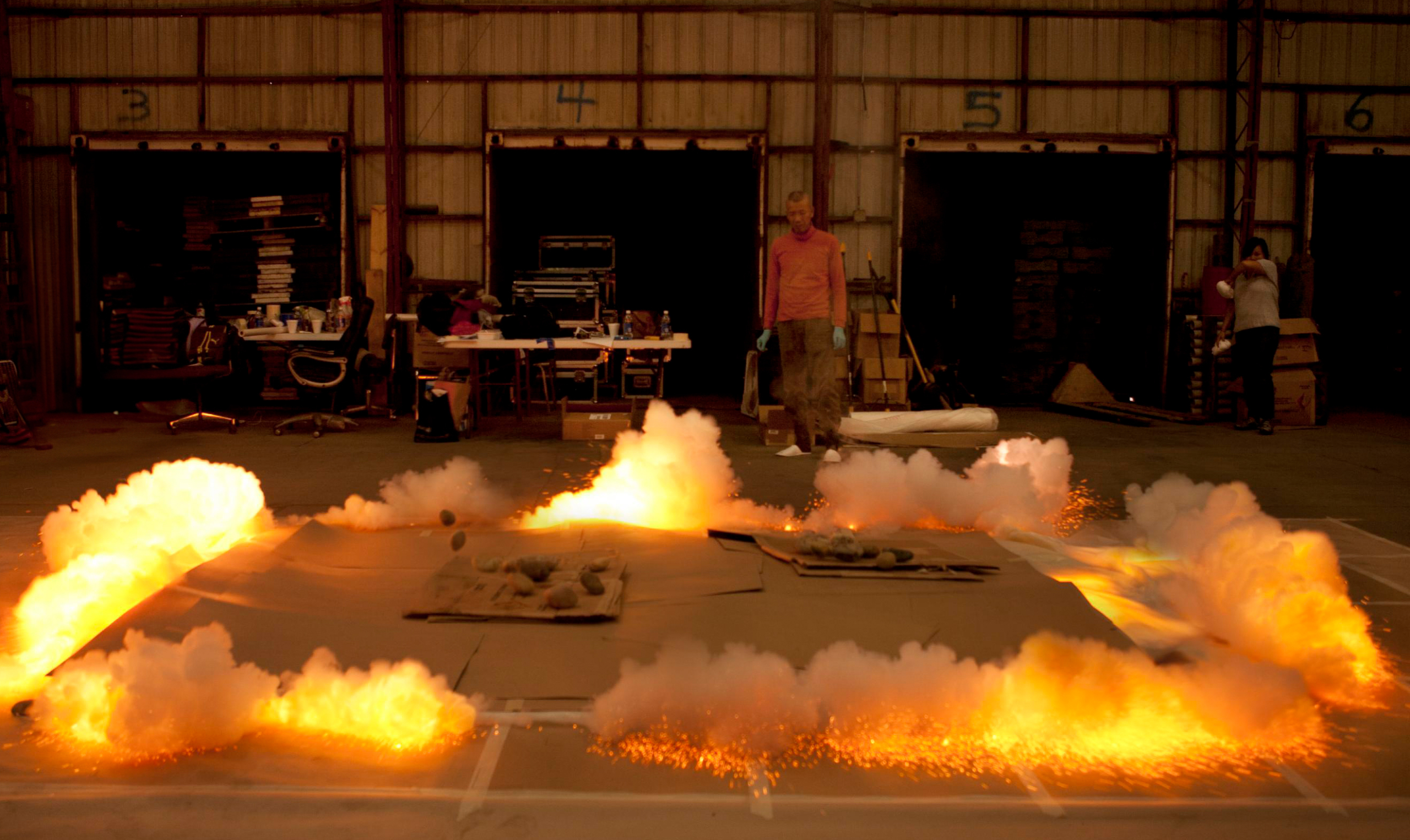
Cai Guo-Qiang (born in China, based in New York City) is a prominent contemporary artist known for his subversive materials, especially gunpowder. His signature use of gunpowder as an artistic medium evolved from a traditional painting practice. Over his four decades of engagement with gunpowder, this explosive material has come to define Cai’s work. Its partly unpredictable properties dictate the artistic process and determine the outcome. Through this medium, the artist invites uncontrollable forces to participate in the creation of his work. His artistic practice, however, is prolific and diverse. It includes gunpowder drawings and paintings, explosion events, as well as videos, multimedia installations, and site-specific works. His work draws on a personal belief system that freely blends symbols and tenets from different cultures, integrating Chinese traditions such as Taoism and feng shui, while engaging in dialogue with global art histories. Cai’s work seeks to establish dialogues among different cultures, different periods of time, different species—always while probing our shared humanity and the connections that can be divined across space and time, out of chaos and disorder. Based on a recent book with its in-depth interviews with the artist, studio assistants, family and collaborators as well as extensive examination, sampling, and scientific analysis of a wide range of artworks, this lecture will explore the making of Cai’s work across media, and the associated conservation issues.
Dr Rachel Rivenc is the Head of Conservation and Preservation at the Getty Research Institute (GRI). She is a conservator and technical art historian whose research focuses on the materials and processes used by contemporary artists, how they impact their work and artistic direction, and the conservation challenges they pose. She has published widely on the topic of contemporary artists materials, including two books Made in Los Angeles: Materials, Processes and the Birth of West Coast Minimalism, and Cai Guo-Qiang: The Artist Materials, which came out in June 2025.
Organised by Dr Pia Gottschaller, Reader in Technical Art History at the Courtauld Institute.