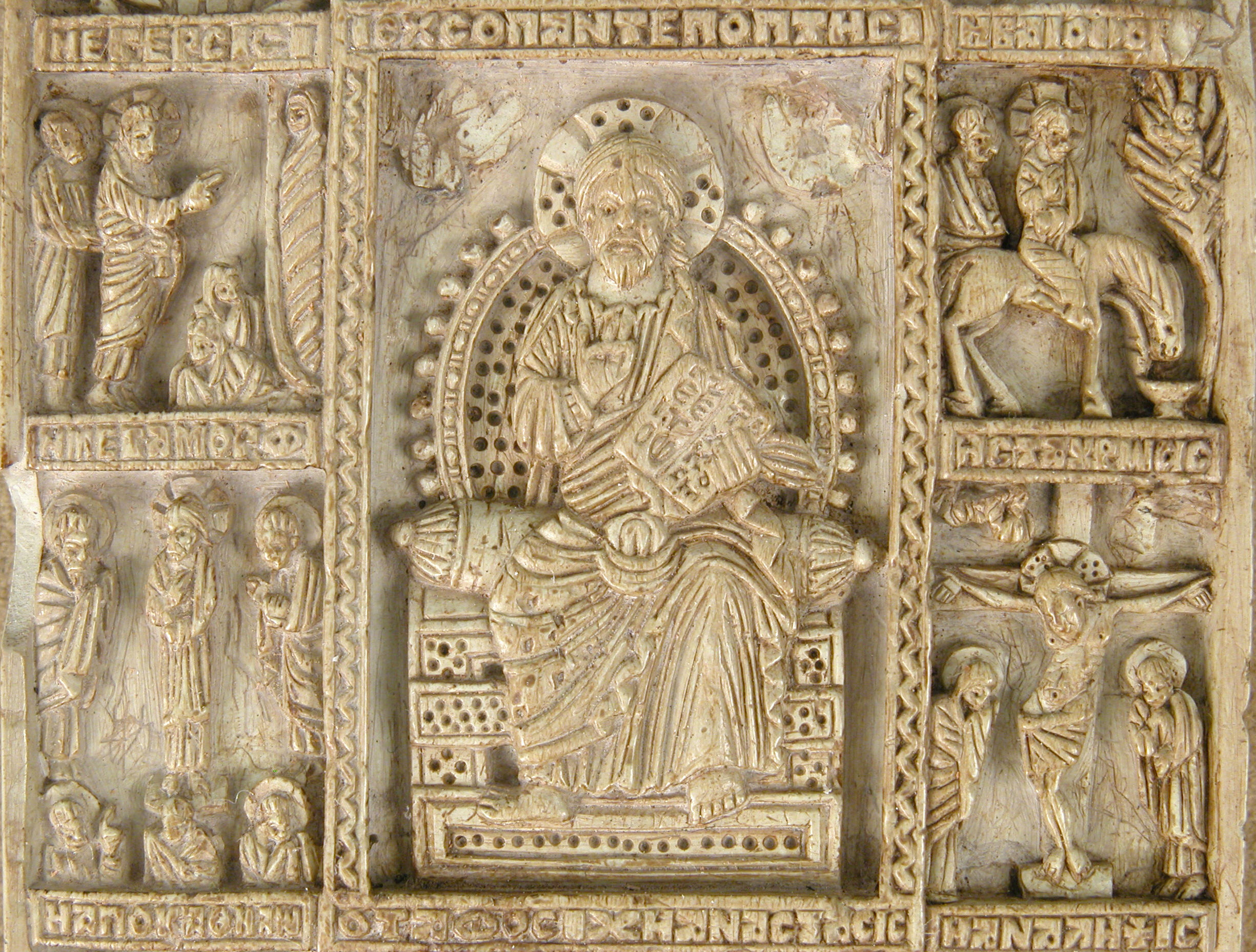
In the Metropolitan Museum of Art, New York, there is a very small but iconographically and epigraphically rich Byzantine icon. Across the thirteen tiny steatite plaques of the Icon of Christ Pantepoptes, c. 1300–1500, there are over 100 figures represented and 324 characters from the Greek alphabet. Particular attention is paid to the image of Christ: he is depicted 23 times, blessing choirs of prophets and saints, appearing in scenes from his life, and enthroned in the largest central image.
Throughout these depictions, Christ receives a number of different naming inscriptions: he is identified as Jesus Christ; Jesus Christ Pantepoptes (the All-Seeing); Jesus Emmanuel (God with us); and Jesus Christ Nika (Conquers). These inscriptions belong to a larger epigraphic phenomenon in Middle and Late Byzantine art, in which a small but significant group of images of Christ were inscribed with epithets in addition to Christ’s usual insignia, IC XC.
This lecture places the Icon of Christ Pantepoptes within this wider epigraphic and onomastic trend and asks what difference these naming inscriptions made to the function and meaning of the icon. It will be shown that the use of different naming inscriptions for images of Christ on the Icon of Christ Pantepoptes places it within a subset of objects and broader discourses concerning sacred names and their theological function in Byzantine art. Furthermore, it will be argued that such epithets shortened the emotional and devotional distance between the viewer and the image of Christ. Finally, it will demonstrate that the shorthand titles we use for particular Christological iconographies – namely ‘Emmanuel’ and ‘Pantokrator’ – constitute an incorrect conflation and therefore require more careful handling.
In doing so, the Icon of Christ Pantepoptes emerges not merely as a complex visual and epigraphic programme but as a sophisticated theological and devotional instrument, in which naming becomes a vital means of mediating the function and meaning of Christ’s image to faithful.
Organised by Dr Jessica Barker, Senior Lecturer in Medieval Art History at the Courtauld Institute, as part of the Medieval Work-in-Progress Series. This series is generously supported by Sam Fogg.
Speaker:
Dr George Bartlett is a Teaching Fellow in Byzantine art at the Courtauld. He completed an AHRC CHASE-funded PhD on Christ’s naming inscriptions in Middle and Late Byzantine art at the University of Sussex in 2020. His research examined the ways in which the different names and titles inscribed alongside images of Christ contributed to wider Byzantine onomastic and Christological theologies, complicated modern understandings of image–text relations in Byzantine culture, and functioned as important devotional tools for Byzantine venerators of Christ’s image. In September 2026, George will begin a Wyvern BILNAS-funded postdoctoral fellowship examining Christological inscriptions from Saint Catherine’s Monastery, Egypt, as part of local and international theological and artistic networks.