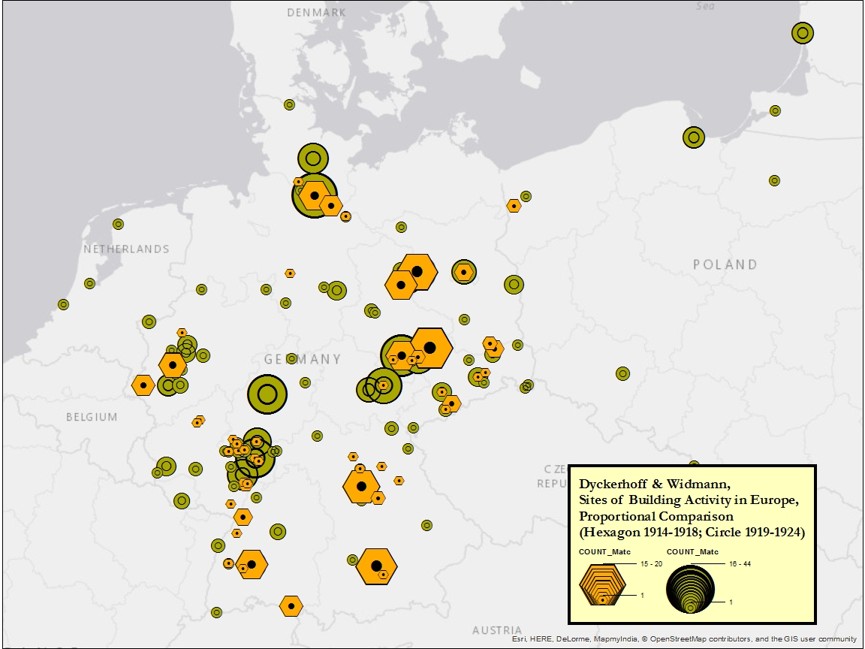
This presentation uses archival evidence and digital mapping to explore the role of the building economy during war. Specifically, it asks the question of how a focus on architecture helps us to understand the capacity for war? Working from a World War I database of the Dyckerhoff & Widmann (Dywidag) construction firm, the patterns of construction and involvement of architects was much deeper and more complex in the German war economy than previously assumed. Dywidag’s expertise in cement construction especially provides a productive focus to explore this nexus of culture and war. Such an analysis at scale requires the inclusion of a broader field of architectural and vernacular building activity otherwise almost entirely expunged from the art historical record. Working at scale, the digital mapping of this archive establishes not only new challenges in relation to the evidence but also to the art historical analytic narrative. The process of digital mapping—a core method of digital art history—helps to examine and explain evidentiary sources just as it points to the potential for new but not-as-yet definitive conclusions such as, for example, on the role of labor in concrete construction. Thus, mapping mediates between evidence and the social art historical narrative. Building off this core case, the talk will also explore implications of this argument for the German building economy during World War II and our own era.
Paul Jaskot is Professor of Art History & German Studies as well as the Director of the Digital Art History & Visual Culture Research Lab at Duke University. His work focuses on the political history of culture in the Nazi period and its postwar impact. His book, The Tyranny of the Object: An Introduction to the Barbarism of Art History is forthcoming (2026).
Co-organised by the Digital Art Histories Research Group #DAHRG, led by Professor Stephen Whiteman and Dr Meredyth Winter, and the Research Cluster Art, Ecologies, Infrastructures, led by Lucy Bradnock and Wenny Teo.