Acts of Creation: On Art and Motherhood
Hettie Judah
Thames & Hudson, 2024. £30 (hardback).
Hettie Judah begins Acts of Creation: On Art and Motherhood by walking us through an imaginary museum (with an unlimited curatorial budget) where we meet the Egyptian goddess Nut, the Sheela-na-gigs of Ireland, and an early twelfth-century Chola bronze. The choice to locate the divine mother in a museum is both a clear call for institutional change and a mirroring of Judah’s highly acclaimed touring exhibition of the same title. However, the vast amount of material afforded an imaginary museum means that Judah’s fictional curation can feel strained. This is a weakness that runs throughout the book, and one that is reflective of Judah’s ambitious attempt to explore motherhood in all its multitudinous forms.
Judah’s second chapter traces the history of the mother in western art, stretching from Leonardo da Vinci’s anatomical drawings to Beyoncé’s 2017 lingerie-clad pregnancy reveal Instagram post. This is a fragmented history, skilfully strung together with easy-to-follow thematic subheadings and large illustrations. A highlight is Judah’s examination of the moralising Victorian’s obsession with the diametrically opposed tropes of the ‘angel in the house’ and the ‘fallen woman’. Judah uses John Everett Millais’ 1851 portrait of a modest Emily Patmore and Ford Madox Brown’s tragic Take Your Son, Sir (1851-92) to gloss the tensions between these competing visions of motherhood, revealing the assumptions of female sexual passivity underpinning both.
Chapter Three sees a shift towards the promise Judah made in her introduction, to ask ‘How might we see the mother differently when motherhood is not only the subject of the artwork, but the circumstance of its creation?’.1 Judah challenges the cultural invisibility of the artist-mother through self-portraiture. Predictable works by the likes of Frida Kahlo and Paula Modersohn-Becker appear, but Judah also surprises with, for example, a nuanced reading of motherhood In the work of Mary Beale and Artemisia Gentileschi. In Chapter Four, Judah explores how creation has historically been praised for its metaphorical potential, not its gestational reality. Obscenely liminal pregnant bodies are continually subject to sanctification and sanitisation. To redress this, Judah fills her pages with artworks that unashamedly centre lived experiences of pregnancy, labour, birth, after birth, and breastfeeding.
In Chapter Five, Judah details the inherently radical praxis of mothering. The kitchen table is presented as a site of resistance and grassroots workshops. The drudgery of washing, cleaning, and feeding is unpaid labour and socialist-feminist artists collectives, such as The Hackney Flashers, evidence how a lack of childcare traps women in a cycle of poverty, isolation, and depression. We meet mothers covered in excrement, mothers drawing with roast beef and flour—struggling mothers who emphatically resist ideas of maternal perfection. There are also parental fears as mothers navigate threats to their children from the outside world, such as school shootings and racially targeted ‘stop and search’ policing.
However, there is only one allusion to child abuse. In the final paragraph, Judah recounts how in Daphne Wright’s I Know What It’s Like (2012) there are ‘memories of breastfeeding a baby that give way to fragments suggesting a capacity for violence in lines lifted from Lady Macbeth (“…while it was smiling in my face, Have plucked my nipple from his boneless gums…”)’.2 The unspoken end of the line is a shockingly violent act of transgression: ‘And dash’d the brains out’. Similarly, Judah only makes fleeting reference to post-partum depression in the form of the ‘mother’s little helpers’ that were prescribed to beat ‘baby blues’ in lieu of real structural support.
In the next chapter, ‘Loss’, Judah admits a tendency to avoid the hard stuff: it is ‘the chapter I didn’t want to write’.3 Despite this hesitancy, it is one of her most successful. Painful and emotionally vulnerable stories are woven together with sensitivity. In Elina Brotherus’ Annunciation (2009-13), loss is a monotonous calendar of failed IVF treatment rounds; in Heartstrings (2022), Su Richardson delivers a message to the daughter she was forced to give up for closed adoption at sixteen; whilst in How It Feels (1996), a peripatetic Tracy Emin wanders around Euston Road recounting an abortion she received six years prior.
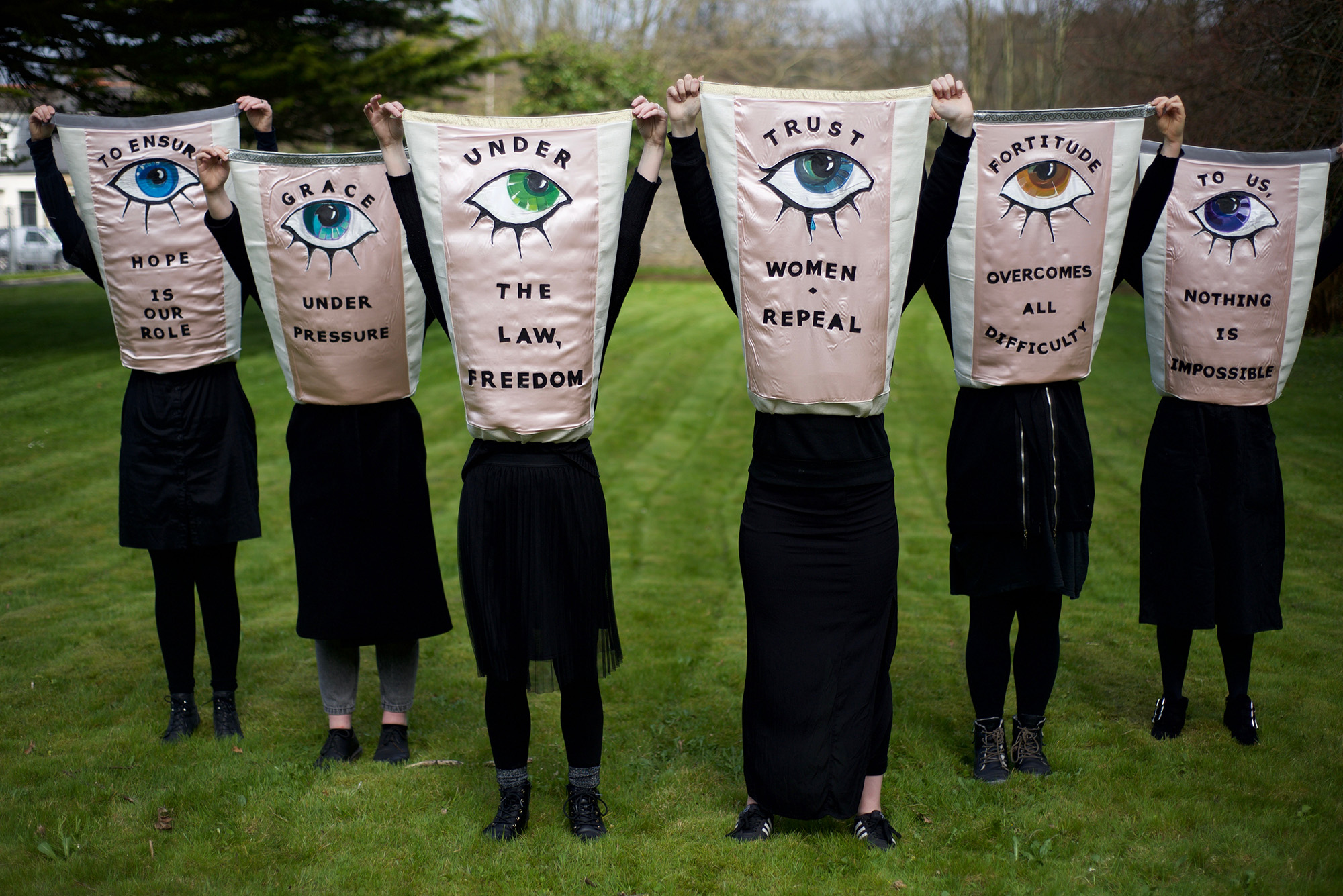
Judah goes on to demonstrate the transformative potential of loss. In response to attacks on women’s reproductive rights, artists transmute their pain into political change. Paula Rego’s Abortion series is cited as a ‘contributing factor’ to Portugal legalising abortion in 2007.4 The collective actions of Ireland’s Artists’ Campaign to Repeal the Eighth Amendment are presented as evidence-collecting, rage-inducing catalysts for change. For example, in Rachel Fallon’s site-specific protest performance, The Aprons of Power (Fig. 1, 2018), white domestic aprons are lifted to reveal hidden pink, fleshy undersides. The work bears witness to the missing mothers incarcerated in Ireland’s Magdalene Laundries, radically placing them into the public realm and connecting past with present.
In the wake of the landmark overturning of Roe v. Wade in 2022, Judah is desperate to conclude this chapter positively, her final line asking us to ‘always leave space for hope’.5 However, the picture remains both bleak and incomplete as Judah makes no mention of the pressingly current (or indeed historical) effects on women’s reproductive healthcare caused by war and genocide. Legislation is not the only sphere in which, as Barbara Kruger’s work glaringly reads on the same page, your body is a battleground.6
Ultimately, Judah ends on a joyful note with her last chapter exploring the family reborn, free from the bounds of heteronormativity. After exploring queer parenthood and collective lesbian mothering, Judah awkwardly crams in a few pages on the cat as child and the animal as mother; in Kiki Smith’s Pietà (1999), Smith cradles her
beloved cat Ginzer; and in Gorilla Milk (2020), Liesl Burisch parallels herself with a caged, elderly gorilla mother. Though the book’s ambitious scope means that it can sometimes feel cramped, it is precisely the sheer force and breadth of Judah’s material that allows her to successfully position mothering as a boundless subject open to all. Judah invites us each of us to consider how we might approach the world through mothering.