The Courtauld Gallery presents first Barbara Hepworth exhibition devoted to her work with colour
Press images: https://tinyurl.com/4mwkr53n
The Courtauld Gallery will present the first exhibition devoted to Barbara Hepworth’s lifelong fascination with colour, shedding light on an unexpected and unexplored aspect of the work of one of the most celebrated British artists of the 20th century.
Barbara Hepworth (1903 – 1975) is best known for her abstract sculptures inspired by nature and the rugged seaside landscapes of Cornwall where she lived and worked from 1939. Throughout her life she emphasised the primacy of direct carving and adhered to the ethos of ‘truth to materials’. Discussing her innovative use of colour with her son-in-law, the art historian Sir Alan Bowness, she said: “In a way my colour has been accepted but never understood.”
Bringing together some 20 sculptures and 30 drawings and paintings, The Joseph Hage Aaronson & Bremen Exhibition: Hepworth in Colour will be the first exhibition to focus on this important but often overlooked aspect of her work.
Hepworth’s early interest in colour dates to the mid-1930s, when she and her future husband, Ben Nicholson, formed part of the European avant-garde. When in 1939, days before the outbreak of the Second World War, she left London for Cornwall with her three young children, Hepworth took with her a single sculpture – her first study for a sculpture with colour. Over the coming years, the landscape of Cornwall inspired her to develop this initial experiment, taking her work in new directions and establishing a lifelong fascination with colour.
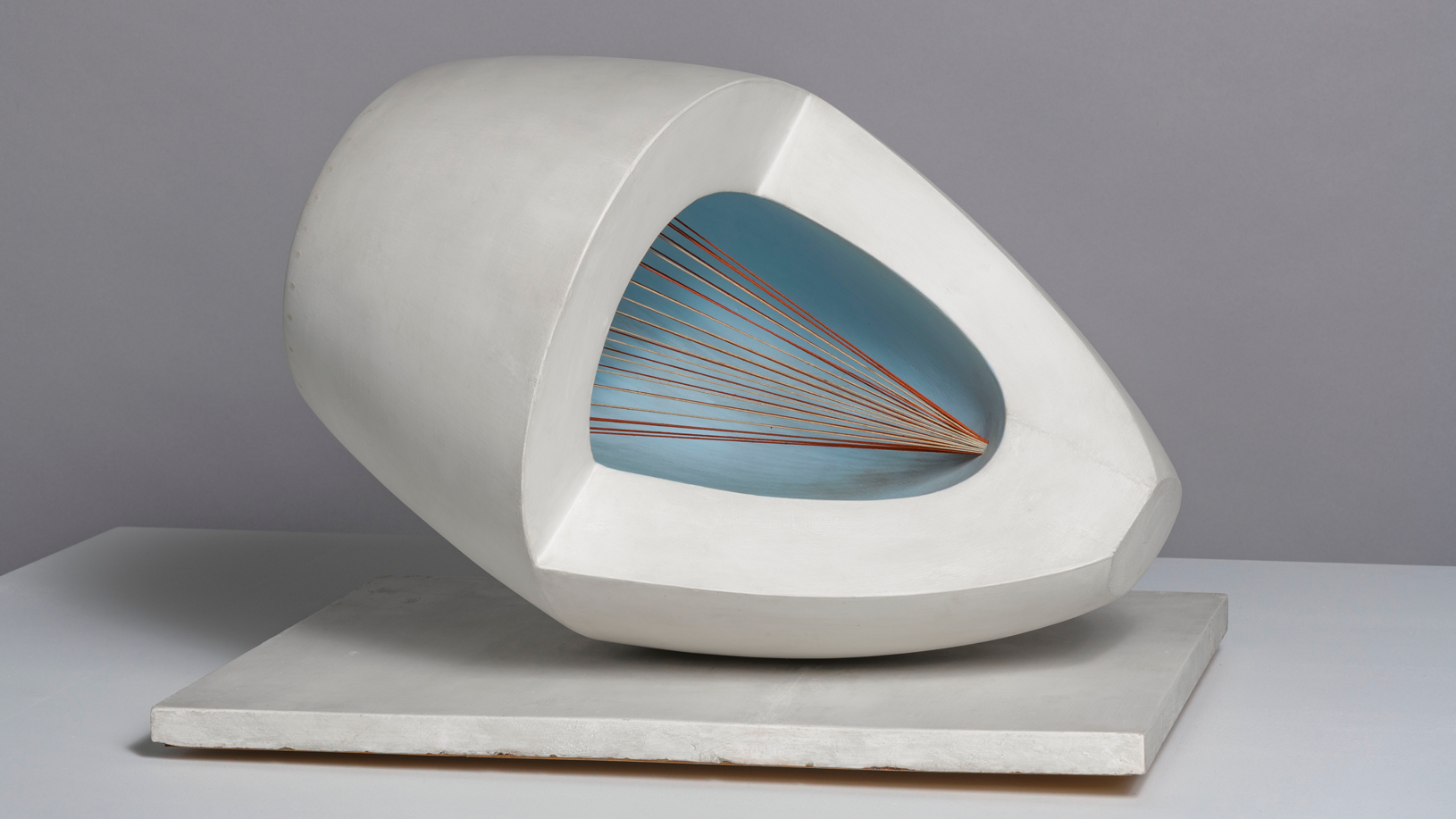
At the heart of the exhibition will be the remarkable group of painted sculptures which Hepworth made between 1940 and 1948. She later recalled how, “I used colour and strings in many of the carvings of this time. The colour in the concavities plunged me into the depths of water, caves or shallows…”. These early works include the boldly painted stone carvings Eidos (1947-8) from the National Gallery of Victoria in Melbourne, Australia and Eos (1946) from a private collection in Hong Kong. They are exhibited together in the UK for the first time since 1954.
A major highlight of the exhibition will be the painted wood carving, Sculpture with Colour (Oval Form), Pale Blue and Red (1943), which was acquired for the nation by The Hepworth Wakefield in 2025 following the successful national fundraising campaign in collaboration with Art Fund to raise £3.8 million. Sculpture with Colour (Oval Form), Pale Blue and Red marked a breakthrough moment in Hepworth’s career, combining strings and colour and, for the first time, the beautiful pale blue associated with the Cornish skies and coast. In private hands since it was created, and rarely exhibited, this will be the first time the sculpture is displayed in London since it was acquired. For Hepworth the strings in her early sculptures ‘were the tension I felt between myself and the sea, the wind or the hill’.
Other seminal painted stringed sculptures in the exhibition include Wave, 1943-44, from the National Galleries of Scotland and Pelagos (‘sea’ in Greek), 1946 from Tate, which was inspired by the bay in St Ives in Cornwall. The exhibition also unites for the first time from private and public collections the six progressively larger versions of the stringed Sculpture with Colour (Deep Blue and Red).
Alongside sculptures, the exhibition features a rich selection of Hepworth’s drawings with colour. Hepworth lacked the materials, studio space and time to produce much sculpture during the first years of the war but her drawings allowed her to continue to explore and develop her ideas. She recalled, ‘In the late evenings, and during the night I did innumerable drawings…exploring the particular tensions and relationships of form and colour which were to occupy me in sculpture during the later years of the war.’ These drawings, usually entitled ‘drawing for sculpture’ are striking for their intricate crystalline forms, punctuated with strong blues, greens, reds and yellows.
The exhibition extends into the 1950s and 1960s to reflect how colour continued to occupy Hepworth in new ways, including in her expressive paintings of the mid and late 1950s, and in her work with patinated bronze and painted marbles.
To coincide with the exhibition, a display of photographs of Barbara Hepworth and Ben Nicholson’s shared London studio at No. 7 the Mall Studios in Hampstead will be presented in the Project Space. Taken between 1932 and 1936 by Paul Laib (1869–1958), these are among the most evocative studio images to emerge in Britain during the 20th century and show the fascinating interrelation of their practices at this time.
The Joseph Hage Aaronson & Bremen Exhibition: Hepworth in Colour is accompanied by a new catalogue, edited by Dr Alexandra Gerstein, Curator of Sculpture and Decorative Arts at the Courtauld and Stephen Feeke, with essays by Alexandra Gerstein, Stephen Feeke, David Batchelor, Eleanor Clayton and Kirstie Dootson.
The exhibition’s Title Sponsor is Joseph Hage Aaronson & Bremen LLP. The exhibition’s Lead Supporter is the Huo Family Foundation, with Support from Art Mentor Foundation Lucerne.
The Joseph Hage Aaronson & Bremen Exhibition:
Hepworth in Colour
12 June – 6 September 2026
Denise Coates Exhibition Galleries, Floor 3
https://courtauld.ac.uk/whats-on/exh-hepworth-in-colour/
Hepworth and Nicholson: The Hampstead Studio Photographs
6 June – 4 October 2026
Project Space, Floor 2
https://courtauld.ac.uk/exh/hepworth-and-nicholson-the-hampstead-studio-photographs/
Download Press Release
MEDIA CONTACTS
Courtauld
www.courtauld.ac.uk/gallery/press
media@courtauld.ac.uk
Bolton & Quinn
Erica Bolton | erica@boltonquinn.com | +44 (0)20 7221 5000
Daisy Taylor | daisy@boltonquinn.com | +44 (0)20 7221 5000
SOCIAL MEDIA – COURTAULD
Facebook @TheCourtauld
Instagram @Courtauld #TheCourtauld
Threads @courtauld
TikTok @TheCourtauld
YouTube TheCourtauld
NOTES TO EDITORS
About the Courtauld
The Courtauld works to advance how we see and understand the visual arts, as an internationally renowned centre for the teaching and research of art history and a major public gallery. Founded by collectors and philanthropists in 1932, the organisation has been at the forefront of the study of art ever since through advanced research and conservation practice, innovative teaching, the renowned collection and inspiring exhibitions of its gallery, and engaging and accessible activities, education and events.
The Courtauld Gallery cares for one of the greatest art collections in the UK, presenting these works to the public at the Courtauld Gallery in central London, as well as through loans and partnerships. The Gallery is most famous for its iconic Impressionist and Post-Impressionist masterpieces – such as Van Gogh’s Self-Portrait with Bandaged Ear and Manet’s A Bar at the Folies-Bergère. It showcases these alongside an internationally renowned collection of works from the Middle Ages and the Renaissance through to the present day.
Academically, the Courtauld Institute is the largest community of art historians and conservators in the UK, teaching and conducting research on subjects ranging from creativity in late Antiquity to contemporary digital art forms – with an increasingly global focus. An independent college of the University of London, the Courtauld offers a range of degree programmes from BA to PhD in the History of Art, curating, art and business and the conservation of easel and wall paintings. Its alumni are leaders and innovators in the arts, culture and business worlds, helping to shape the global agenda for the arts and creative industries.
Founded on the belief that everyone should have the opportunity to engage with art, the Courtauld works to increase understanding of the role of art throughout history, across all societies and geographies, and to champion its importance in the present day. This could be through exhibitions offering a chance to look closely at world-famous works; events bringing art history research to new audiences; accessible short courses; digital engagement, innovative school, family, and community programmes; or taking a formal qualification. The Courtauld’s ambition is to transform access to art history education, ensuring as many people as possible can benefit from the tools it offers to better understand the visual world around us.
The Courtauld is an exempt charity and relies on generous philanthropic support to achieve its mission of advancing the understanding of the visual arts of the past and present across the world through advanced research, innovative teaching, inspiring exhibitions, programmes and collections.
The collection cared for by the Courtauld Gallery is owned by the Samuel Courtauld Trust.
About Joseph Hage Aaronson & Bremen LLP
Joseph Hage Aaronson & Bremen LLP (JHAB) is an elite dispute resolution and advisory law firm based in London. Established by barristers Joe Hage and Graham Aaronson KC in 2013, the firm uniquely integrates the expertise of leading solicitors and barristers, as well as specialist accountants and data scientists, to provide comprehensive solutions to complex legal challenges. We have an international client base that ranges from ultra-high net worth individuals and trusts to publicly listed blue-chip companies, foreign government entities and the world’s largest funds.
About Huo Family Foundation
The Huo Family Foundation is a grant-giving foundation based in London. Its mission is to support education, communities and the pursuit of knowledge. Its current areas of focus are education; the arts; and science. Through its donations, the Foundation hopes to improve the prospects of individuals, and to support the work of organisations seeking to ensure a safe and successful future for all society. The Foundation aims to make art more accessible to all through its support for galleries, museums and centres for the performing arts. For more information, huofamilyfoundation.org