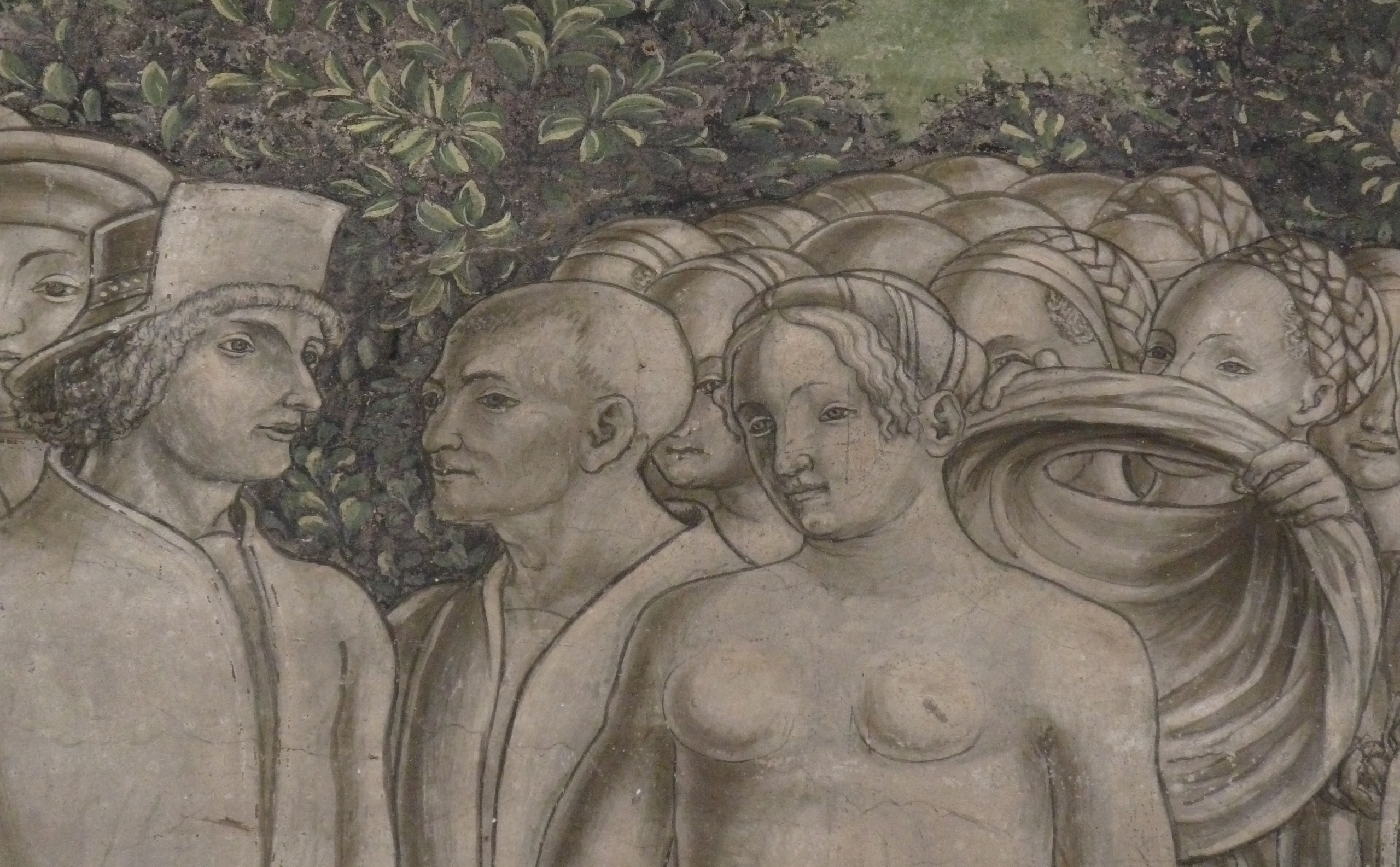
In the camera di Griselda from Roccabianca castle, near Parma, patriarchal might was triumphantly reinforced and, simultaneously, made ridiculous. The room’s frescoes depict in elaborate detail the maddening Griselda tale, familiar from Boccaccio, Chaucer, and Petrarch (among others), in which the peasant Griselda marries Marchese Gualtieri and then patiently endures his cruel trials. Art historians have generally assumed that these terra verde frescoes celebrated the love between the cycle’s patron, Pier Maria Rossi, and his aristocratic mistress, Bianca Pellegrini, within a private bedroom. Structural evidence presented here, however, indicates that this ground floor camera was originally entered from outside the castle and was traversed by various, though well-regulated, publics. The camera di Griselda, moreover, may have served as a chamber for legal disputes.
The boundaries of court audiences were thus particularly porous within the chamber. And the frescoes’ scenes are packed with onlookers, recalling the room’s actual visitors and thematising networks of rule and courtly barriers alike. Throughout late medieval and early modern Europe, the Griselda tale proved malleable in the hands of able adaptors, and interpreters. Indeed, those who encountered the frescoes at Roccabianca likely contested Gualtieri’s abusive authority with unstable, equivocal, and conflicting responses to Griselda’s plight.
Modern exegetes of Griselda’s tale, moreover, have underscored the centrality of clothing as a charged indicator of social status. New research into fifteenth-century fashion allows us to appreciate the sophisticated ways that garments and adornment visually animated the narrative in the camera di Griselda. Roccabianca’s artists, McCall will argue, attentively underscored the ways that clothing embodied Griselda’s repeated social transformations. Her clothed and unclothed body could signify both her submission and resistance to Gualtieri’s will.
Timothy McCall is Professor of Art History and Bernard Lucci Chair in Italian Studies at Villanova University. Tim’s research centers on Italian Renaissance courts, and on visual intersections of power and gender (particularly masculinity), in addition to histories of fashion and material culture. In 2022, Tim published Brilliant Bodies: Fashioning Courtly Men in Early Renaissance Italy, with PSUP. Making the Renaissance Man: Masculinities in the Courts of Renaissance Italy, appeared with Reaktion Books in 2023, and The Fabric of War: The Material Culture and Social Lives of Banners in Renaissance Europe, co-written with John Gagné, was recently published in Cambridge University Press’s Elements in the Renaissance series.
Organised by Dr Robert Brennan, Lecturer in Italian Art 1300-1500, as part of the Italian Renaissance seminar series.