Małgorzata Mirga-Tas
The Whitworth, Manchester
11 April – 7 September
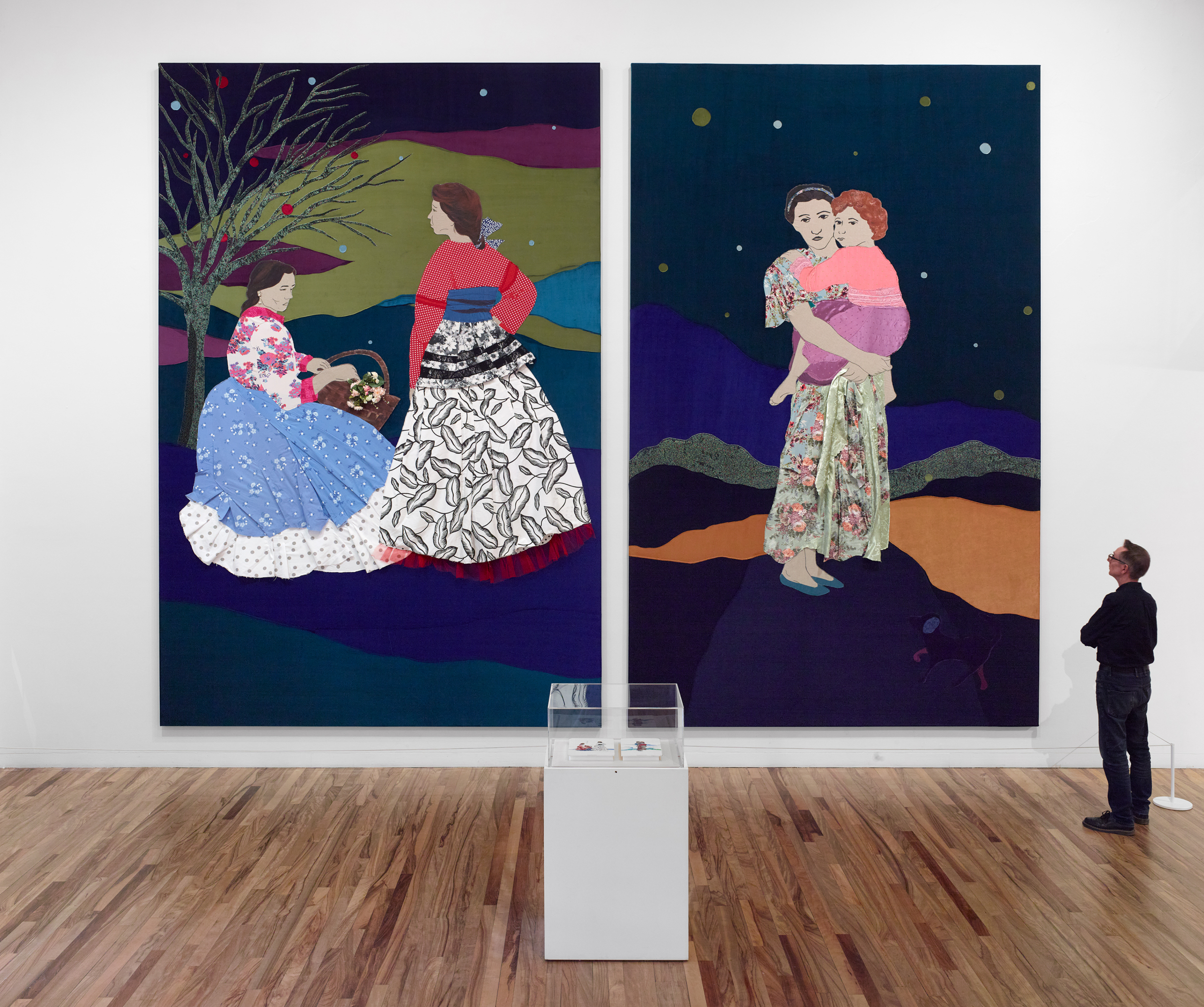
The first works one sees upon entering Małgorzata Mirga-Tas’ exhibition at The Whitworth Art Gallery in Manchester are the towering Ćhajengri Duma (Women’s Thoughts) (2024) and Romani Kali Daj (Roma Madonna) (2024, Fig. 1). In both, landscapes of rolling hills and vast skies are abstracted by fabrics of overlapping block
colour. The minimalistic backgrounds outline and push forward two sets of women. Each couple interacts with a calm, subtle familiarity, taking in a nighttime landscape in one work and holding a child close in another. The presence of these figures is amplified by their elaborately patterned dresses, whose frills and folds are rendered three-dimensional. Mirga-Tas cuts, paints, and stitches pieces of fabric, crafting stories that, when collaged together, enfold the viewer into the history and lives of Romani communities.
At first glance, Mirga-Tas’ textile-based works on display in Manchester could be mistaken for large-scale paintings. However, their overpowering size is counterbalanced by the intimacy of homely fabrics and faces stitched with close attention to individuality. In her work, Mirga-Tas is concerned with how clothing and fabrics underpin or aid the presentation of a person’s character and their life. Textiles, patterns, and colours indicate her subjects’ passions and relationships and are often inspired by or cut from the sitter’s own clothes, tablecloths, or curtains. Mirga-Tas calls these items ‘microcarriers of history’.1 By placing historical importance on such personal items, Mirga-Tas opens up the retelling of history beyond the written word. These patchworked materials add a homely, handmade aesthetic to her work that is at odds with the vast size of the pictorial planes and the history they represent.
The exhibition is a continuation of a collaboration with the Tate St. Ives and was initially shown there last year, marking the artist’s first major museum exhibition in the UK. In 2022, Mirga-Tas represented Poland at the 59th Venice Biennale, becoming the first Roma artist to do so. Mirga-Tas stitches together the people, friends, family, and historical figures of the Romani community in Spain and Poland with both the past and the present. In doing so, she crafts tender portraits and reworks historical narratives to show the humanity of a historically ostracised group of people. At the same time, the compositions of collaged fabric on a vast scale challenge the historical delineation between craft and fine art. Ultimately, Mirga-Tas unearths the untold stories of women’s artistic output and collaborative, community-based creativity.
One strand of Mirga-Tas’ work refigures historical representations of Romani people. Ćhajengri Duma is based on a nineteenth-century photograph of two Andalusian Romani women found in an online archive, while Romani Kali Daj was inspired by an 1879 painting by French academic artist William-Adolphe Bouguereau. The original titles of both historical images refer to the women as ‘Gypsies’, a name given to the Roma people when it was a widely held belief that they originated from Egypt, rather than northern India, and has been used as a derogatory slur since the seventeenth century.2 Mirga-Tas refashions misrepresentations of her community and history through an understanding gaze of affiliation.
Continuing through the gallery, one comes face-to-face with another thread of Mirga-Tas’ artistic attention: portraits. Further through the room, the ceiling of the Whitworth is lower and the works over two metres tall. This compression of space forces the full-body portraits from the Siukar Manusia series into direct eye contact with the viewer. Almost life-size, they wait like a panel gathered to tell their story. This time, the figures are not anonymous subjects but survivors, or descendants of survivors, of the Romani Holocaust (Porajmos), who lived in the industrial Nowa Huta district of east Krakow. The six sitters are set against rich blue voids. This darkness throws their visages into relief, emphasising the fabrics of their clothes.
The exhibition concludes in the separate Project Space. The works in this section depart from the first two galleries. The backgrounds in these works range from planes of red to riotous collages of juxtaposing patterns, suggesting natural landscapes. We again see groups of women and children, both historical and contemporary. Portraits of nineteenth-century Romani women from Andalucia stand next to a trio of women and a baby sitting on a wooden porch in contemporary dress. This melding of figures from different periods reiterates the genealogy of family and community, which can be seen through the visualised practice of textile production and is seen today through this same craft-based vehicle.
In the centre of the room, visitors come across two of Mirga-Tas’ textiles incorporated into wooden folding screens. These screens bring to the forefront the concern with craft, sewing, patchwork quilting, and needlework that has historically been categorised as women’s work or as craft in opposition to fine art. They are displayed alongside textiles from The Whitworth’s collection, selected by Mirga-Tas, serving to interrogate the definitions of ‘art’ and ‘craft’. On one wall is an early twentieth-century rug, a Kelim from Iran, crafted by the Qashqai people. Mirga-Tas expands the exhibition to look at the creative labour of historically nomadic groups and asks viewers to consider how a community’s identity is woven into transportable textiles.
In Untitled (After Gentile da Fabriano) (2023), Mirga-Tas’ portraiture and historical reinterpretation are again woven together. Based on an Italian renaissance scene of the Adoration of the Magi, Mirga-Tas replaces the Madonna with her cousin, Dr Anna Mirga-Kruszelnicka, an anthropologist and Roma activist. In place of the Three Kings are Mirga-Tas, her mother, and a young girl. They are gathered around a flowing patchwork quilt; Mirga-Tas’ mother holds threads between her stitched hands. The group is set within a landscape of spindly trees with the hills and sky composed of patterned fabric. It is a multigenerational scene, wherein a community is formed through the labour of textiles. It exemplifies the passing down of skills, stories, and advice within a comfortable space of togetherness.
Mirga-Tas’ exhibition proves that material culture cannot be contained within two dimensions, and it spills out of the artworks into the exhibition space. This trickling over reiterates the tactility of fabric, its daily subjection to touch, its exchange through various hands, and how it carries history into the present through the hands of the women who wove it and then care for it.