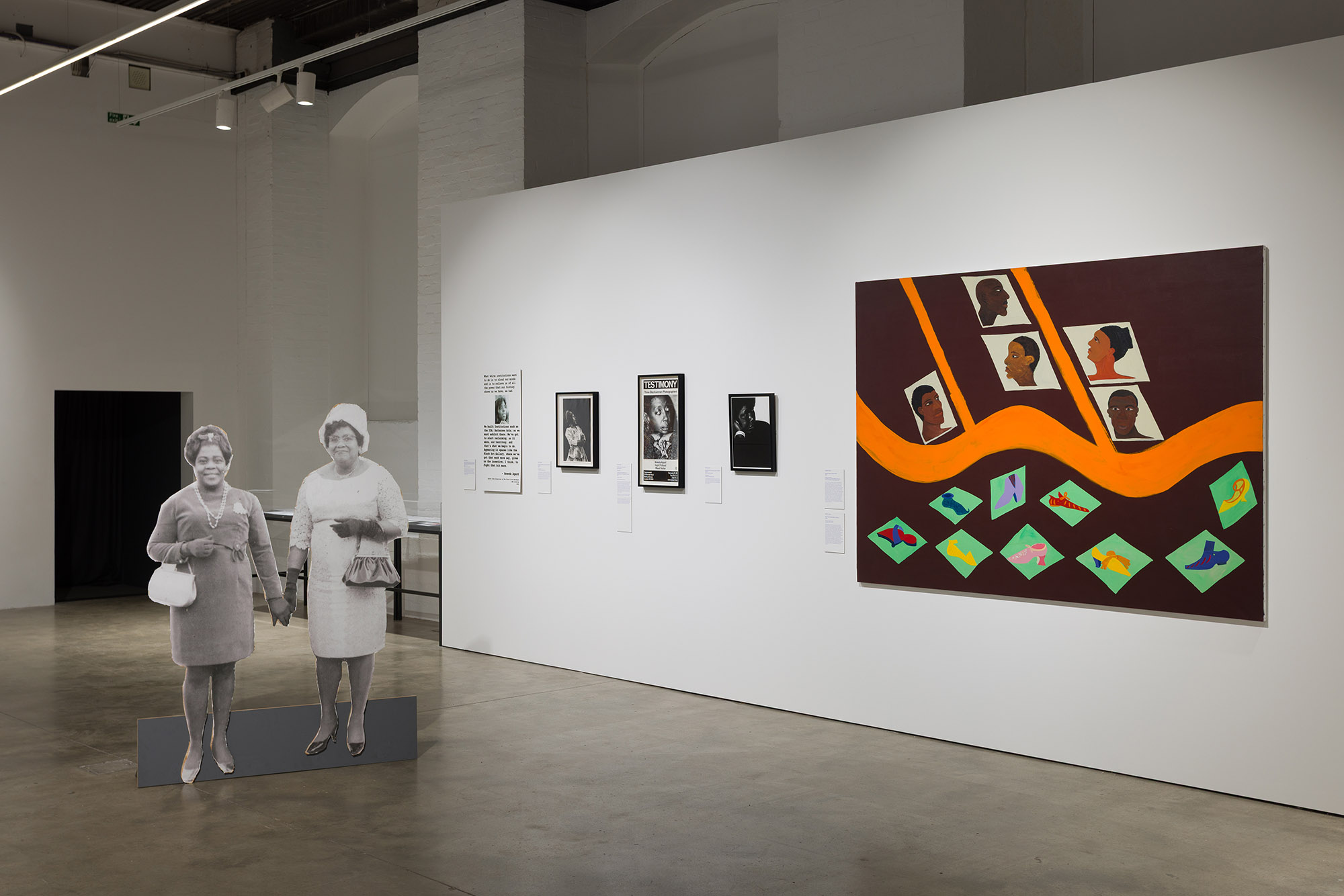
Connecting Thin Black Lines 1985-2025
Institute of Contemporary Art, London
24 June to 7 September 2025
Walking into Connecting Thin Black Lines 1985-2025 at London’s Institute of Contemporary Art (ICA), I was struck less by what was on the walls than by where it was shown. Curated thoughtfully by Lubaina Himid, this exhibition and the accompanying events programme marked forty years since her original 1985 show The Thin Black Line. The title was a wry reference to the exhibition’s confinement to a narrow corridor at the ICA, emblematic of the exhibiting artists’ fight for visibility in the face of institutional marginalisation.1 Forty years later, these eleven artists are among the most celebrated in the country: Turner Prize winners, Royal Academicians, recipients of national and international honours, and subjects of major retrospectives. Yet the ICA’s reflection on this groundbreaking but spatially constrained show evoked a similar sense of containment.
In 1985, Himid proposed an exhibition across all of the ICA’s gallery spaces and an interdisciplinary events programme. Instead, she was given one wall to display works by Brenda Agard, Sutapa Biswas, Sonia Boyce, Chila Kumari Burman, Jennifer Comrie, Claudette Johnson, Ingrid Pollard, Veronica Ryan, Marlene Smith, Maud Sulter, and herself. In 2025, Himid was granted an events programme which predominantly highlighted filmmakers of colour. However, the scale of the exhibition itself still fell short of her original vision. Connecting Thin Black Lines only occupied the ICA’s lower level, and most artists were represented by just one or two works, while the upstairs galleries remained conspicuously empty. This raised an uncomfortable question: why did the ICA choose to revisit the exhibition in this way? Was it a sincere attempt to address earlier neglect, or a performative gesture of virtue signalling? The apparent lack of institutional investment suggests the latter: the ICA’s role seems largely custodial rather than collaborative. Much of the intellectual and logistical labour—the selection of works, exhibition texts, archival material, and artworks—was provided by the artists themselves, particularly Himid and Sutapa Biswas. Had the ICA curated a companion display in the vacant upstairs spaces, perhaps foregrounding younger Black British women artists, it could have materially enacted the ‘connecting’ promised by the title and extended Himid’s long-standing ethos of mutual support.
That ethos has deep roots. In the mid-1980s, when institutional recognition was scarce, Himid and her peers relied on one another to exhibit, promote, and collect one another’s work. In addition to The Thin Black Line, Himid curated Five Black Women at the Africa Centre (1983), and Black Women Time Now at Battersea Arts Centre (1983-84), creating opportunities where none had otherwise been offered. The 2025 exhibition acknowledged this history through vitrines of archival material—largely assembled by Biswas—which document the challenges of sustaining a career as a Black British woman artist in an art world inclined to overlook them. That these documents were provided by Biswas, while several artworks, including those by Boyce and Sulter, were loaned from Himid’s personal collection, underlines a troubling continuity: four decades later, the burden of preserving and presenting Black women’s art history still rests disproportionately with the artists themselves.
The shortcomings of the ICA’s framing did not extend to Himid’s curatorial vision. Despite the exhibition’s modest scale, her selection constructed a dialogue across past, present, and future, attesting to the diversity of these artists’ experiences and the visual strategies through which they articulate them. Yet, a shared pre- occupation with occupying and reclaiming space united the works, expressed particularly through a deliberate use of scale. Even when the subject matter is intimate, large-format works boldly occupied the gallery space and commanded the viewer’s attention. Claudette Johnson’s Trilogy (1981-86) presents three large drawings of Black women, each posed in a manner that asserts physical and psychological presence. Johnson’s invitation for her subjects to ‘take up as much space as possible’ is reflected in their expansive gestures and unflinching, direct gazes.2
In the ICA’s corridor, once the literal site of marginalisation, Chila Kumari Burman’s neon sculptures transformed a liminal space into a vibrant, immersive installation. Saturated with bright colour and playful motifs drawn from her childhood, such as tigers and ice cream vans, the works carry pointed slogans: ‘Without us there is no Britain’ and ‘We are here coz you were there’. These phrases distil the artists’ enduring contribution to Britain’s culture while confronting its colonial legacies. They made this previously marginalised show unmissable.
Extending this concern with visibility into the realm of representation, Sulter’s work reimagines the canon of art history. Her photograph Polyhymnia (Portrait of Dr Ysaye Barnwell) (1989) is part of a series that visualises the Ancient Greek muses of creativity as Black women. Addressing the underrepresentation of Black women in British art institutions, Sulter positioned contemporary Black artists at the centre of a canon from which they have historically been excluded. The sitter, adopting a statuesque pose, is lit in high contrast, producing a reverential image. She holds an egg, which for Sulter symbolised the continuity of past, present, and future: ‘a promise of both a memory of ourselves and a picturing of the future’.3 By drawing on ancient tradition, Sulter rewrote history to forge a more inclusive future for her subjects.
Even amid its tension between past and present, the exhibition similarly offers a hopeful outlook towards the future. Himid’s painting Venetian Maps: Shoemakers (1997), bold in chromatic intensity and graphic clarity, reflects on the African diaspora’s integral yet often ‘invisible’ role in European cultural development.4 Its inclusion feels anticipatory: Himid will represent Britain at the 2026 Venice Biennale, following Sonya Boyce’s Golden Lion-winning pavilion in 2022.
If The Thin Black Line in 1985 amplified voices largely unheard within British institutions, Connecting Thin Black Lines reasserted their relevance and necessity. Although many of these artists have gained national and international recognition, the exhibition reminded us that the structures which once confined their work to a corridor have not disappeared. Despite the ICA’s partial redress, Connecting Thin Black Lines was a compelling demonstration of artistic resilience. These artists continue to create work that expands, questions, and redefines the spaces available to them, and their art from the 1980s continues to captivate audiences today.5 The exhibition’s contradictions between celebration and containment, progress and persistence, are precisely what made it meaningful. In revisiting this history with clarity and defiance, it offered not closure but a challenge: to ensure that Black women’s contributions to British art are not read as footnotes, but as central narratives.
Citations
[1] The term ‘Black’ was commonly used by people of African, Caribbean, and South Asian heritage in 1980s Britain as a political term of resistance, denoting a shared experience of racial oppression. My use of the term throughout this review reflects this.
[2] Claudette Johnson, quoted on an exhibition label, Connecting Thin Black Lines 1985-2025, Institute of Contemporary Arts, London, 2025.
[3] Maud Sulter, quoted in ‘“Zabat”–photographs by Maud Sulter’, Victoria and Albert Museum.
[4] Lubaina Himid, quoted on an exhibition label, Connecting Thin Black Lines 1985- 2025, Institute of Contemporary Arts, London, 2025.
[5] Sadly, Maud Sulter died in 2008, and Brenda Agard died in 2012.