Siena: The Rise of Painting, 1300-1350
The National Gallery, London
8 March – 22 June 2025
An infant swaddled in robes of vibrant orange and purple reaches up to his mother’s face, curiously tugging at her veil. Though tiny in her arms, his animated behaviour and expression draw viewers into a moment of maternal intimacy. This depiction of The Virgin and Child by Duccio, a Sienese painter active in the late thirteenth and early fourteenth centuries, greets visitors at the entrance of the National Gallery’s Siena: The Rise of Painting, 1300-1350. Its deliberately low placement, bringing the painting to the viewer’s eye level, provides a stark contrast with the elevated positioning once accorded to devotional images in Sienese churches and chapels. Such a spiritual hierarchy between holy image and viewer is effectively dismantled in the exhibition, allowing for intimate engagement with these sacred images without the barriers that historically distanced the faithful from them. At the same time, the exhibition sets out to challenge another entrenched hierarchy: the art-historical narrative that has long privileged Florence as the centre of Renaissance painting while relegating Siena to the margins.
Siena: The Rise of Painting, 1300-1350 follows the transformation of the medieval city’s artistic culture through the work of painters Duccio di Buoninsegna, Pietro and Ambrogio Lorenzetti, and Simone Martini, leading artists of the Trecento in Siena. Simultaneously, the exhibition extends far beyond the reach of egg tempera on panel to articulate the devotional narrative and artistry of the medieval city. The Enthroned Virgin and Child, an exquisite ivory sculpture from the late thirteenth century, epitomises the city’s harmonious blend of material splendour with spiritual intent. Its intricate carvings mirror the detailed ornamentation of Sienese painting, illustrating the city’s artistic ideals through the unification of craft, beauty, and devotion. Other religious artworks and artefacts, ranging from altarpieces and paintings to ivory sculptures, artisanal silks, and liturgical objects, contribute to a viewer’s sense of the sumptuous world of Sienese devotion. The study of Italian painting from this period has played a central role in the development of art history. Drawing in large part from Giorgio Vasari’s Lives of the Most Excellent Painters, the historiography has more commonly celebrated Florence over medieval Siena. Although Sienese artists, such as Duccio, are praised in this tradition, they are consistently measured against Florentine contemporaries whom Vasari held in higher regard. While Florentine painting often favoured rational perspective, classical harmony, and secular civic pride, the Sienese works, such as those displayed here, revel in the power of mystical imagery, ethereal colour palettes, and transcendental presence. These characteristic differences were not accidental. Instead, as the National Gallery’s exhibition demonstrates, they were deliberate choices that reflected Siena’s civic identity and theological outlook.
Lando di Pietro’s Head of Christ (a fragment of a crucifix) powerfully embodies this outlook. The intense naturalism and emotional immediacy transform Christ’s suffering into a moment of quiet transcendence, reflecting Sienese art’s deep-rooted mystical spirituality and its emphasis on direct, affective devotion. No longer a distant detail on a suspended crucifix, Lando’s sculpted fragment confronts visitors directly, evoking a powerful anticipation as they study its features, almost waiting for the closed eyes to flutter open. This placement at eye level transforms a devotional image, once seen from below, into a direct and personal encounter, blurring the boundary between the sacred image and the viewer, and allowing its tactile realism and devotional charge to be fully experienced. The Head of Christ demonstrates how Sienese art extended beyond panel painting into a richly varied language of spiritual and emotional expression. In doing so, it underscores the argument that Siena’s contributions to the late medieval Italian art world were distinctive and innovative, rather than merely decorative or secondary to Florence. This ingenuity, rooted in the Sienese concern for visceral impact and spiritual closeness, also invites reflection on the evolving relationship between the spectator and the sacred.
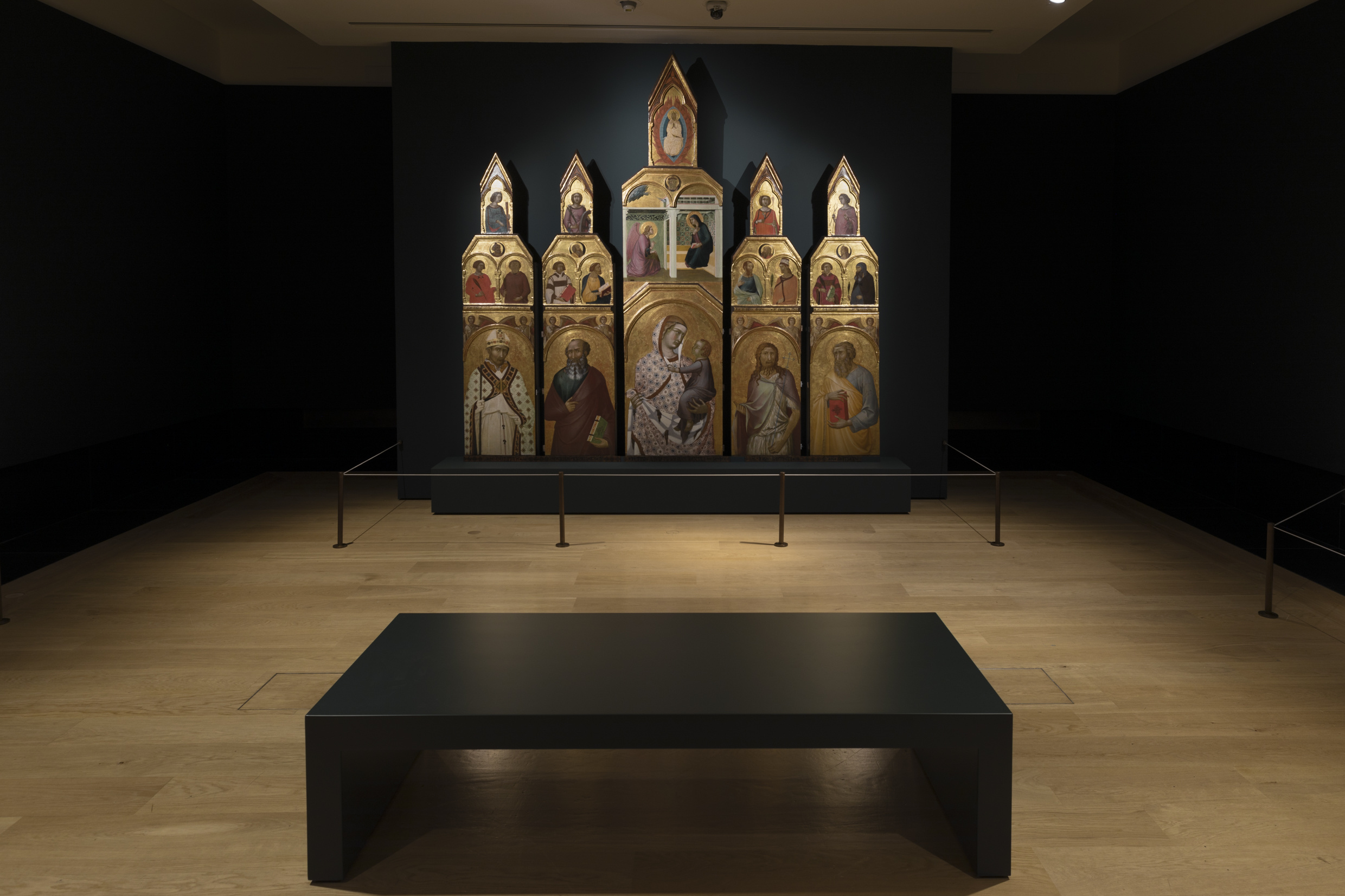
The exhibition’s physical lighting further reinforces this sense of intimacy. Dim rooms and angled ceiling lights create shadows and gentle glimmers across the artworks, evoking the ambience of a candlelit chapel while accentuating the gilded embellishments that catch and reflect the light (Fig. 1). These curatorial decisions result in an immersive experience that approximates the original contexts of these works, where art and faith converge. However, now viewed in a different setting, they can be examined up close, allowing the exhibition’s visitors to understand the technical mastery required to create these effects. This presentation evokes the reverence historically associated with these objects and their presence in sacred spaces, encouraging moments of contemplation that are both poignant and profound. A thematic presentation, rather than a rigid, chronological arrangement, effectively fosters a deeper emotional response from visitors. By diverging from the linear evolution of style or technique, this exhibition enables viewers to draw connections between the resonant and devotional tone of each object, as reflected in the diverse works of the artists. Such an approach promotes contemplating the artworks as living expressions of faith, enabling interaction rather than viewing them as fixed historical artefacts.
Duccio’s The Virgin and Child with Saints Dominic and Aurea, a triptych from the early fourteenth century, exemplifies this engaging atmosphere. It highlights the presence and theatricality of the present painted saints. They appear to reach out to the viewer, their direct gaze and poised posture dissolving the traditional fourth wall that typically separates art from its audience. This shift instils a sense of recognition and dialogue rather than passive observation. In this way, the viewer’s experience is transformed from one of distanced contemplation to active engagement, significantly altering the devotional experience.
Ultimately, Siena: The Rise of Painting, 1300-1350 achieves more than a reassessment of Sienese painting; it performs a quiet but powerful reframing of art history itself. By accentuating emotional intensity and spiritual immediacy, this exhibition challenges the dominant narrative that positioned Florence as the epicentre of innovation. Instead, Sienese artists are shown to have pioneered a visual language that speaks across time, not through rational clarity, but through fervent devotion and visual intimacy. The exhibition foregrounds the emotive depth and spiritual presence of Sienese art, reaffirming its enduring relevance in our historical and spiritual consciousness.