Built in 1863, Hoxton Hall in the working class East End of London is one of only two surviving mid-Victorian music halls in the city. However, although licensed as a music hall, its builder and proprietor James Mortimer intended that the hall should be dedicated to the mid-Victorian project of “rational recreation”, “affording to the humbler classes an entertainment that shall provide instruction with amusement.” The programme for the opening night of the new hall survives, and this presentation will examine its mixture of entertainment (a conjuror; singing; storytelling), information (the latest news, transmitted by telegraph; a magic lantern slide show of “The Prince of Wales’s Tour in East”), and education (talks on the British Army and “The Story of the Lives of Poor Men who have Risen from the Ranks”; a talk on “Homes of the People: As they are and as they might be” by Mortimer himself) in the light of Victorian projects for social control over the growing urban working classes, and as a model of ideological prestidigitation.
This event is organised by Professor Steve Edwards, Manton Professor of British Art and Director of the Manton Centre for British Art, The Courtauld.
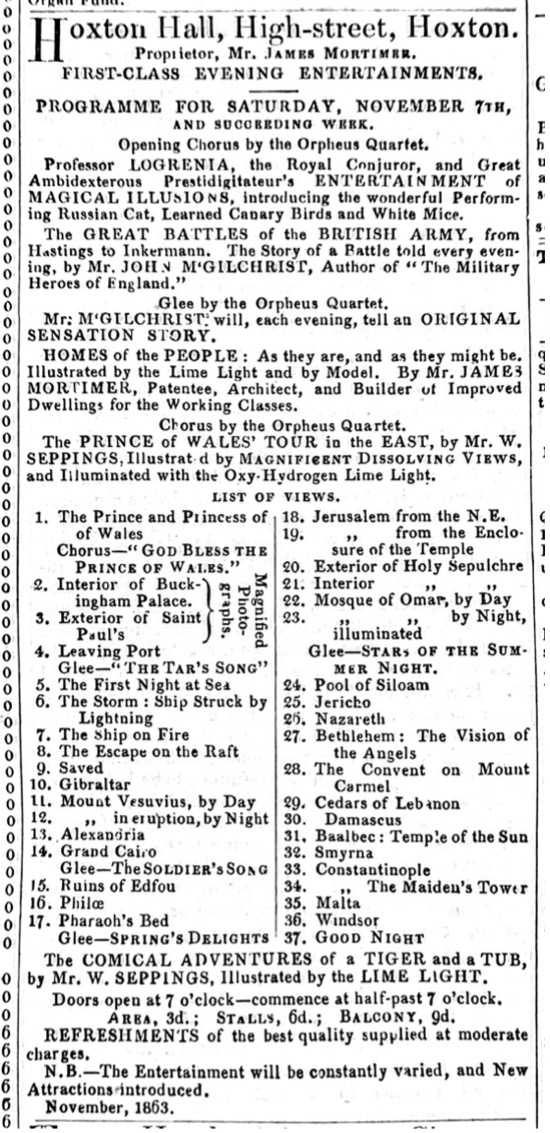
With contributions from:
Professor Nicholas Till is a historian, theorist and artistic practitioner of opera and music theatre. His publications include Mozart and the Enlightenment (1992), The Cambridge Companion to Opera Studies (2012) and Beckett and Musicality (2014). He is currently co-editing a history of Hoxton Hall entitled Hoxton Hall: The History of an East End Music Hall, to be published by Exeter University Press. From 2019-2024 he was Pierre Audi Chair in Opera and Music Theatre at the University of Amsterdam, and he is currently Emeritus Professor of Opera and Music Theatre at the universities of Sussex and Amsterdam.